
📰 SCIENCE & TECHNOLOGY

India’s First Polar Research Vessel

India's First Polar Research Vessel INS Dhruv launched to boost Antarctic research capabilities. Learn about features, specifications, and India's polar exploration ambitions.

⏱️ 10 min read
📊 1,804 words
📅 July 2025
SSC Banking Railways UPSC TRENDING
🎧 Prefer listening? Check out our podcast

“This vessel represents India’s resolve to become self-reliant in polar exploration while contributing to global climate science.” — Union Minister Sarbananda Sonowal

India is building its first indigenously made Polar Research Vessel (PRV). The effort is part of a strategic partnership between Garden Reach Shipbuilders and Engineers Ltd. (GRSE) and Norway’s Kongsberg. This landmark project strengthens both India’s polar research capabilities and its domestic shipbuilding capacity.

This step moves India closer to becoming a key player in polar science, ocean research, and clean maritime technology — reducing decades-long dependence on foreign vessels for Antarctic and Arctic expeditions.

June 2025 MoU Signed
1983 First Antarctic Base
87% Yards Meet Global Standards
3 Antarctic Stations
📊 Quick Reference
Project India’s First Polar Research Vessel
Indian Partner GRSE (Kolkata)
Foreign Partner Kongsberg (Norway)
Coordinating Body NCPOR (Goa)
Announced At Nor-Shipping 2025 Summit
Strategic Vision MAHASAGAR (under SAGAR)

📰 Why in News?

On June 3, 2025, Union Minister Sarbananda Sonowal witnessed the signing of an agreement between GRSE and Kongsberg at the Nor-Shipping 2025 Summit. This Memorandum of Understanding (MoU) lays the groundwork for building India’s first Polar Research Vessel.

The ship will support polar and ocean studies, guided by the National Centre for Polar and Ocean Research (NCPOR), headquartered in Goa.

🎯 Simple Explanation

Think of a Polar Research Vessel as a floating laboratory that can break through ice. Until now, India had to borrow or rent such ships from other countries for Antarctic missions. Building our own PRV means Indian scientists can conduct year-round research with full control — like having your own car instead of always taking a taxi.

📜 Background: India’s Polar Research Journey
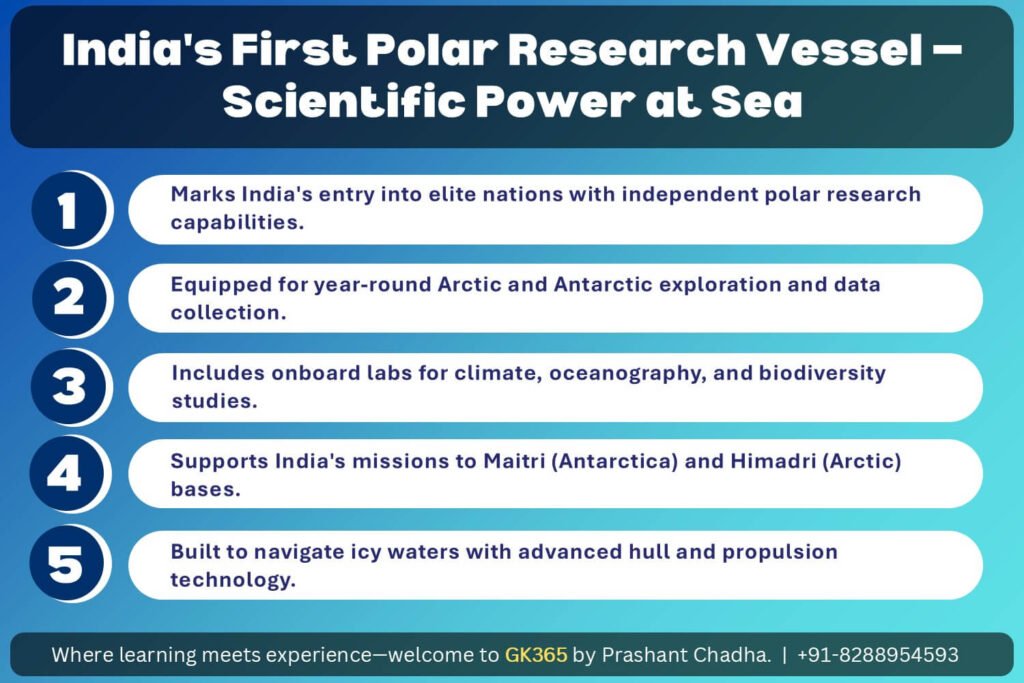
India's First Polar Research Vessel - GRSE and Kongsberg Partnership
India’s First Polar Research Vessel marks a new chapter in indigenous shipbuilding

India has participated in polar research for decades. However, until now, the country has relied on foreign ships for its expeditions to Antarctica and the Arctic.

Key milestones in India’s polar journey:

  • NCPOR (National Centre for Polar and Ocean Research), based in Goa, manages all polar and ocean programs
  • India established its first Antarctic base, Dakshin Gangotri, in 1983
  • This was followed by Maitri (1989) and Bharati (2012) stations
  • The new vessel will enable year-round research with full Indian control
1983
India establishes Dakshin Gangotri — first Antarctic research base
1989
Maitri station established as permanent research base
2012
Bharati station commissioned — India’s most advanced Antarctic facility
June 2025
MoU signed for India’s first Polar Research Vessel (GRSE + Kongsberg)
✓ Quick Recall

India’s 3 Antarctic Stations: Dakshin Gangotri (1983, now decommissioned), Maitri (1989, active), Bharati (2012, active). Remember: “DMB” — Dakshin, Maitri, Bharati — in chronological order.

🤝 About the MoU & Polar Research Vessel

Who Signed the MoU:

  • GRSE (India): Garden Reach Shipbuilders and Engineers Ltd., a Kolkata-based defense shipyard known for complex naval vessels
  • Kongsberg (Norway): A global leader in marine technology, digital systems, and polar vessel expertise

Project Goals:

  • Design and build India’s first indigenous Polar Research Vessel
  • Equip the ship with ice-navigation tools, ocean sensors, and onboard laboratories
  • Create a platform for year-round polar expeditions

Broader Strategic Aims:

  • Promote Make in India and Atmanirbhar Bharat in shipbuilding
  • Expand India’s polar research capabilities
  • Deepen India-Norway ties in sustainable maritime technology
Partner Country Role
GRSE India (Kolkata) Ship construction and integration
Kongsberg Norway Marine technology and navigation systems
NCPOR India (Goa) Scientific coordination and operations

✨ Purpose and Key Features of the PRV

The vessel will serve as a mobile research base and operations hub in polar waters. Key features include:

  • Ice-Strengthened Hull: Reinforced structure to navigate through thick polar ice
  • Deep-Sea Mapping: Advanced tools for ocean floor surveys and bathymetric studies
  • Climate Monitoring Systems: Equipment to study glaciers, ice sheets, and atmospheric conditions
  • Marine Biology Labs: Onboard facilities to monitor ecosystems and polar wildlife
  • Smart Navigation: Kongsberg’s digital systems for safe polar operations
  • Extended Endurance: Capability for long-duration missions in remote waters
💭 Think About This

Why does India need its own polar vessel? Consider: climate change research requires continuous monitoring, the Arctic is becoming strategically important as ice melts, and scientific self-reliance reduces dependency on other nations’ schedules and priorities.

🌊 MAHASAGAR Vision and India’s Maritime Strategy
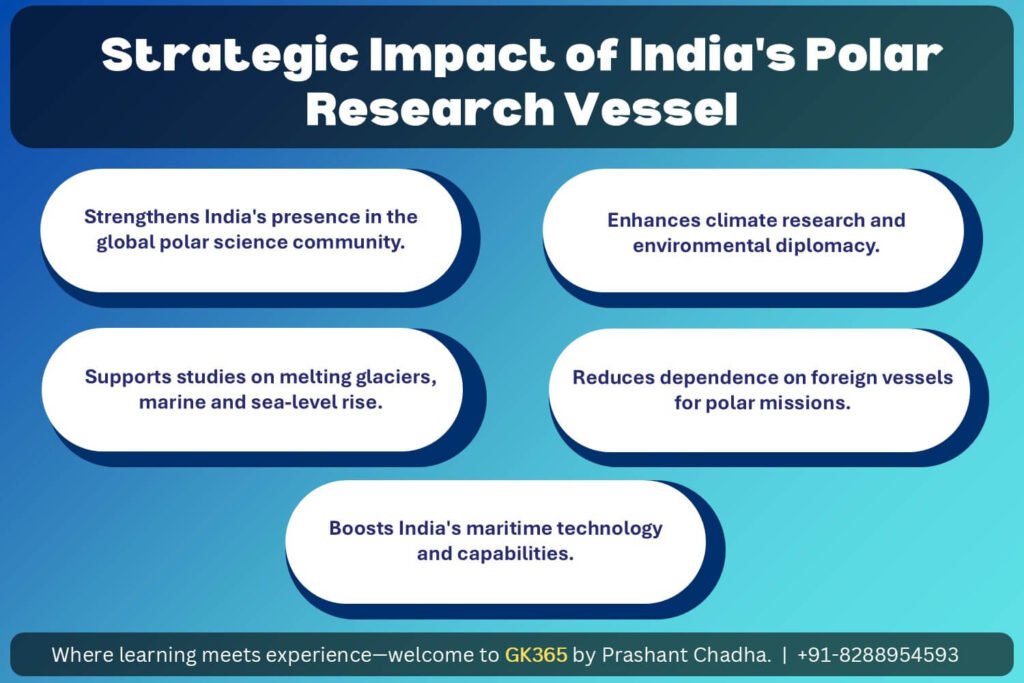
India's Polar Research Vessel - Maritime Strategy
The PRV aligns with India’s MAHASAGAR vision for regional maritime leadership

This project aligns with India’s MAHASAGAR vision — Mutual and Holistic Advancement for Security Across the Global Area Regions. It extends the broader SAGAR (Security and Growth for All in the Region) doctrine.

Key Focus Areas:

  • Stronger maritime security and domain awareness
  • Greener, more digital shipbuilding practices
  • Sustainable use and exploration of ocean resources
  • Regional cooperation in the Indian Ocean and beyond
⚠️ Exam Trap

Don’t confuse: SAGAR vs MAHASAGAR. SAGAR (Security and Growth for All in the Region) focuses on Indian Ocean cooperation. MAHASAGAR is the expanded vision covering global maritime reach. The PRV falls under MAHASAGAR as it operates in polar regions, not just the Indian Ocean.

🇮🇳🇳🇴 India-Norway Cooperation: Key Highlights

At the Nor-Shipping 2025 summit in Norway, Minister Sarbananda Sonowal engaged with Norway’s maritime industry, including the Norwegian Shipowners’ Association.

Key Outcomes:

  • Invited Norwegian investments in India’s green shipping sector
  • Showcased India as a major provider of global seafarers and maritime professionals
  • Promoted India’s ship recycling sector — 87% of yards now meet Hong Kong Convention standards
  • Explored joint R&D in sustainable maritime technologies

Norway, with its expertise in polar shipping and sustainable maritime practices, is an ideal partner for India’s first PRV project.

🌍 Significance: Why the PRV Matters

The Polar Research Vessel project carries multiple dimensions of significance:

  • Scientific Research: Enables independent climate studies, oceanography, and marine biology research
  • Strategic Presence: Expands India’s footprint in Arctic and Antarctic regions
  • Industrial Growth: Boosts shipbuilding sector and creates high-tech jobs
  • Self-Reliance: Reduces dependence on foreign vessels for polar missions
  • Green Technology: Promotes sustainable and eco-friendly shipping practices
  • Global Standing: Strengthens India’s voice in international climate negotiations
💭 For GDPI / Essay Prep

The PRV project connects multiple themes: Atmanirbhar Bharat, climate diplomacy, blue economy, and India’s role as a responsible global power. It demonstrates how scientific investment can serve both national interests and global commons like climate research.

🧠 Memory Tricks
Partnership Formula:
“GK-NC” — GRSE + Kongsberg builds it, NCPOR operates it. (Also sounds like “GK” for General Knowledge!)
Antarctic Stations:
“DMB” — Dakshin Gangotri (1983), Maitri (1989), Bharati (2012). Think: “Decade-Milestone-Breakthrough”
Vision Hierarchy:
SAGAR → MAHASAGAR. Small sea (Indian Ocean) → Big ocean (Global). “MAHA” means “great” in Sanskrit — so MAHASAGAR is the greater/expanded vision.
📚 Quick Revision Flashcards

Click to flip • Master key facts

Question
Who are the partners building India’s first Polar Research Vessel?
Click to flip
Answer
GRSE (Garden Reach Shipbuilders, Kolkata) and Kongsberg (Norway), with NCPOR coordinating scientific operations.
Card 1 of 5
🧠 Think Deeper

For GDPI, Essay Writing & Critical Analysis

🌍
How does India’s investment in polar research align with its climate diplomacy goals and responsibilities as a major developing nation?
Consider: Paris Agreement commitments, leadership in International Solar Alliance, Arctic Council observer status, and contribution to global climate data.
⚖️
Is building indigenous polar research capability a luxury or necessity for India? Evaluate the cost-benefit equation.
Think about: Strategic autonomy vs. rental costs, technology transfer benefits, employment generation, and long-term scientific returns on investment.
🎯 Test Your Knowledge

5 questions • Instant feedback

Question 1 of 5
Which Indian shipyard is partnering with Kongsberg to build India’s first Polar Research Vessel?
A) Mazagon Dock Shipbuilders
B) Garden Reach Shipbuilders (GRSE)
C) Cochin Shipyard Limited
D) Hindustan Shipyard Limited
Explanation

GRSE (Garden Reach Shipbuilders and Engineers Ltd.) is the Indian partner for building the Polar Research Vessel, in collaboration with Norway’s Kongsberg.

Question 2 of 5
When was the MoU for India’s first Polar Research Vessel signed?
A) January 26, 2025
B) March 15, 2025
C) June 3, 2025
D) August 15, 2025
Explanation

The MoU was signed on June 3, 2025, at the Nor-Shipping Summit in Norway.

Question 3 of 5
Which organization coordinates India’s polar and ocean research programs?
A) NCPOR (National Centre for Polar and Ocean Research)
B) ISRO (Indian Space Research Organisation)
C) DRDO (Defence Research and Development Organisation)
D) NIO (National Institute of Oceanography)
Explanation

NCPOR (National Centre for Polar and Ocean Research), headquartered in Goa, coordinates India’s polar and ocean research programs.

Question 4 of 5
Which is India’s most recently established Antarctic research station?
A) Dakshin Gangotri (1983)
B) Maitri (1989)
C) Himadri (2008)
D) Bharati (2012)
Explanation

Bharati station, established in 2012, is India’s newest and most advanced Antarctic research station.

Question 5 of 5
What does MAHASAGAR stand for in India’s maritime strategy?
A) Maritime Holistic Action for Strategic and Global Resource
B) Mutual and Holistic Advancement for Security Across Global Area Regions
C) Marine Habitat and Sea Growth for All Regions
D) Mission for Advancement of Harbours and Shipping Growth in All Regions
Explanation

MAHASAGAR stands for Mutual and Holistic Advancement for Security Across Global Area Regions — the expanded maritime vision under SAGAR.

0/5
Loading…
📌 Key Takeaways for Exams
1
Project Partners: GRSE (India) + Kongsberg (Norway) signed MoU on June 3, 2025, for India’s first indigenously built Polar Research Vessel.
2
Coordinating Body: NCPOR (National Centre for Polar and Ocean Research), headquartered in Goa, will manage scientific operations.
3
Antarctic Stations: India has three Antarctic stations — Dakshin Gangotri (1983, decommissioned), Maitri (1989), and Bharati (2012).
4
Strategic Vision: PRV aligns with MAHASAGAR (Mutual and Holistic Advancement for Security Across Global Area Regions) under the broader SAGAR doctrine.
5
Ship Recycling: 87% of Indian ship recycling yards meet Hong Kong Convention standards — highlighted during India-Norway discussions.
6
Key Features: PRV will have ice-strengthened hull, deep-sea mapping, climate monitoring, marine biology labs, and smart navigation systems.

❓ Frequently Asked Questions

Why is India building its own Polar Research Vessel?
India currently relies on foreign vessels for Antarctic and Arctic expeditions. An indigenous PRV will provide self-reliance in polar research, enable year-round missions under Indian control, and reduce dependency on other nations’ schedules and priorities.
Who are the key partners in this project?
GRSE (Garden Reach Shipbuilders and Engineers Ltd., Kolkata) is the Indian shipbuilder. Kongsberg (Norway) provides marine technology and navigation expertise. NCPOR (National Centre for Polar and Ocean Research, Goa) will coordinate scientific operations.
What is the difference between SAGAR and MAHASAGAR?
SAGAR (Security and Growth for All in the Region) focuses on Indian Ocean cooperation and regional maritime security. MAHASAGAR (Mutual and Holistic Advancement for Security Across Global Area Regions) is the expanded vision covering global maritime reach, including polar regions.
What are India’s current Antarctic research stations?
India has established three Antarctic stations: Dakshin Gangotri (1983, now decommissioned and buried in ice), Maitri (1989, still operational), and Bharati (2012, India’s most advanced Antarctic facility).
When will the Polar Research Vessel be operational?
The exact timeline is not yet confirmed. Construction will begin after the design phase is finalized. The MoU signed in June 2025 marks the beginning of the project planning stage.
🏷️ Exam Relevance
UPSC Prelims UPSC Mains (GS-III) SSC CGL SSC CHSL Banking PO State PSC NDA/CDS Railways
Prashant Chadha

Connect with Prashant

Founder, WordPandit & The Learning Inc Network

With 18+ years of teaching experience and a passion for making learning accessible, I'm here to help you navigate competitive exams. Whether it's UPSC, SSC, Banking, or CAT prep—let's connect and solve it together.

18+
Years Teaching
50,000+
Students Guided
8
Learning Platforms

Stuck on a Topic? Let's Solve It Together! 💡

Don't let doubts slow you down. Whether it's current affairs, static GK, or exam strategy—I'm here to help. Choose your preferred way to connect and let's tackle your challenges head-on.

🌟 Explore The Learning Inc. Network

8 specialized platforms. 1 mission: Your success in competitive exams.

Trusted by 50,000+ learners across India

Leave a Comment

GK365 - Footer



