
“The Bill sets India on a path to becoming a leader in responsible gaming — where innovation can thrive without compromising consumer safety.”
The Union Cabinet, chaired by Prime Minister Narendra Modi, has cleared the Online Gaming Bill, 2025. This landmark legislation seeks to regulate India’s fast-growing digital gaming industry by promoting e-sports and social gaming while banning online betting. The Bill will be introduced in the Lok Sabha soon, making betting and money gaming punishable offences with fines and imprisonment.
This comes at a time when India’s gaming sector is booming but faces concerns over fraud, misleading advertisements, and addiction. The Bill aims to establish a clear legal framework that separates legitimate gaming from harmful money-based platforms.
📜 Background: The Need for Regulation
India has over 450 million online gamers, making it one of the largest gaming markets worldwide. Cheap data, affordable smartphones, and a young population have driven this explosive growth. The industry is expected to cross ₹40,000 crore by 2028.
But the rise has brought risks. Betting apps, often disguised as casual games, have grown unchecked. Several fraud cases revealed how such apps lure users with promises of quick earnings, causing financial losses. Students and young people have been among the worst affected.
States struggled to regulate betting due to the absence of a central law, leading to patchy enforcement. The new Bill provides a uniform national framework to address these challenges.
Think of it like traffic rules for the gaming highway. Currently, there are no clear national rules — some states ban betting, others allow it, and fraudulent apps slip through the cracks. The new Bill creates uniform traffic signals: green light for e-sports and social games, red light for betting and gambling apps.
⚖️ Key Provisions of the Online Gaming Bill
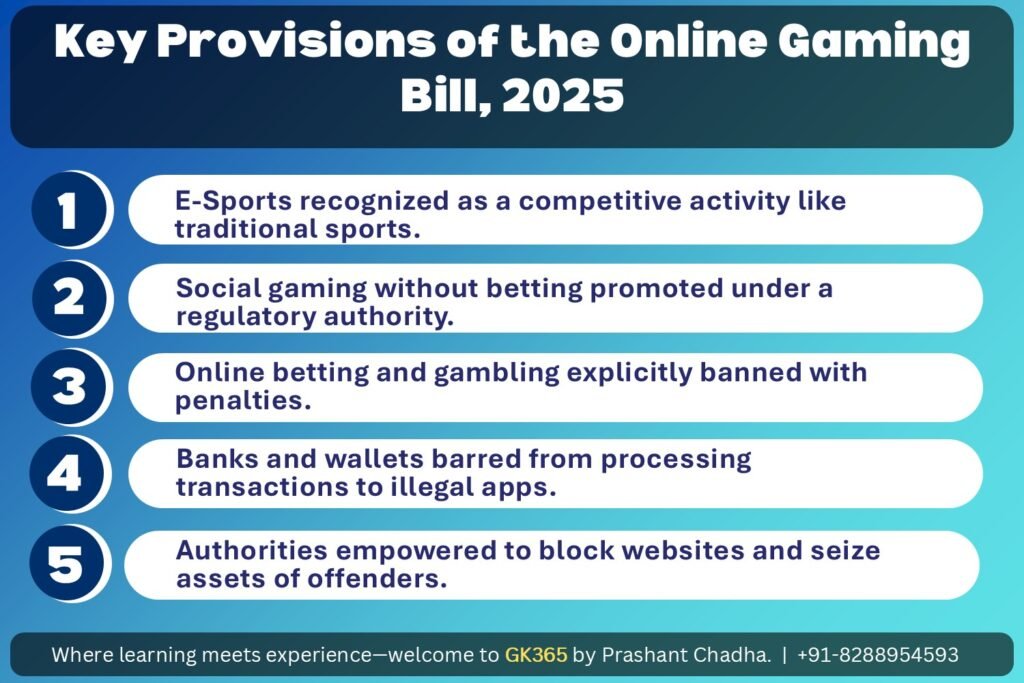
The Bill introduces a comprehensive framework with five major pillars designed to clean up the gaming ecosystem while promoting legitimate e-sports:
| Provision | Details | Impact |
|---|---|---|
| E-Sports Promotion | Regulatory authority to oversee e-sports; recognized as competitive sport | Investment, jobs, international exposure |
| Money Gaming Ban | Offering or promoting betting/gambling is criminal offence | Operators, advertisers, middlemen face penalties |
| Advertisement Ban | Ads for money-based gaming prohibited; celebrity endorsements penalized | Reduces misleading promotions |
| Financial Restrictions | Banks, wallets, payment gateways cannot transfer money to betting platforms | Cuts off financial lifeline |
| Enforcement Powers | Search, seize, investigate; block websites/apps; fines and imprisonment | Stronger deterrence |
Don’t confuse: The Bill does NOT ban all online gaming. It specifically bans money gaming/betting while PROMOTING e-sports and social gaming. The distinction between skill-based gaming (legal) and chance-based gambling (banned) is crucial for exam questions.
1. Promotion of E-Sports and Social Games:
- A regulatory authority will oversee e-sports and social gaming
- E-sports recognized as a competitive activity like traditional sports
- Social gaming without betting encouraged as part of India’s digital economy
2. Prohibition of Online Money Gaming:
- Offering or promoting betting or gambling online is a criminal offence
- Operators, advertisers, and middlemen face penalties
3. Ban on Gaming Advertisements:
- Ads for money-based gaming will be banned
- Celebrities and influencers endorsing such platforms risk fines
4. Financial Restrictions:
- Banks, wallets, and payment gateways cannot transfer money to betting platforms
- Institutions must block transactions linked to illegal apps
5. Enforcement and Penalties:
- Authorities can search, seize, and investigate illegal operators
- Penalties include fines, imprisonment, and stronger measures for repeat offenders
- Websites and apps promoting money gaming can be blocked
🌍 Why the Bill Matters
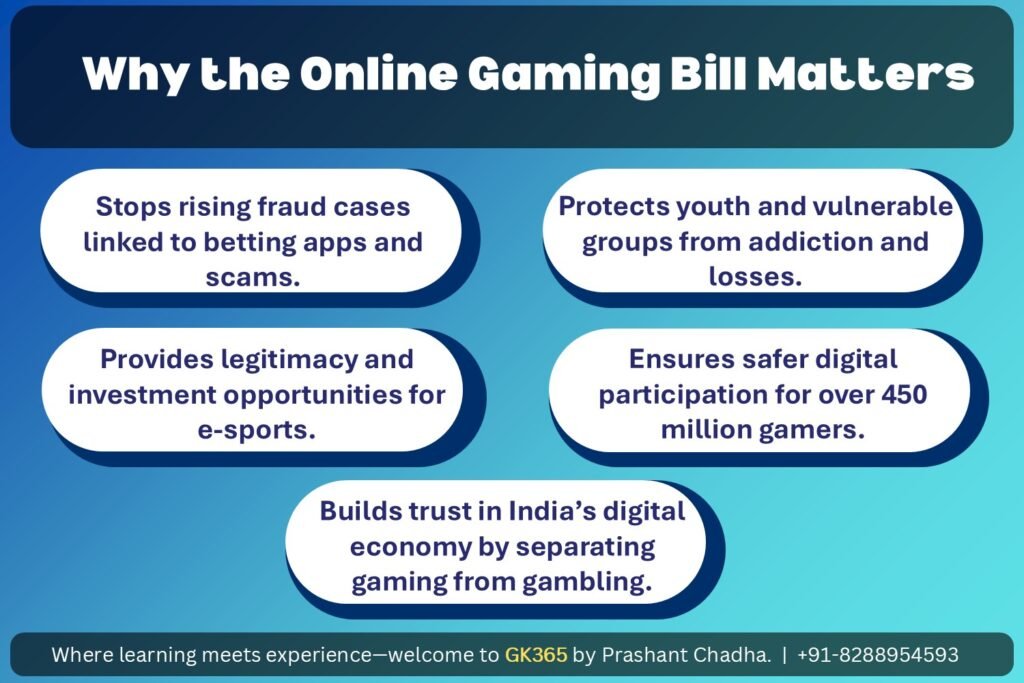
The Bill addresses three critical concerns plaguing India’s gaming ecosystem:
Rising Fraud Cases: India has seen scams involving fraudulent gaming apps and money laundering networks. The Bill shuts down financial channels and makes betting a defined offence.
Protecting Consumers: The law shields vulnerable users, especially youth, from addiction and losses. Families will also see reduced disputes linked to gambling debts.
Boosting E-Sports Industry: By separating skill-based gaming from betting, the Bill gives legitimacy to e-sports. This recognition could bring investment, jobs, and international exposure for Indian players.
Three-Fold Impact: (1) Curbs Fraud, (2) Protects Consumers (especially youth), (3) Boosts E-Sports. Remember: “FCB” — Fraud, Consumers, Boost!
👥 Impact on Stakeholders
The Bill affects multiple stakeholders across the gaming ecosystem:
- Players and Consumers: Clearer rules ensure safer participation in legitimate gaming
- E-Sports Startups and Investors: Recognition makes it easier to attract funding and build tournaments
- Celebrities and Influencers: Endorsing betting apps can now lead to penalties and fines
- Financial Institutions: Banks and payment gateways must strengthen monitoring systems
- Law Enforcement: Agencies will have more authority to block sites and prosecute offenders
The Bill places responsibility on celebrities and influencers for endorsing betting apps. Is this fair? Should brand ambassadors be held liable for the products they promote? Consider the ethical dimensions of celebrity endorsements and their influence on young consumers.
🌐 Global Comparisons
Different countries have adopted varying approaches to regulate online gaming and betting:
| Country | Approach | Key Features |
|---|---|---|
| India (New Bill) | Ban betting, promote e-sports | Complete ban on money gaming; e-sports as recognized sport |
| China | Strict restrictions | Strong restrictions on betting; gaming time limits for minors |
| United States | State-level regulation | Many states ban betting but support e-sports |
| Singapore | Licensing system | Regulated platforms with licenses |
India’s model bans betting but supports e-sports, striking a balance between consumer safety and economic growth. The approach is similar to China’s strict stance but with more emphasis on promoting legitimate gaming as an industry.
🔮 Challenges & Future Outlook
Implementation Challenges:
- Effective enforcement requires coordination across agencies
- Betting operators often host servers abroad, making tracking difficult
- Public awareness campaigns needed to help users distinguish legal gaming from gambling apps
Long-Term Prospects:
- Cleaning up fraudulent apps will build trust in the gaming ecosystem
- Recognition of e-sports can create careers in streaming, coaching, and event management
- Industry estimates suggest India could be among the top five global e-sports markets by 2030
The Bill, already cleared by the Cabinet, will be introduced in the Lok Sabha soon. Cross-party support is expected due to public concern over betting scams.
The Bill raises important questions about balancing innovation with regulation. How can India nurture a world-class gaming industry while protecting vulnerable consumers? Consider the tension between free market principles and the need for consumer protection in emerging digital sectors.
Click to flip • Master key facts
For GDPI, Essay Writing & Critical Analysis
5 questions • Instant feedback
The Union Cabinet, chaired by PM Narendra Modi, has cleared the Online Gaming Bill, 2025.
India has over 450 million online gamers, making it one of the largest gaming markets worldwide.
The Bill PROMOTES e-sports and social gaming while BANNING online betting and money gaming.
Under the Bill, banks, wallets, and payment gateways CANNOT transfer money to betting platforms.
Industry estimates suggest India could be among the top five global e-sports markets by 2030.








