
“The work lacks glamour. It matters for people who cross the border daily and for traders who depend on lower risk.” — On the importance of India-Nepal border coordination
India and Nepal resumed high-level border coordination talks at the 9th Annual Coordination Meeting held in New Delhi from November 12 to 14, 2025. The meeting brought together India’s Sashastra Seema Bal (SSB) and Nepal’s Armed Police Force (APF) to address cross-border crime, intelligence sharing, and coordinated border management. This engagement comes after months of limited contact following the September 2025 youth-led protests in Nepal and leadership changes in both countries’ border agencies.
👥 Key Participants: SSB and APF
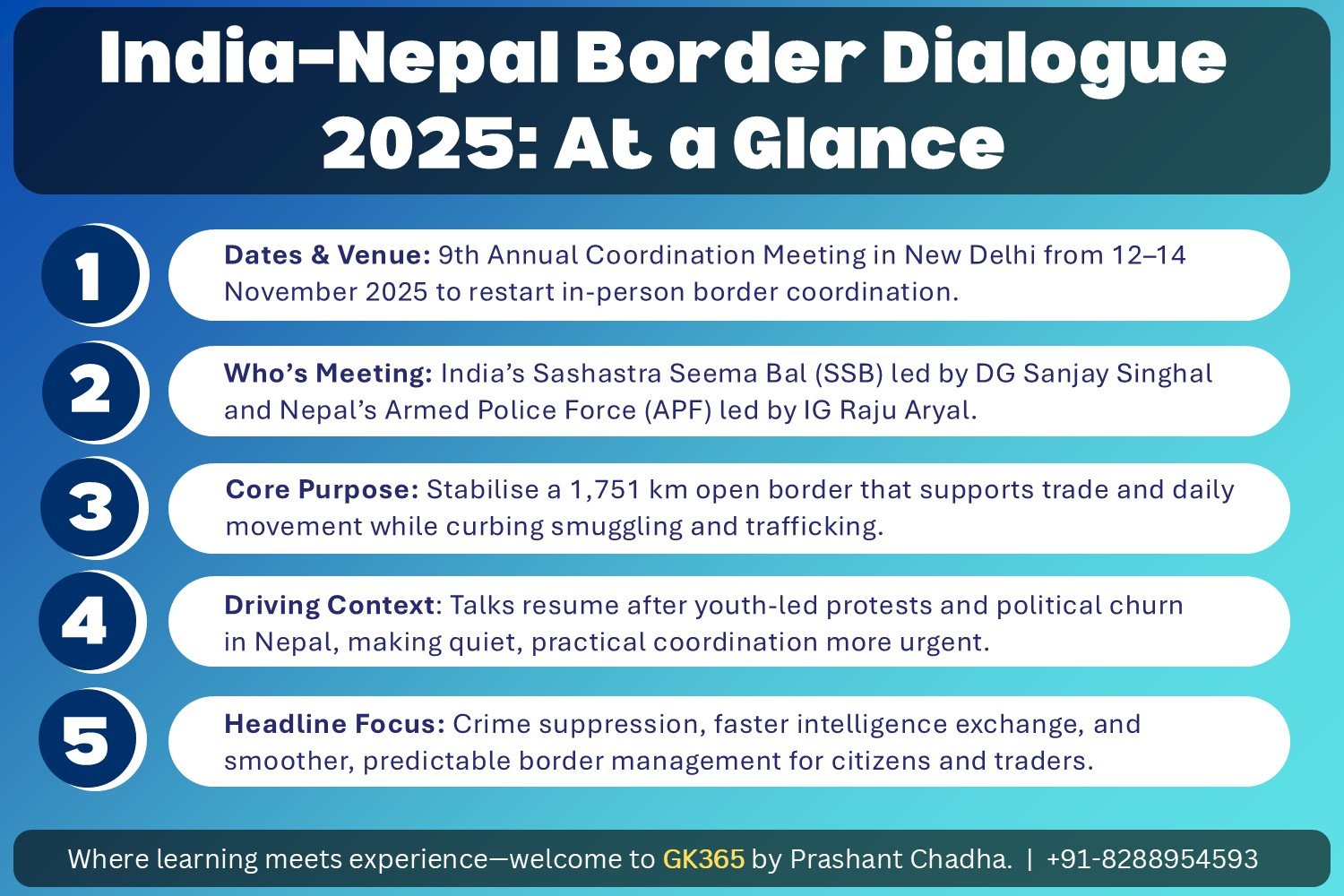
The meeting brought together two key border security forces:
India’s Sashastra Seema Bal (SSB):
- Led by Director General Sanjay Singhal (took charge in September 2025)
- Guards the 1,751 km India-Nepal border
- Also guards the 699 km India-Bhutan border
- Functions under the Ministry of Home Affairs
Nepal’s Armed Police Force (APF):
- Led by Inspector General Raju Aryal (since 2022)
- Paramilitary force responsible for border security
- Coordinates with SSB on cross-border issues
Think of SSB and APF as “border neighbors” who need to talk regularly to keep their shared fence safe. SSB is India’s dedicated force for the Nepal and Bhutan borders, while APF is Nepal’s paramilitary force. Their annual meetings are like neighbors meeting to discuss common problems — from stopping criminals to helping lost travelers.
📋 Main Agenda Items
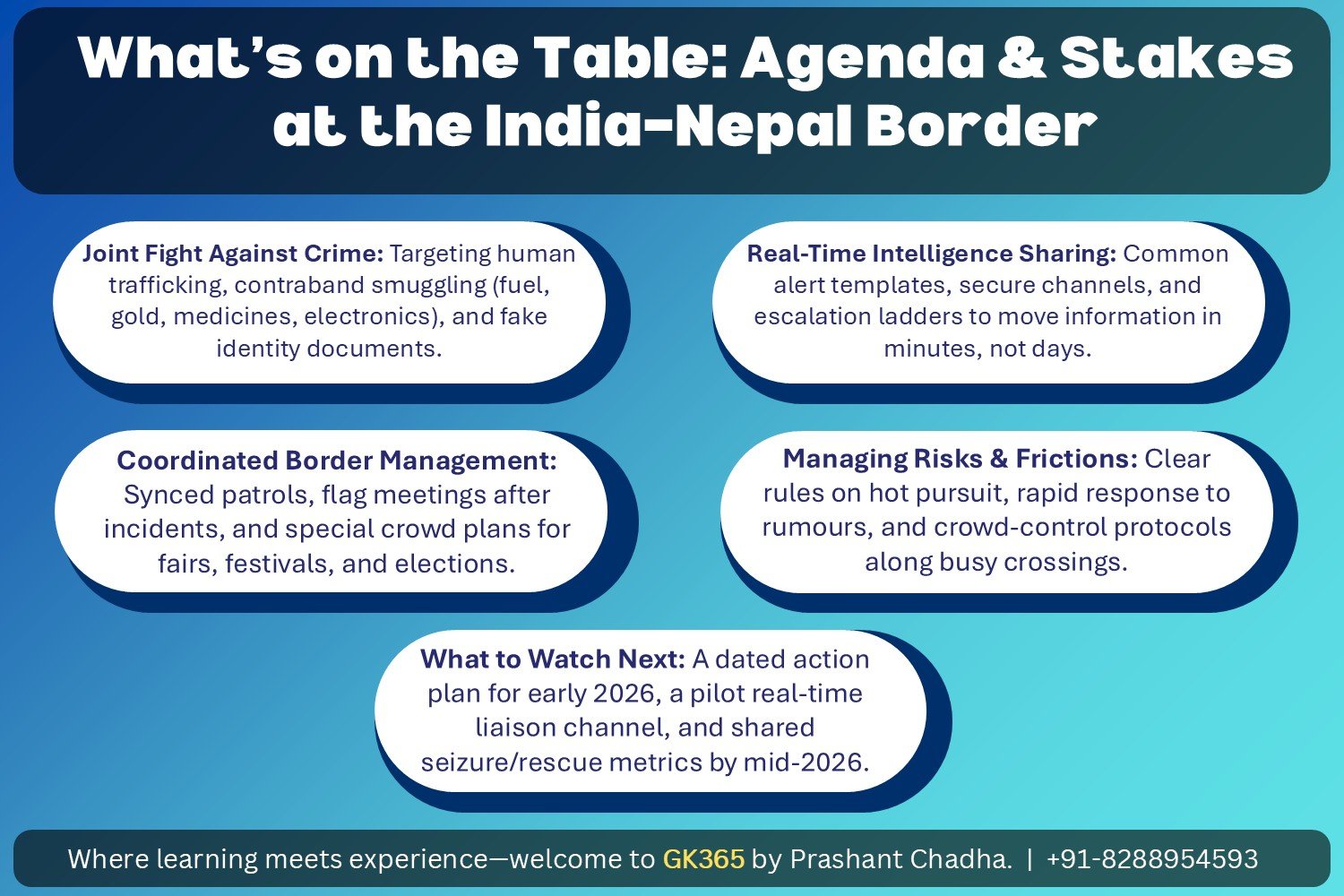
The meeting focused on three broad deliverables:
- Joint Strategies Against Cross-Border Crime: Covering human trafficking, contraband smuggling, and illegal trade that exploits porous stretches and busy market towns
- Real-Time Intelligence Exchange: Faster alerts on crime networks, forged identity papers, and vehicle routes through shared formats and secure channels
- Coordinated Border Management: Patrol synchronization, flag-meet protocols after incidents, and quick liaison during festivals and election periods
| Agenda Area | Focus | Expected Outcome |
|---|---|---|
| Cross-Border Crime | Trafficking, smuggling, illegal trade | Joint suppression strategies |
| Intelligence Sharing | Crime networks, forged documents | Real-time alert system |
| Border Management | Patrols, flag-meets, festivals | Calm, predictable border |
| Document Fraud | Fake Aadhaar, licenses, papers | Shared watchlists |
🗺️ The Indo-Nepal Border: Characteristics
The India-Nepal border has unique characteristics:
- Length: Approximately 1,751 km
- Nature: Largely open, road-dense, and mostly unfenced
- Daily Movement: Families cross daily for work, healthcare, and markets
- Checkposts: Dozens of notified checkposts handle formal movement
- Vulnerable Points: Village tracks, riverbeds, and forest corridors used by smugglers
- Crime Peaks: Harvest seasons (cash in hand) and periods with fuel price gaps
The open border supports deep people-to-people ties and trade but also attracts criminals who exploit porous stretches.
SSB’s Dual Mandate: SSB guards both the India-Nepal border (1,751 km) AND the India-Bhutan border (699 km). This dual responsibility forces resource trade-offs that joint planning with APF can ease.
🇳🇵 Political Context in Nepal
The talks follow significant political turmoil in Nepal:
- September 2025: Youth-led protests erupted after a social media ban, anger over corruption and unemployment
- PM Resignation: K. P. Sharma Oli resigned amid the unrest
- Interim Cabinet: Former Chief Justice Sushila Karki leads an interim government pledging reforms
- Casualties: Clashes left dozens dead and many injured
- Impact: Strained administration bandwidth and disrupted routine cross-border engagement
This tense climate raised the value of quiet, practical work with India on border stability.
Don’t confuse: The current interim PM of Nepal is Sushila Karki (former Chief Justice), NOT K. P. Sharma Oli who resigned during the September 2025 protests. The interim cabinet was formed after the youth-led protests.
🤝 How the Forces Cooperate
SSB and APF work together at three levels:
1. Headquarters Level:
- Annual meetings set priorities, timelines, and review metrics
- This week’s 9th Annual Meeting fits in this tier
2. Frontier/Sector Level:
- Officers agree on patrol grids and monthly contact schedules
- De-confliction steps after arrests are planned here
3. Post Level:
- Local commanders trade phone numbers and set up communication patterns
- Flag meetings after incidents and quick case-level coordination
🚨 Crime Patterns Driving Cooperation
Three crime clusters recur along this border:
1. Human Trafficking:
- Networks recruit in poorer districts and move victims through quiet crossings
- Rescue work needs rapid cross-border verification and shelter coordination
2. Contraband and Tax Evasion:
- Fuel, medicine, electronics, and gold attract smugglers during price gaps
- Syndicates use mini-trucks with false bottoms or switch loads at night
3. Fake Documents and Identity Misuse:
- Forged Aadhaar cards, driving licenses, and citizenship papers
- Criminals use them to change identities across the border
The open India-Nepal border is a double-edged sword. It enables deep people-to-people ties, cultural exchange, and legitimate trade. But the same openness creates vulnerabilities for trafficking and smuggling. How can the two countries balance security with the traditional freedom of movement?
📅 Expected Outcomes & Timelines
Near Term (0-3 months):
- Two joint trainings on trafficking and document forensics
- A pilot 24×7 liaison desk pairing one SSB frontier with one APF regional HQ
- Shared directory for all border posts with weekly verification
Short Term (3-6 months):
- Quarterly flag-meeting calendar locked at sector level
- Template for festival-season crowd plans at four busy crossings
- Joint drill to test alert speed on mock smuggling routes
By Mid-2026:
- Measurable drop in repeat-offender vehicle plates on watchlists
- Faster recovery of trafficking victims
- Uptick in coordinated seizures near riverine gaps
Click to flip • Master key facts
For GDPI, Essay Writing & Critical Analysis
5 questions • Instant feedback
The 9th Annual Coordination Meeting between SSB and APF was held in New Delhi from November 12-14, 2025.
The India-Nepal border is approximately 1,751 km long. SSB also guards the 699 km India-Bhutan border.
Sashastra Seema Bal (SSB) is India’s border force for the Nepal and Bhutan borders, functioning under the Ministry of Home Affairs.
Sushila Karki, former Chief Justice, leads the interim cabinet in Nepal after PM K.P. Sharma Oli resigned during the September 2025 protests.
APF stands for Armed Police Force, Nepal’s paramilitary force responsible for border security, led by IG Raju Aryal.








