
“The Constitution is not just a legal document — it is a social pact that guides how India governs and how citizens live together.” — Justice DY Chandrachud
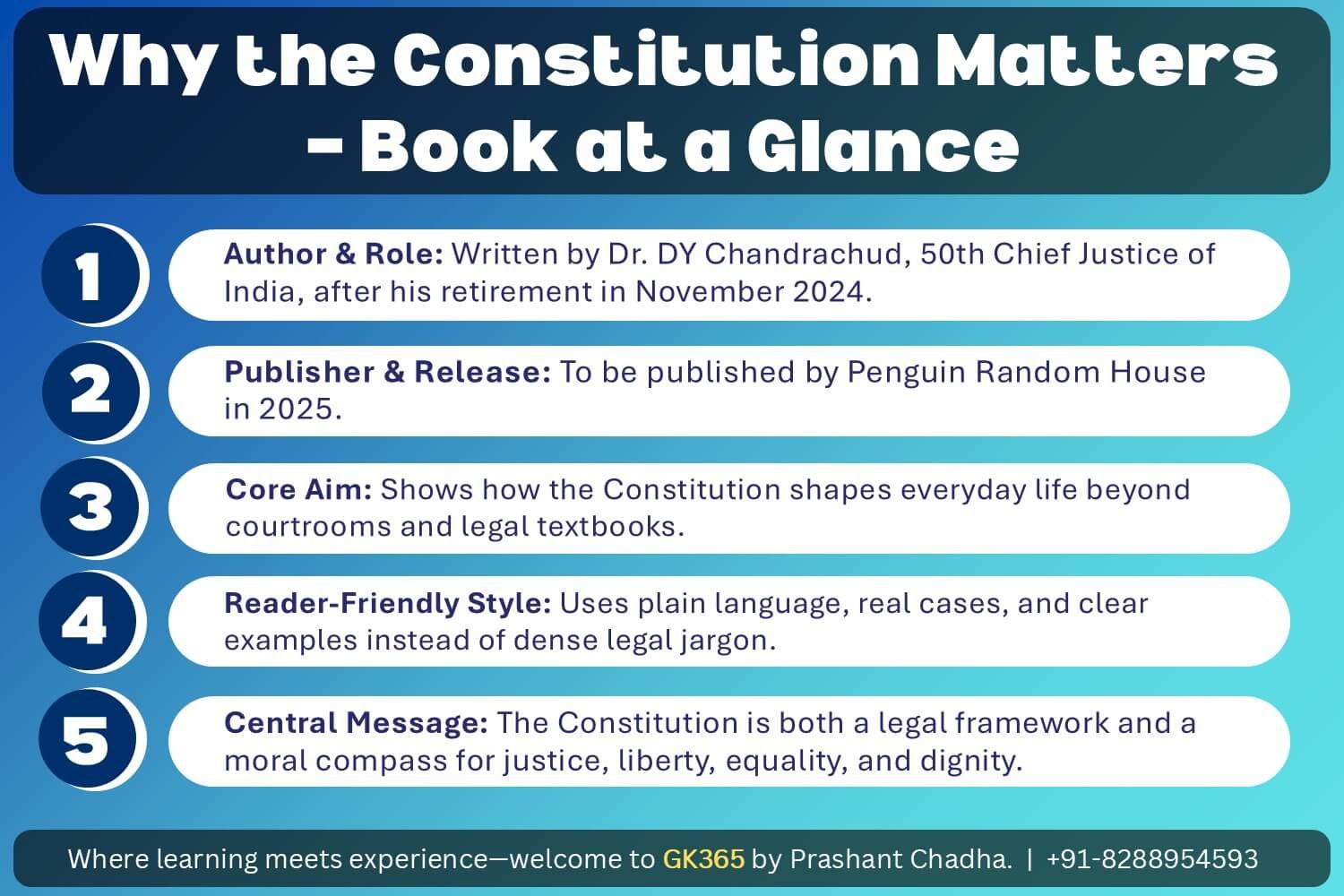
In 2025, Penguin Random House will release Why the Constitution Matters, a landmark book by Dr. DY Chandrachud, who retired in November 2024 as the 50th Chief Justice of India. Drawing on more than two decades of judicial experience, the book explains how the Constitution shapes daily life — not as distant legal text, but as a living guide to justice, liberty, and dignity.
This debut work bridges the gap between courtrooms and common citizens. It invites readers to see constitutional values as practical tools for everyday choices and public action, making it essential reading in an era of heightened debate on rights and accountability.
👤 About the Author: Justice DY Chandrachud
Justice Dhananjaya Yeshwant Chandrachud built a distinguished judicial record defined by expanding rights and upholding constitutional values. His journey took him from advocate to the highest judicial office in India.
He began his career as an advocate, later serving on the Bombay High Court. He became Chief Justice of the Allahabad High Court before joining the Supreme Court. In November 2022, he was sworn in as the 50th Chief Justice of India, serving until his retirement in November 2024.
Landmark Contributions: Justice Chandrachud is known for affirming the right to privacy, advancing gender equality and workplace rights, backing LGBTQ+ dignity, and defending free expression and judicial independence.
📜 The Book in Context
India adopted its Constitution on 26 January 1950, establishing the framework for the world’s largest democracy. Yet many citizens still view it as distant legal text, accessible only to lawyers and judges. Public debate on rights, liberty, and government accountability has grown sharper in recent years.
This book arrives to bridge courtrooms and common life. It treats constitutional values not as abstract principles but as guides for everyday choices and public action. The structure favors readers outside law schools, using plain language, real cases, and practical examples.
Think of the Constitution as a user manual for India. Most people know it exists but rarely read it. Justice Chandrachud’s book is like a friendly guide that explains how this manual affects your daily life — from your right to privacy on your phone to equal treatment at work.
| Feature | Traditional Legal Texts | Why the Constitution Matters |
|---|---|---|
| Language | Technical jargon | Plain, accessible prose |
| Audience | Lawyers and scholars | General readers and students |
| Examples | Case citations | Real-life stories from 25+ years |
| Purpose | Legal reference | Civic engagement and awareness |
✨ Key Themes Explored
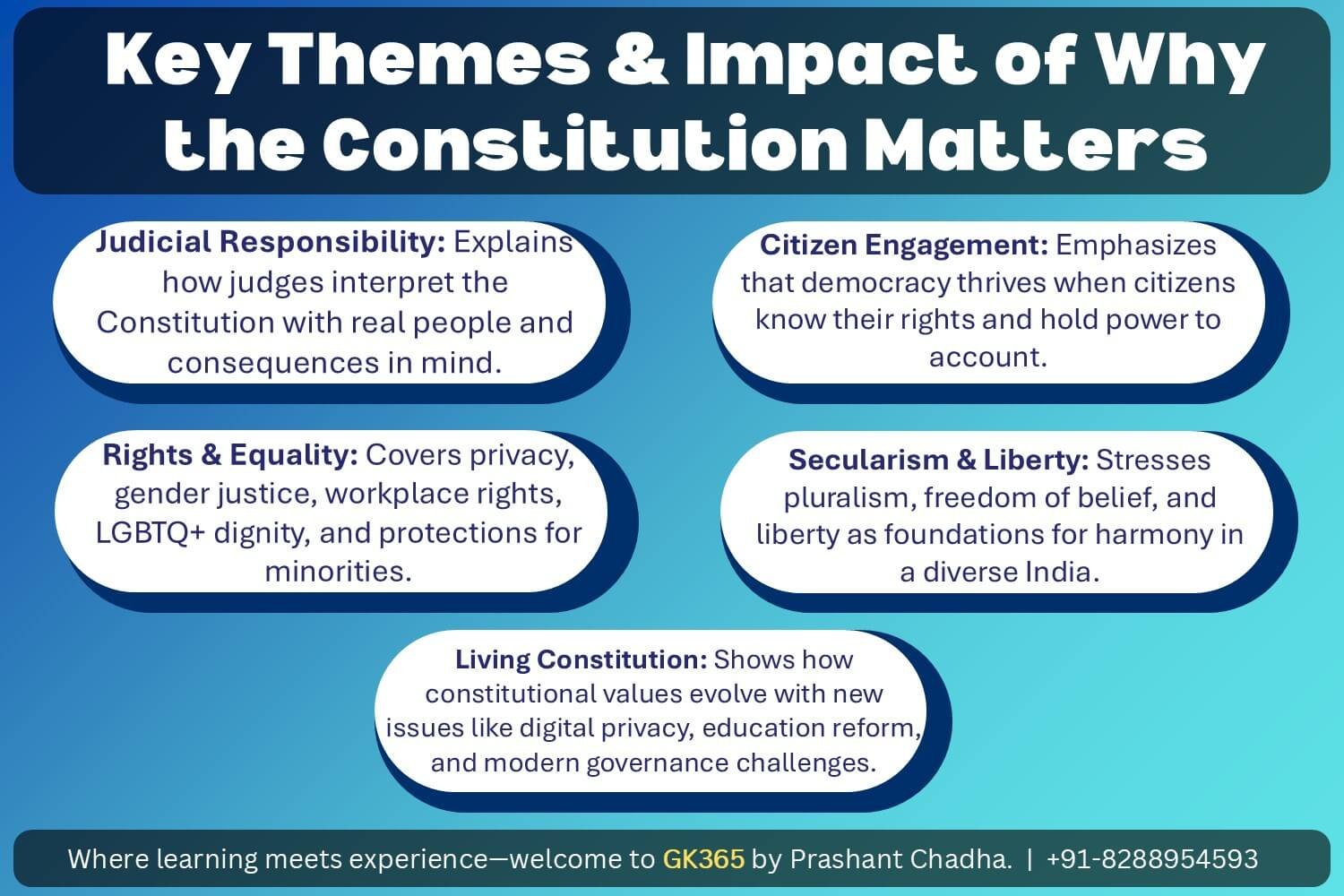
The book explores several interconnected themes that shape constitutional interpretation and citizen engagement:
Judicial Responsibility and Interpretation: Judges read the Constitution with citizens in mind. Each interpretation carries real effects on lives. The aim is always justice, equality, and fairness.
Citizen Engagement: Democracy works when people take part. Knowledge of rights helps citizens question power and demand accountability from institutions.
Human Rights and Equality: Rights must adapt to a changing society. The Constitution supports inclusion across lines of gender, caste, religion, and economic status.
Secularism and Liberty: Pluralism holds a diverse country together. Freedom of belief and liberty protections maintain social harmony in a nation of many faiths.
Justice as a Living Idea: Constitutional values evolve with new challenges — digital privacy, education reform, environmental rights. Application keeps justice meaningful across generations.
The Constitution was written in 1949-50. How can a 75-year-old document address modern issues like data privacy, artificial intelligence, or climate change? Justice Chandrachud argues that the Constitution is a “living document” — its principles remain constant while their application evolves.
⚖️ Why the Constitution Still Matters
The book makes a compelling case for why the Constitution remains vital in contemporary India:
Protection from State Overreach: The Constitution limits government power and protects individual rights. It ensures that even elected majorities cannot violate fundamental freedoms.
Checks and Balances: It establishes separation of powers between legislature, executive, and judiciary — each checking the others to prevent abuse of power.
Minority Protection: Constitutional provisions safeguard vulnerable groups from majoritarian excesses, ensuring that democracy does not become tyranny of the majority.
Institutional Accountability: Public institutions remain answerable to the people through constitutional mechanisms, maintaining transparency and rule of law.
Do not confuse: The Constitution of India was ADOPTED on 26 November 1949 but CAME INTO EFFECT on 26 January 1950. Republic Day celebrates the latter date. The Constituent Assembly took almost 3 years (1946-1949) to draft it.
👩🏫 Who Should Read This Book
The book speaks to multiple audiences with different needs:
Students of Law, Politics, and Civics: Clear explanations of constitutional principles without overwhelming legal jargon make it ideal for undergraduate and graduate students.
Civil Service Aspirants: UPSC and State PSC candidates will find constitutional principles explained through real cases — perfect for essay writing and interview preparation.
Lawyers and Judges: Reflections from a former Chief Justice of India offer insights into judicial reasoning and constitutional interpretation at the highest level.
General Readers: Anyone interested in understanding how the Constitution affects daily life will find an approachable entry point to a complex subject.
Civil Society Groups: Organizations working on rights awareness can use the book as a resource for training and public education programs.
🌍 Anticipated Reception and Impact
Justice Chandrachud’s standing as a reformist judge will draw attention far beyond legal circles. The book arrives at a time when questions about free speech, equality, and institutional power dominate public discourse.
Universities and law schools may adopt it for constitutional law courses. Civil society groups can use it for rights awareness programs. Public discussions on governance and democracy can draw on its framework to analyze contemporary debates.
The book may guide future judges, lawyers, and public leaders by demonstrating how legal reasoning connects with social responsibility. Penguin Random House’s distribution network will help it reach readers across India and internationally.
The book connects to broader debates about judicial activism vs. restraint, constitutional morality, and the role of courts in a democracy. Understanding these themes will strengthen your answers on polity and governance topics.
Click to flip • Master key facts
For GDPI, Essay Writing & Critical Analysis
5 questions • Instant feedback
Justice DY Chandrachud served as the 50th Chief Justice of India from November 2022 to November 2024.
The book Why the Constitution Matters is published by Penguin Random House in 2025.
The Indian Constitution came into effect on 26 January 1950, which is celebrated as Republic Day.
Justice Chandrachud is known for landmark judgments on the Right to Privacy, including the Puttaswamy case.
Justice Chandrachud joined the Supreme Court of India in 2013 before becoming CJI in 2022.








