
“Cities must show that data and technology improve daily life for real people — better water pressure, faster permits, cheaper and safer trips, cooler streets, and homes families can afford.” — World Cities Day 2025 Vision
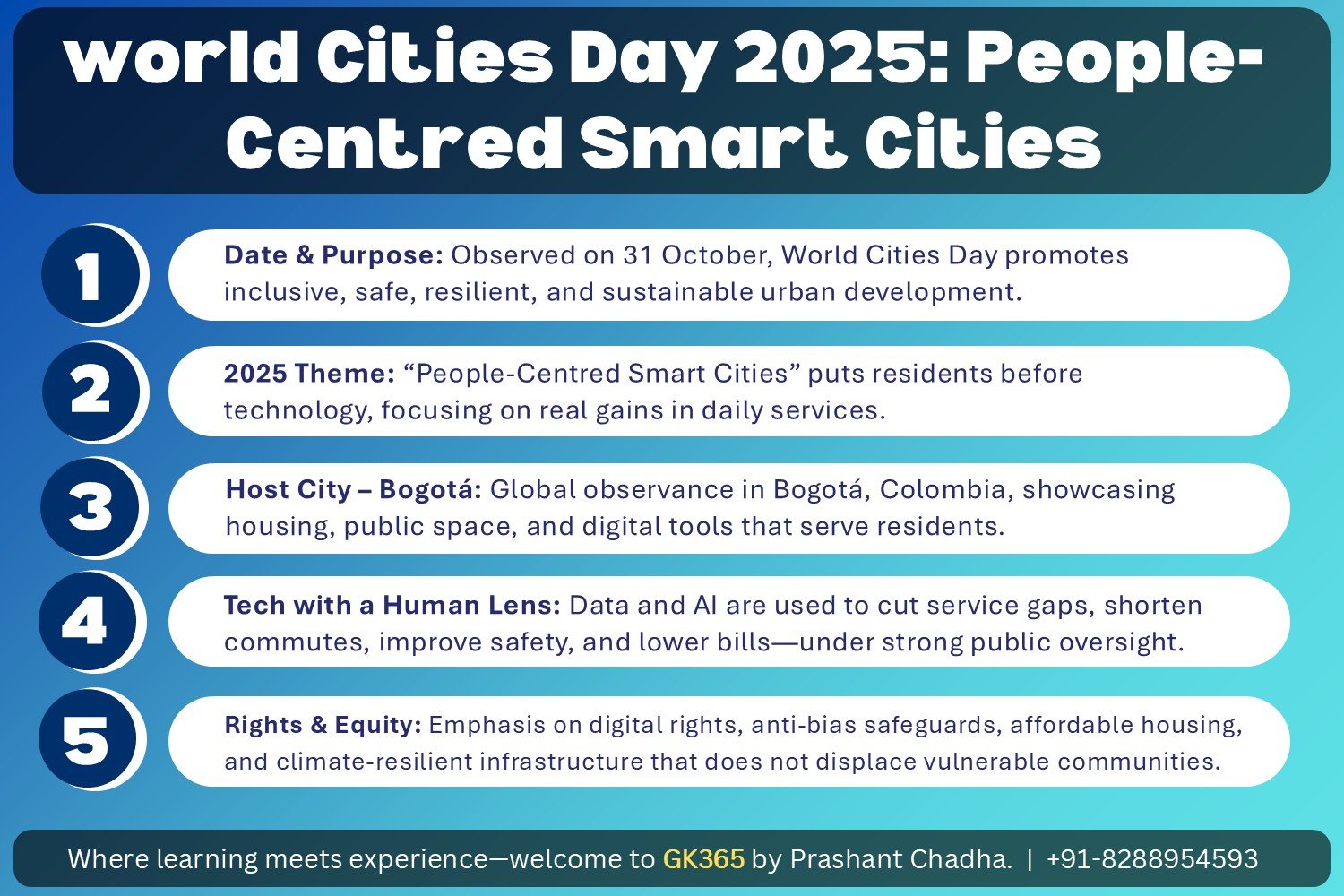
World Cities Day is observed every year on 31 October to highlight urbanization trends and promote inclusive, safe, resilient, and sustainable cities. The 2025 global theme is “People-Centred Smart Cities”, calling on city leaders to put residents first by using data and technology for tangible improvements in daily services. The global observance will be held in Bogotá, Colombia, announced by UN-Habitat in July 2025. World Cities Day also closes Urban October, a month of events that begins with World Habitat Day.
📜 Origin and Purpose of World Cities Day
The United Nations General Assembly created World Cities Day through a resolution in 2013. The first observance took place in 2014.
The day supports one core aim: cities should grow in ways that are inclusive, safe, resilient, and sustainable. This goal aligns with:
- SDG 11: Sustainable Cities and Communities
- New Urban Agenda: Adopted in Quito, Ecuador in 2016
World Cities Day also links to World Habitat Day, which opens Urban October on the first Monday of October each year. Urban October is a month of events led by UN-Habitat.
Think of World Cities Day as an annual “check-up” for cities around the world. Just like a doctor examines your health, this day examines how well cities are serving their residents — asking whether urban growth is helping everyone or leaving some people behind. The day closes Urban October, a month-long global conversation about making cities better.
🏙️ The 2025 Theme: People-Centred Smart Cities
The 2025 theme, “People-Centred Smart Cities”, places residents before technology. City leaders are asked to design and run technology that serves people first.
This idea covers several key points:
- Digital services should be simple to use
- Public data should guide fair choices
- AI systems should improve service delivery and stay under public oversight
- Benefits should spread fairly across all neighborhoods, not only central or wealthy areas
The theme shifts focus from showcase projects to tangible improvements in daily services that residents actually feel.
Key Principle: A people-centred smart city starts from local needs, studies service gaps by place, income, gender, and age, brings residents into design, and measures progress with indicators like travel time, water pressure, rent burdens, and service wait times.
🇨🇴 Bogotá as Host City 2025
The global observance of World Cities Day 2025 will take place in Bogotá, Colombia, on 31 October 2025. UN-Habitat named Bogotá as the host in July 2025.
The city will welcome:
- National and local government leaders
- Civil society groups and NGOs
- Universities and research institutions
- Private sector firms
The program will include sessions and site visits. Local agencies plan to present work on housing, public space, and digital tools that support residents in daily life.
🤖 Data, AI, and Daily Services
Data and AI can improve core services when governance is strong and goals stay clear. Concrete applications include:
- Water & Sanitation: Sensors detect leaks and predict pipe failures
- Public Health: Linked data guides mobile vaccination teams
- Waste Management: Route planning raises pickup reliability
- Permits & Benefits: One-stop digital portals reduce queues
- Public Safety: Hotspot analysis guides lighting and transport plans
- Disaster Readiness: Flood and heat models trigger targeted warnings
| Service Area | AI/Data Application | Benefit |
|---|---|---|
| Water & Sanitation | Leak detection sensors | Reduced water loss |
| Public Health | Vaccination gap analysis | Better coverage |
| Waste Management | Route optimization | Lower fuel costs |
| Permits | Digital one-stop portals | Faster approvals |
| Public Safety | Hotspot mapping | Targeted interventions |
| Disaster Response | Early warning systems | Reduced casualties |
People-centred work also means rights-centred work. Cities should protect privacy, guard against algorithmic bias, and explain automated decisions. Residents need clear consent choices, limits on data retention, and ways to appeal when systems fail.
🌍 Climate Risk & Infrastructure Funding Gap
Climate change places new stress on transport, energy, water, drainage, and health systems. The 2024 World Cities Report (launched at WUF12) highlights alarming figures:
- Funding Gap: $4.5 to $5.4 trillion per year needed for climate-resilient urban infrastructure
- Current Funding: Only ~$831 billion per year is currently tracked
- At-Risk Population: More than 2 billion urban residents could face at least an extra 0.5°C of warming by 2040
Cities can respond through: (1) Strengthening project preparation, (2) Using blended finance, and (3) Directing funds toward highest-risk communities.
Don’t confuse: The $4.5-5.4 trillion figure is the annual funding gap for climate-resilient urban infrastructure globally — NOT total investment needed. Current tracked funding is only ~$831 billion/year, far below the requirement.
🏠 Social & Economic Inclusion
The World Cities Report warns about “green gentrification” — when eco-projects raise land values, increase rents, and displace low-income households from improved areas.
Cities have several options to protect vulnerable communities:
- Mixed-income housing near new transit or parks
- Rent support linked to upgrades
- Community land trusts for long-term affordability
- Impact assessments for every major green project
The agenda also stresses supporting informal workers (street vendors, recyclers, day laborers) through digital IDs, safe vending zones, cashless fees, and micro-insurance.
📋 12-Month Action Agenda for Cities
The 2025 theme translates into a practical one-year action plan for cities:
- Publish a People-Centred Smart City Charter with principles on privacy, equity, and transparency
- Map service gaps by neighborhood using income, gender, age, and disability data
- Run co-design sprints with low-income residents for permits, benefits, and transport
- Set up an algorithm register listing purpose, data sources, and fairness checks
- Launch digital service standards with mobile-first, plain-language requirements
- Create public dashboards showing service metrics updated weekly
- Prepare climate-resilient projects with feasibility studies and financing plans
- Guard against green displacement by tracking rent trends near new assets
- Support informal workers with vending zones, digital IDs, and cashless systems
- Invite external audits by civil society for transparency
Click to flip • Master key facts
For GDPI, Essay Writing & Critical Analysis
5 questions • Instant feedback
World Cities Day is observed on 31 October every year, closing Urban October which begins with World Habitat Day.
The 2025 theme is “People-Centred Smart Cities”, focusing on technology that serves residents first.
Bogotá, Colombia will host World Cities Day 2025, announced by UN-Habitat in July 2025.
The UN General Assembly created World Cities Day through a resolution in 2013, with the first observance in 2014.
The annual funding gap for climate-resilient urban infrastructure is $4.5 to $5.4 trillion, far exceeding current tracked funding of ~$831 billion.








