
“The Games showed a double reality: humanoid robots are advancing quickly, but reaching human-level agility remains a distant goal.” — World Humanoid Robot Games 2025
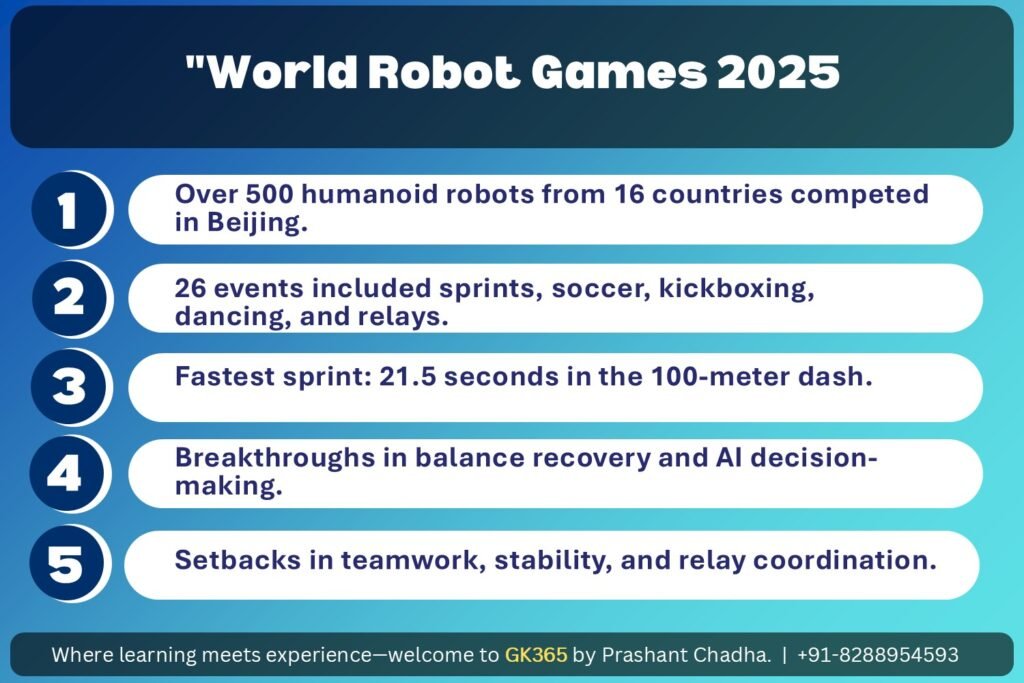
Beijing hosted the World Humanoid Robot Games, where more than 500 robots from 16 countries competed in 26 events across four days. The contests ranged from sprints and kickboxing to dancing and relay races. The event highlighted breakthroughs in robotics alongside persistent challenges in balance, coordination, and autonomy.
This landmark competition brought together engineers, AI experts, and roboticists from across the globe, offering a rare opportunity to benchmark progress in both hardware and software under high-pressure, real-world scenarios.
🤖 An Arena of Intelligent Machines
Humanoid robots mimic human movement and structure. At the Games, they were tested in sports and real-world tasks that demanded adaptability. Unlike controlled lab conditions, the live arena forced robots to deal with unpredictability — an essential step toward true autonomy.
The competition brought together engineers, AI experts, and roboticists, offering a rare chance to benchmark progress in both hardware and software under high-pressure scenarios. It served as both a spectacle and a serious testing ground for cutting-edge technology.
Think of this like the Olympics for robots. Just as human athletes compete in running, team sports, and combat events, these humanoid robots faced similar challenges — but with an added twist: they had to think and adapt on their own, without human controllers guiding every move.
🏃 Events and Competitions
The Games featured 26 different events testing various aspects of robotic capability:
100-Meter Sprint: The fastest robot completed the dash in 21.5 seconds — a benchmark for biped locomotion. Though slower than human sprinters, it demonstrated improved joint coordination and stability.
Soccer Matches: Autonomous soccer featured both skill and chaos. Some robots dribbled and passed effectively, while others collided, stumbled, or fell. The games showed progress in AI decision-making but exposed limits in multi-agent teamwork.
Kickboxing Duels: Kickboxing tested agility and recovery. Some robots absorbed hits and regained balance — an important step for applications in risky environments. Others struggled to stay upright, highlighting weaknesses in dynamic stability.
Dancing and Relay Races: Dance routines tested rhythm and synchronization, while relays required precise hand-offs. Relay events proved especially difficult, as one fall often triggered multiple collapses in a chain reaction.
| Event | Skills Tested | Key Observation |
|---|---|---|
| 100m Sprint | Speed, Balance, Coordination | Best time: 21.5 seconds |
| Soccer | AI Decision-making, Teamwork | Individual skill good; team coordination weak |
| Kickboxing | Agility, Impact Recovery | Some showed self-correction ability |
| Dancing | Rhythm, Synchronization | Tested motor precision |
| Relay Races | Hand-offs, Coordination | Chain collapses from single failures |
✨ Highlights and Setbacks
The competition revealed both remarkable achievements and persistent challenges in humanoid robotics:
Speed Milestones: The 21.5-second sprint was hailed as a major achievement in robotic biped mobility. For context, the human world record is 9.58 seconds, but the gap is narrowing as robotics technology improves.
Recovery and Balance: Kickboxing robots showed progress by self-correcting after impacts. This marks a significant leap from earlier designs that would shut down after even small disturbances.
Coordination Issues: Soccer highlighted the challenge of cooperative AI. Robots often chased the ball simultaneously, leading to confusion and breakdowns in teamwork — a problem that mirrors challenges in autonomous vehicle coordination.
Chain Reactions: Relay races exposed fragility in recovery mechanisms. Unlike humans who can catch themselves in various ways, robots lacked diverse recovery options, causing domino-like collapses.
Do not confuse: The 21.5-second time is for 100 meters, not 100 yards. Also, remember this is biped (two-legged) robots only — wheeled robots can move much faster but were not part of this competition.
🌍 Global Participation and Innovation Trends
Teams from 16 countries showcased different strategic approaches to humanoid robotics:
- Japan: Focused on precision locomotion and balance — building on decades of robotics leadership
- China: Emphasized scale and integration, fielding the largest team presence at the Games
- South Korea: Showcased advanced AI trained on dynamic simulations
- Germany: Prioritized stability-focused designs, though with slower overall speed
The diversity of approaches showed that no single method dominates yet. Public failures also gave engineers valuable lessons for refining their systems — the open competition format meant that everyone could learn from shared challenges.
The competition reflects broader geopolitical trends in technology. China, Japan, and South Korea are investing heavily in robotics as a strategic industry. How might leadership in humanoid robotics translate to economic and military advantages in the coming decades?
🔧 Engineering Lessons Learned
The Games provided valuable insights for the robotics community:
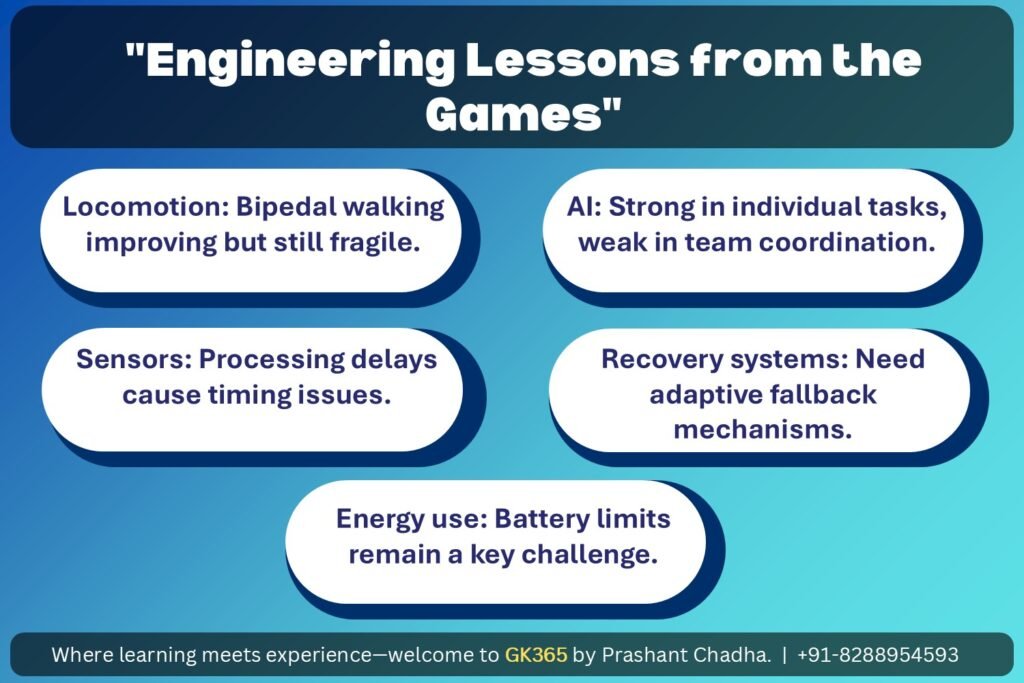
- Locomotion: Bipedal walking is improving but still fragile under real-world conditions
- AI Decision-making: Individual tasks are manageable, but group autonomy remains weak
- Sensor Integration: Processing delays often caused timing errors in fast-moving scenarios
- Recovery Systems: Robots need adaptive fallback mechanisms for unpredictable situations
- Energy Efficiency: High-performance designs still face significant battery limitations
These lessons will guide research toward robustness, decentralized AI, and modular recovery systems in future humanoid robot designs.
5 Key Engineering Challenges: Remember “LASER” — Locomotion fragility, AI coordination gaps, Sensor delays, Energy limits, Recovery mechanisms needed.
🚀 Future Implications for Humanoid Robotics
The Games signaled wider implications for the robotics industry and society:
- Practical Applications: Advances in balance suggest future roles in disaster response, healthcare, elderly care, and industrial work
- Entertainment Potential: Robot competitions may evolve into e-sports for machines, creating new entertainment industries
- Standardization Needs: Failures showed the need for common AI and motion protocols across the industry
- Global Competition: Heavy investments from Japan, China, and South Korea underline robotics as a field of geopolitical importance
As engineers improve sensors, AI algorithms, and locomotion systems, future competitions will likely feature smoother, more lifelike performances. The technology gap between robots and humans continues to narrow.
Click to flip • Master key facts
For GDPI, Essay Writing & Critical Analysis
5 questions • Instant feedback
More than 500 humanoid robots from 16 countries participated in the World Humanoid Robot Games in Beijing.
The fastest robot completed the 100-meter dash in 21.5 seconds, which is a benchmark for biped locomotion.
The Games featured 26 different events testing various aspects of robotic capability.
Japan is known for focusing on precision locomotion and balance in humanoid robotics.
Relay races were particularly challenging because one robot fall often triggered chain-reaction collapses in the team.








