
“Women grow half the world’s food, yet own less than a tenth of its farmland. 2026 is the year to change that equation.” — UN General Assembly Resolution
The United Nations General Assembly has declared 2026 the International Year of the Woman Farmer. This landmark resolution highlights the vital role women play in agriculture worldwide and calls attention to the deep inequalities they face. The aim is to promote policies that give women equal access to land, tools, markets, and decision-making power.
Women grow nearly half the world’s food. Yet they have fewer rights, less support, and limited access to resources. In India, about 80% of working women are in agriculture, but they own only 8.3% of farmland. This global observance offers a chance to fix that imbalance and reshape rural economies.
📰 Why in News?
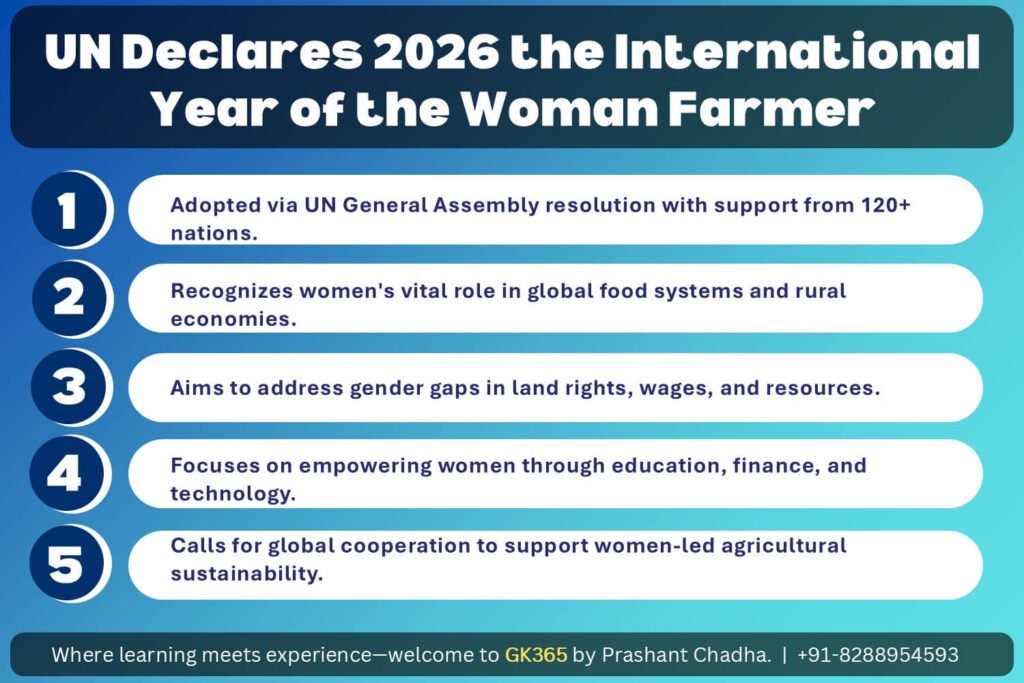
The UN General Assembly has designated 2026 as the International Year of the Woman Farmer. The goal is to raise global awareness about women’s role in farming and push for fairer agricultural policies. The resolution targets gender gaps in land rights, finance, technology, and leadership—especially in countries where women form the majority of the farm workforce.
In India, this recognition is overdue. Although women make up nearly 80% of agricultural workers, they own less than 10% of land and struggle to access credit, farm tools, and modern technology. The declaration creates a policy window to address these structural inequities.
Think of it like this: Women do most of the farming work globally, but they rarely own the land they work on, can’t easily get loans, and don’t have a seat at the table when farm policies are made. The 2026 UN declaration is like a global spotlight—shining attention on this gap so governments and institutions take action to fix it.
✨ Understanding the International Year of the Woman Farmer
This observance goes beyond symbolism. It supports three key goals:
- Recognizing women’s work: Women grow 50% of the world’s food but rarely shape policy.
- Closing gender gaps: The effort focuses on land rights, financial tools, and value chains.
- Promoting climate resilience: It encourages sustainable farming and use of climate-smart tools.
This aligns with UN Sustainable Development Goals—especially Goal 5 (Gender Equality) and Goal 2 (Zero Hunger). The declaration creates a framework for countries to review and reform their agricultural policies with a gender lens.
If women produce half the world’s food but own less than 10% of farmland globally, what happens to food security when land is sold, inherited, or disputed? The ownership gap creates a vulnerability that affects not just women—but entire food systems.
🌍 Women in Global Agriculture: Key Statistics
The numbers tell a stark story of contribution without corresponding rights:
- Women grow approximately 50% of the world’s food globally.
- In Africa and Asia, women produce 60–80% of the food.
- Yet globally, women own less than 15% of agricultural land.
| Indicator | India Data | Source |
|---|---|---|
| Working women in agriculture | 80% | Census Data |
| Farmland owned by women | 8.3% | NFHS |
| Rural women in agri-jobs | 76.95% | PLFS 2023-24 |
| Rural women without mobile phones | 51% | NSO |
Key Paradox: In India, 80% of working women are in agriculture, but only 8.3% own farmland. This 80-8 gap is frequently tested in exams as it highlights structural gender inequality in rural India.
🇮🇳 Women Farmers in India: Reality Check
India presents a stark picture of women’s agricultural contribution versus their rights and recognition:
- Land ownership: Just 8.3% of women own farmland, limiting credit access and policy benefits.
- Unpaid labor: 77% of rural women work in agriculture, often without pay or recognition.
- Digital divide: Over half of rural women do not own a mobile phone, cutting them off from weather alerts, crop advisories, and pricing tools.
- Policy gaps: Many government schemes do not address women’s specific needs or fail in execution.
The PLFS 2023-24 data shows that 76.95% of rural women aged 15+ work in agriculture-related activities—making it the dominant sector for female employment in rural India.
Don’t confuse: The 8.3% figure refers to women who own agricultural land (NFHS data). This is different from the percentage of women who work in agriculture (80%). The ownership-work gap is the key issue—women work on land they don’t own.
⚡ Key Challenges Faced by Women Farmers
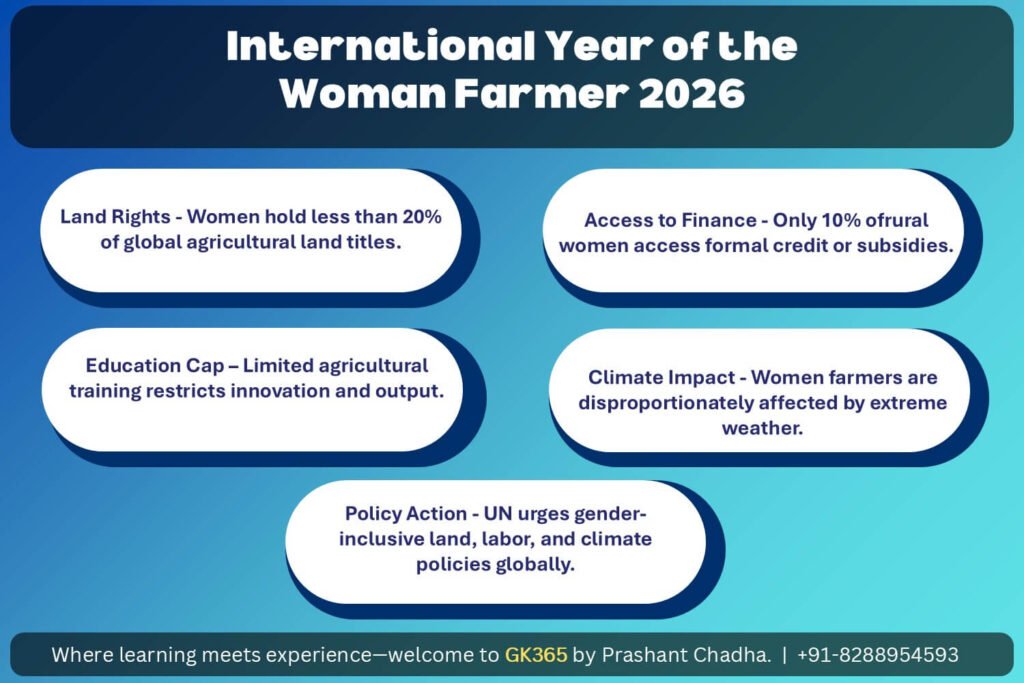
Women farmers face a unique set of interconnected challenges:
- Dual workload: Household duties reduce time and energy for farming activities.
- No land rights: Without legal titles, women cannot access credit, subsidies, or insurance.
- Limited finance: Microloans are too small for real change; few get support for long-term needs.
- Low tech access: Without smartphones or internet, women miss out on key advisories and schemes.
- Climate risks: Women are more vulnerable to floods, droughts, and irregular weather, with fewer resources to respond.
These challenges create a cycle where women contribute labor but cannot accumulate assets, access benefits, or influence policy—keeping them in a subordinate position within agricultural systems.
🏛️ Government Initiatives in India
Several schemes aim to support women farmers, though implementation gaps remain:
| Scheme | Focus Area | Key Feature |
|---|---|---|
| MKSP (Mahila Kisan Sashaktikaran Pariyojana) | Capacity Building | Trains women, improves access to farm tools |
| Farm Mechanisation Scheme | Equipment Access | 50–80% subsidy on tools and equipment |
| National Food Security Mission | Production Support | 30% funds reserved for women (some states) |
| SHG Networks | Financial Inclusion | Joint farming and financial freedom |
MKSP stands for Mahila Kisan Sashaktikaran Pariyojana (Women Farmer Empowerment Project). It is a sub-component of the Deendayal Antyodaya Yojana–National Rural Livelihoods Mission (DAY-NRLM). This is a frequently asked connection in exams.
🌐 Global Best Practices and Case Studies
ENACT Project (Assam, India)
- Led by the World Food Programme and the Assam government.
- Uses mobile-based climate alerts to support women farmers.
- Encourages climate-resilient crops and better seed systems.
- Demonstrates how technology can bridge the digital gender gap in agriculture.
International Examples
- FAO Partnerships: Support women-run cooperatives across developing nations.
- Kenya’s Women-Only Groups: Help women access loans, technology, and market linkages.
- Rwanda’s Land Reform: Mandated joint land titling, increasing women’s land ownership significantly.
The ENACT project in Assam shows how climate adaptation and gender empowerment can be addressed together. This “co-benefits” approach—where one intervention achieves multiple goals—is increasingly seen as the most effective development strategy.
📋 Policy Recommendations for Gender-Equitable Agriculture
Experts and international bodies recommend the following reforms:
- Use gender data: Design plans using male–female comparisons (gender-disaggregated data).
- Secure land rights: Simplify land transfers and inheritance laws for women.
- Expand finance: Offer loans, insurance, and credit targeted specifically at women farmers.
- Improve tech access: Provide devices and digital training to bridge the mobile phone gap.
- Back women-led ventures: Strengthen SHGs, cooperatives, and Farmer Producer Organizations (FPOs).
- Change official records: List women as “farmers,” not “agricultural laborers” or “helpers.”
These recommendations align with the spirit of the 2026 UN declaration and can guide India’s agricultural policy reforms.
Click to flip • Master key facts
For GDPI, Essay Writing & Critical Analysis
5 questions • Instant feedback
2026 has been declared the International Year of the Woman Farmer by the UN General Assembly.
According to NFHS data, only 8.3% of farmland in India is owned by women, despite women constituting about 80% of the agricultural workforce.
MKSP (Mahila Kisan Sashaktikaran Pariyojana) is a sub-component of DAY-NRLM and focuses on empowering women farmers through training and capacity building.
The ENACT project, led by WFP and Assam government, uses mobile-based climate alerts to support women farmers with climate-resilient agriculture practices.
According to NSO data, 51% of rural women in India do not own a mobile phone, creating a significant digital divide that limits their access to agricultural information and services.








