
“A much different trade deal with India stands close.” — President Donald Trump at the Oval Office swearing-in ceremony, November 2025
Sergio Gor, 38, has taken charge as the new United States Ambassador to India. He took the oath in the Oval Office on 11 November 2025 with President Donald Trump present and Vice President J.D. Vance administering the oath. The ambassadorship is described as a priority posting for Washington.
The appointment comes during a tense but busy period. Washington and New Delhi argue over trade and tariffs, yet leaders on both sides still speak about a broader partnership. Gor also holds the additional brief of Special Envoy for South and Central Asia, expanding his diplomatic scope beyond the Delhi embassy.
👤 Who is Sergio Gor?
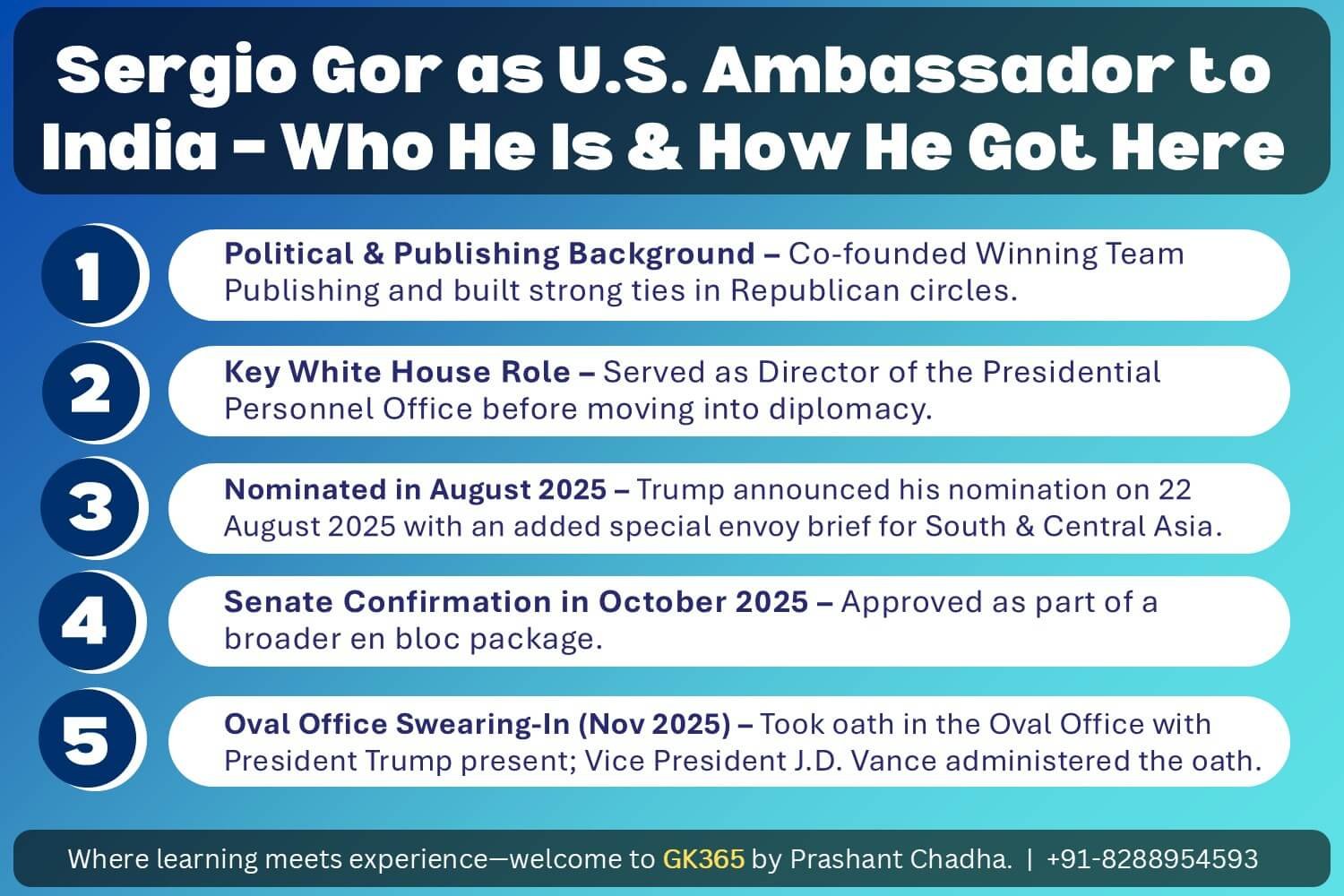
Gor comes from a background in politics and publishing. In 2021 he co-founded Winning Team Publishing with Donald Trump Jr. and built wide links across Republican networks. In 2025 he served as Director of the White House Presidential Personnel Office before shifting into his diplomatic post.
Earlier work placed him on Capitol Hill and on Senator Rand Paul’s staff. Public profiles describe a rapid rise inside Trump’s circle during the 2024 transition and the first part of 2025. His closeness to the President is seen as proof of direct access to the Oval Office — a key asset for his diplomatic role.
Think of Sergio Gor as a political insider who rose through publishing and White House staffing to land one of America’s most important diplomatic posts. His direct line to President Trump means he can potentially fast-track decisions on trade, defense, and visas that usually get stuck in bureaucracy.
📜 Nomination, Confirmation & Swearing-In
President Trump nominated Gor on 22 August 2025. The White House tied the ambassador post to a special envoy brief for South and Central Asia. The Senate approved the nomination in October through a broad en bloc vote.
Gor took the oath in the Oval Office on 10–11 November 2025, with cameras present and prepared remarks by the President on trade and security ties with India. The ceremony aimed to show movement in the bilateral relationship, with Trump stating that a “much different” trade deal with India stood close.
Key Dates: Nominated on 22 August 2025, confirmed in October 2025, sworn in on 11 November 2025. VP J.D. Vance administered the oath in the Oval Office.
🎯 Strategic Priorities Flagged by Gor
During hearings and briefings, Gor set out four main lines of work:
- Indo-Pacific Stability: Keep a stable balance in the region amid rising tensions
- Counter Beijing: Work with India against coercive moves by China
- Security Cooperation: Advance defense ties, including intelligence sharing and co-production
- Trade Barriers: Clear obstacles in trade and investment so flows rise in both directions
These themes match live debates in both capitals. Indian and U.S. officials list similar priorities on recent agendas. At the same time, they continue to clash over tariffs and market access.
The four priorities reveal a balancing act: Washington wants India as a strategic partner against China while also pressing hard on trade. Can Gor maintain both tracks without one undermining the other?
💰 Trade, Tariffs & a Possible Deal
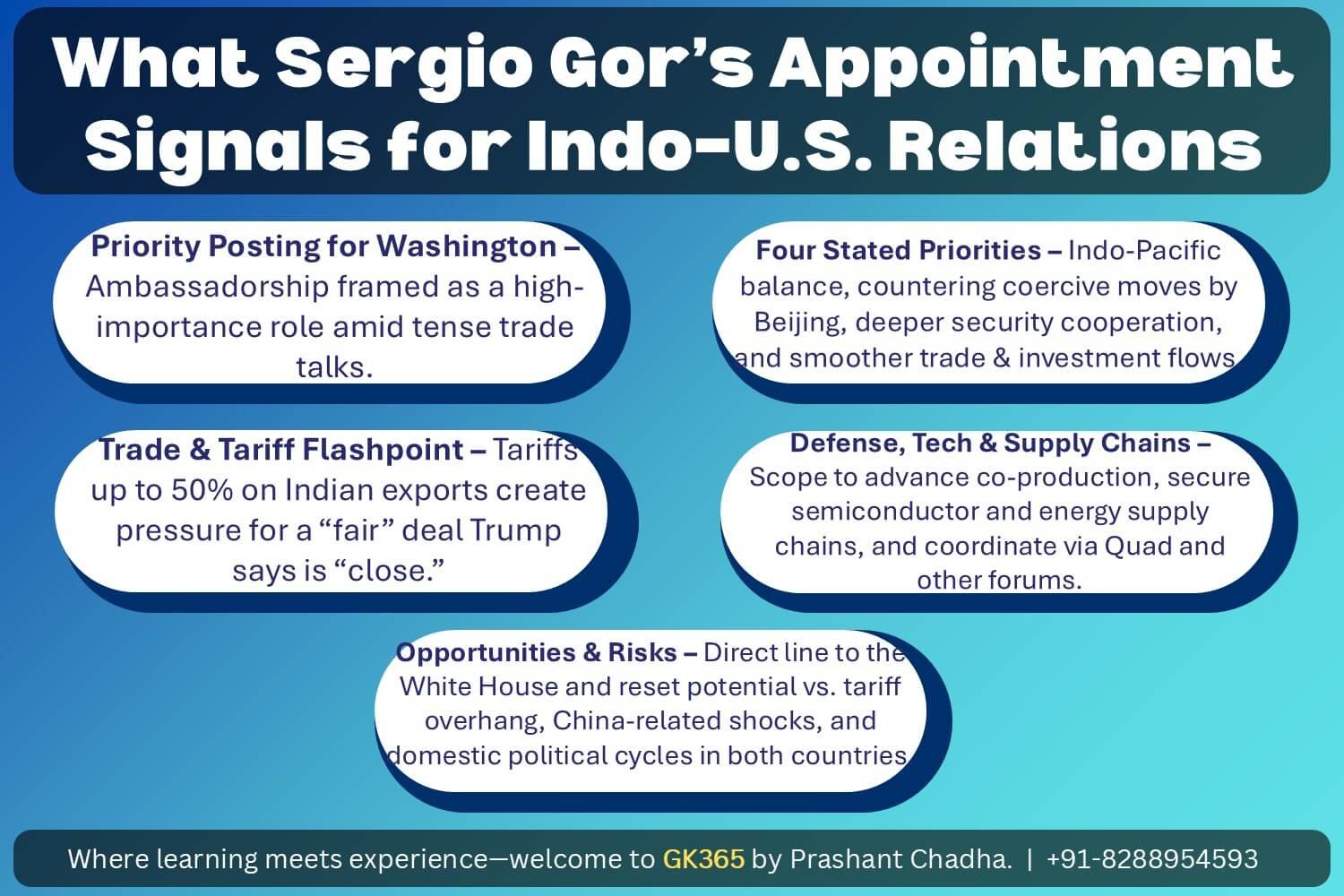
Trade remains the hardest file. In late August, Trump raised tariffs on many Indian exports to 50 percent, and both sides exchanged sharp public statements. The hike hit labor-intensive sectors such as textiles, gems, and seafood.
During the swearing-in, Trump said a “fair” trade deal with India was near and claimed the new agreement would exceed past pacts. He linked energy sales and investment to the negotiations. His remarks came before any final text yet still created near-term expectations.
Gor faces a central test here. He must find what New Delhi can accept on tariffs and standards while holding Washington’s demands. Clear milestones on goods, services, and digital rules will matter.
Don’t confuse: The 50% tariff is the current rate imposed by Trump in August 2025 on Indian exports. The “trade deal” mentioned at the swearing-in is still under negotiation — no final agreement has been signed yet.
| Aspect | Current Challenge | Potential Resolution |
|---|---|---|
| Tariffs | 50% on many Indian exports | Staged reduction via bilateral deal |
| Sectors Hit | Textiles, gems, seafood | Sector-specific relief packages |
| Digital Rules | Data localization disputes | Precise definitions and review clauses |
| Energy Trade | Untapped potential | Linked to broader deal framework |
🛡️ Defense & Intelligence Cooperation
Security ties between the two countries have grown over two decades. The shared agenda now covers maritime domain awareness, joint exercises, and transfers of sensitive technology under several agreements. The added special envoy brief gives Gor scope to coordinate beyond the Delhi embassy across South and Central Asian desks.
New rounds of talks can sit inside existing formats such as the Quad and the U.S.-India Defense Technology and Trade Initiative (DTTI). Speed will sit at the top of this file. India seeks real co-production and prompt delivery. Washington seeks reliable access and joint planning.
Key Frameworks: Quad (US-India-Japan-Australia) and DTTI (Defense Technology and Trade Initiative) are the main platforms for Indo-U.S. defense cooperation.
💻 Technology, Energy & Supply Chains
Both governments speak about secure supply chains in semiconductors, critical minerals, clean energy equipment, and telecom. Recent Indian statements describe outreach to U.S. chipmakers and defense firms, in line with Washington’s reshoring and friend-shoring plans.
An early step can focus on semiconductors. A shared plan can align Indian incentives with U.S. export-control comfort and realistic supplier timelines. A second track can cover grid upgrades and storage projects so that more U.S. energy technology enters Indian markets.
⚖️ Opportunities & Risks
Opportunities:
- Direct White House Access: Gor’s closeness to Trump gives a direct route for faster decisions on trade waivers, export licenses, and defense clearances
- Reset Moment: After months of tariff headlines, both governments share an interest in visible improvement
- People-to-People Links: Student flows, tourism, and consular services shape how the partnership feels on the ground
Risks:
- Tariff Overhang: High duties cast a long shadow over any partial deal and invite skepticism from industry
- China Factor: A sharp incident on the LAC or South China Sea can upset trade or technology talks
- Domestic Cycles: State polls in India and U.S. primary positioning can harden public lines on trade
The appointment raises questions about whether personal access to leadership can overcome institutional friction in diplomacy. How much can one ambassador’s relationship with the President actually change the trajectory of a complex bilateral relationship?
🇮🇳 India’s Initial Response
India’s Ambassador to the United States, Vinay Mohan Kwatra, extended public congratulations through statements and online posts. The message signals New Delhi’s readiness to work with the new envoy even as disputes continue.
Kwatra has served as India’s envoy in Washington since 12 August 2024 after a term as Foreign Secretary. In recent weeks, he has stayed active on trade, defense, and technology meetings in Washington. His outreach gives the U.S. mission in Delhi a counterpart with deep knowledge of India’s system.
Click to flip • Master key facts
For GDPI, Essay Writing & Critical Analysis
5 questions • Instant feedback
Sergio Gor was sworn in on 11 November 2025 in the Oval Office, with VP J.D. Vance administering the oath.
Gor was nominated on 22 August 2025, confirmed by the Senate in October 2025.
Trump raised tariffs on many Indian exports to 50 percent in late August 2025, hitting textiles, gems, and seafood.
Vinay Mohan Kwatra has been serving as India’s Ambassador to the U.S. since 12 August 2024.
Sergio Gor holds the additional role of Special Envoy for South and Central Asia, expanding his scope beyond the Delhi embassy.








