
“Happiness is not about income alone — it reflects well-being, living conditions, and social strength.” — World Happiness Report
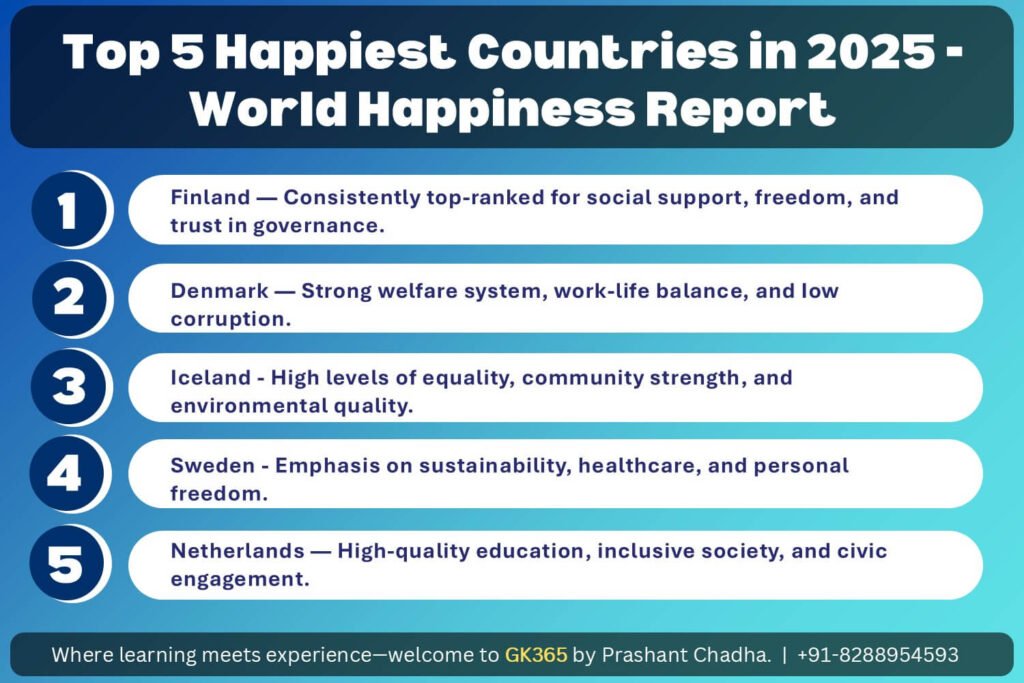
The World Happiness Report 2025, published by the United Nations Sustainable Development Solutions Network, ranks over 150 countries based on life satisfaction, social support, and quality of life indicators. For the seventh consecutive year, Finland has claimed the top spot as the world’s happiest country, followed by fellow Nordic nations Denmark, Iceland, Sweden, and the Netherlands.
This comprehensive guide explores the Top 5 Happiest Countries in 2025, the key factors driving their success, and what other nations can learn from these happiness leaders.
📜 What is the World Happiness Report?
The World Happiness Report is an annual global survey conducted by the United Nations Sustainable Development Solutions Network (UN SDSN). It evaluates and ranks over 150 countries using a comprehensive methodology based on six core indicators that measure quality of life and citizen well-being.
Think of the World Happiness Report like a “report card” for countries — but instead of grades in subjects, it measures how satisfied citizens are with their lives based on income, health, relationships, freedom, generosity, and trust in their government.
The Six Core Indicators:
- GDP per capita: Measures income levels and economic prosperity
- Social support: Evaluates help from friends, family, and institutions
- Healthy life expectancy: Reflects public health systems and lifespan
- Freedom: Tracks people’s ability to make life choices independently
- Generosity: Captures charitable behavior and community support
- Trust (Absence of Corruption): Evaluates government integrity and public confidence
Mnemonic for 6 Indicators: “Good Social Health Frees Generous Trust” — GDP, Social support, Healthy life expectancy, Freedom, Generosity, Trust
📌 Top 5 Happiest Countries in 2025
The World Happiness Report 2025 rankings continue to be dominated by Nordic countries, reflecting their strong social systems, high trust levels, and balanced approach to work-life harmony.
| Rank | Country | Happiness Score | Key Strength |
|---|---|---|---|
| 1 | Finland 🇫🇮 | 7.736 | Trust, Education, Nature Access |
| 2 | Denmark 🇩🇰 | 7.521 | Work-Life Balance, Social Trust |
| 3 | Iceland 🇮🇸 | 7.515 | Safety, Gender Equality |
| 4 | Sweden 🇸🇪 | 7.345 | Sustainability, Freedom |
| 5 | Netherlands 🇳🇱 | 7.306 | Inclusivity, Urban Planning |
Don’t confuse: The World Happiness Report is published by the UN Sustainable Development Solutions Network, NOT by UNDP or UNESCO. Also, remember that Norway and Switzerland are in the Top 10 but NOT in the Top 5 for 2025.
🏆 Finland: The World’s Happiest Country
Finland has topped the World Happiness Report for an unprecedented seven consecutive years. With a happiness score of 7.736, Finland demonstrates that sustainable happiness comes from strong institutions, social equality, and connection with nature.
Why Finland Leads:
- Strong public services: Free healthcare, world-class education, and reliable welfare systems
- Trust in government: High confidence in institutions and legal systems
- Access to nature: 73% forest coverage, low population density, emphasis on outdoor activities
- Education excellence: Finnish education system promotes equality and critical thinking
- Low corruption: One of the least corrupt countries globally
Finland has cold, dark winters and relatively high taxes — factors often associated with unhappiness. Yet Finns consistently rank as the happiest. This challenges the assumption that climate and tax rates determine life satisfaction. Perhaps it’s about what those taxes buy: security, healthcare, and peace of mind.
🌍 Denmark, Iceland, Sweden & Netherlands
Denmark (Rank #2, Score: 7.521)
- Hygge culture: Emphasis on coziness, togetherness, and simple pleasures
- Work-life balance: Average 33-hour work week with 5-6 weeks paid vacation
- Universal welfare: Free healthcare and education eliminate financial anxiety
- Social cohesion: Strong community bonds and neighborhood trust
Iceland (Rank #3, Score: 7.515)
- Safety: One of the lowest crime rates in the world
- Gender equality: Global leader in gender parity for over a decade
- Natural beauty: Volcanic landscapes, geothermal energy, and pristine nature
- Small community: Population of ~380,000 creates tight social bonds
Sweden (Rank #4, Score: 7.345)
- Personal freedom: Strong protection of individual rights and expression
- Sustainability leader: Pioneer in clean energy and environmental policies
- Innovation culture: Home to global companies like Spotify, IKEA, Volvo
- Parental benefits: 480 days of paid parental leave
Netherlands (Rank #5, Score: 7.306)
- Cycling culture: Bike-friendly cities promote health and reduce pollution
- Tolerance and diversity: Society values personal freedom and inclusion
- Pragmatic governance: Efficient public services and low bureaucracy
- Part-time work: World’s highest rate of part-time employment by choice
✨ Why Nordic Countries Dominate Happiness Rankings
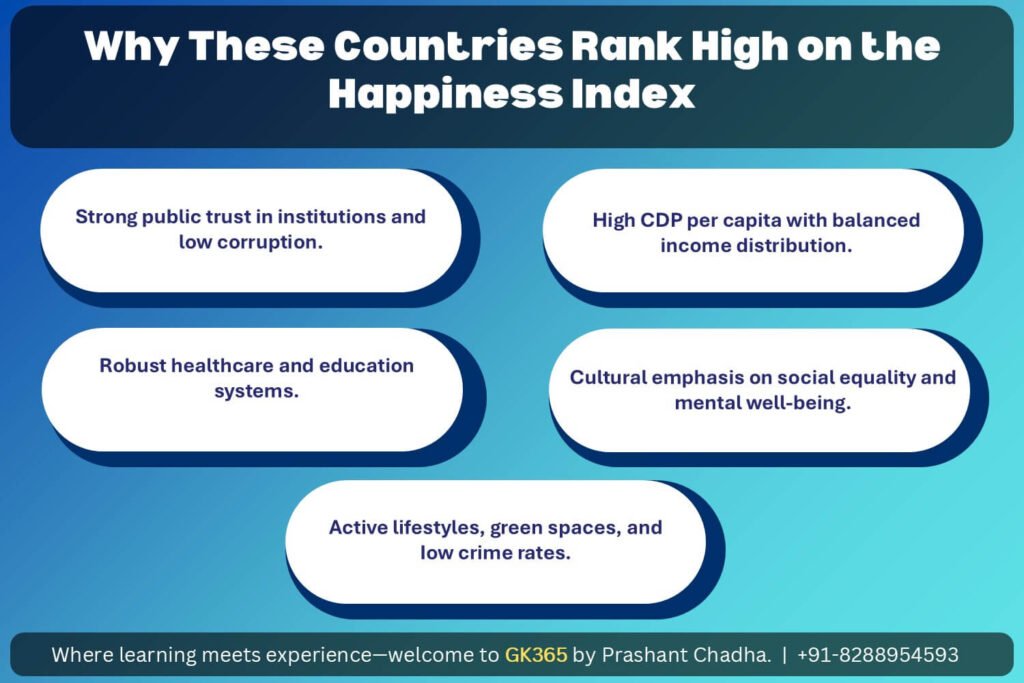
The consistent dominance of Nordic nations in happiness rankings is not coincidental. These countries share a common set of values and policies that create conditions for widespread well-being.
Common Success Factors:
- Comprehensive welfare systems: Healthcare, education, pensions, and unemployment benefits are universal
- High social trust: Citizens trust each other and their institutions
- Low corruption: Transparent governance and accountable leaders
- Work-life balance: Shorter work weeks, longer vacations, flexible arrangements
- Gender equality: High female workforce participation and shared parenting
- Connection to nature: Access to green spaces and outdoor activities
- Equality focus: Low income inequality and social stratification
The “Nordic Model” combines free market capitalism with strong social safety nets. Citizens pay high taxes but receive extensive public services in return — healthcare, education, childcare, and retirement security. This reduces anxiety about life’s basic needs and allows people to focus on personal fulfillment.
⚖️ Global Comparison: USA and India
United States: Despite being the world’s largest economy, the U.S. ranks outside the Top 10 in the 2025 report. Key factors affecting its ranking include high income inequality, healthcare access issues, political polarization, and rising mental health concerns among youth.
India: India ranks significantly lower in the happiness index. Challenges include economic disparities between regions and populations, limited social safety nets, population pressure on resources, and varying quality of public services across states.
| Factor | Nordic Countries | USA / India |
|---|---|---|
| Healthcare | Universal, free | Private/Mixed systems |
| Income Inequality | Low (Gini ~27) | High (Gini ~41+) |
| Work Hours | ~33-35 hrs/week | 40-48+ hrs/week |
| Social Trust | Very high | Moderate to low |
| Paid Leave | 5-6 weeks minimum | Limited/None |
📈 Future Trends in Global Happiness
The World Happiness Report increasingly focuses on emerging factors that will shape future rankings:
- Mental health investment: Countries prioritizing mental healthcare are likely to see ranking improvements
- Climate action: Environmental policies correlate strongly with citizen well-being
- Digital wellness: Managing screen time and social media’s impact on youth happiness
- Youth focus: Separate tracking of young people’s happiness reveals generational differences
- Post-pandemic recovery: Social connections and community rebuilding remain critical
The 2025 report reveals a concerning trend: in many Western countries, youth happiness is declining even as overall national scores remain stable. This suggests that economic growth alone cannot guarantee well-being for future generations. Mental health support, meaningful employment, and climate action are becoming decisive factors.
Click to flip • Master key facts
For GDPI, Essay Writing & Critical Analysis
5 questions • Instant feedback
Finland has been ranked #1 in the World Happiness Report for 7 consecutive years from 2018 to 2025.
The World Happiness Report is published by the United Nations Sustainable Development Solutions Network (UN SDSN), not UNDP, WHO, or UNESCO.
The Top 5 order is: Finland (7.736), Denmark (7.521), Iceland (7.515), Sweden (7.345), Netherlands (7.306). Norway is in the Top 10 but not Top 5.
Trust (absence of corruption) is one of the 6 core indicators. Climate is NOT a direct indicator, though it may indirectly affect happiness.
Denmark ranks 2nd with a happiness score of 7.521 in the World Happiness Report 2025.








