
“Excellence is not a destination but a continuous journey.” — IIT-Madras completes seven years at the top of Indian higher education rankings.
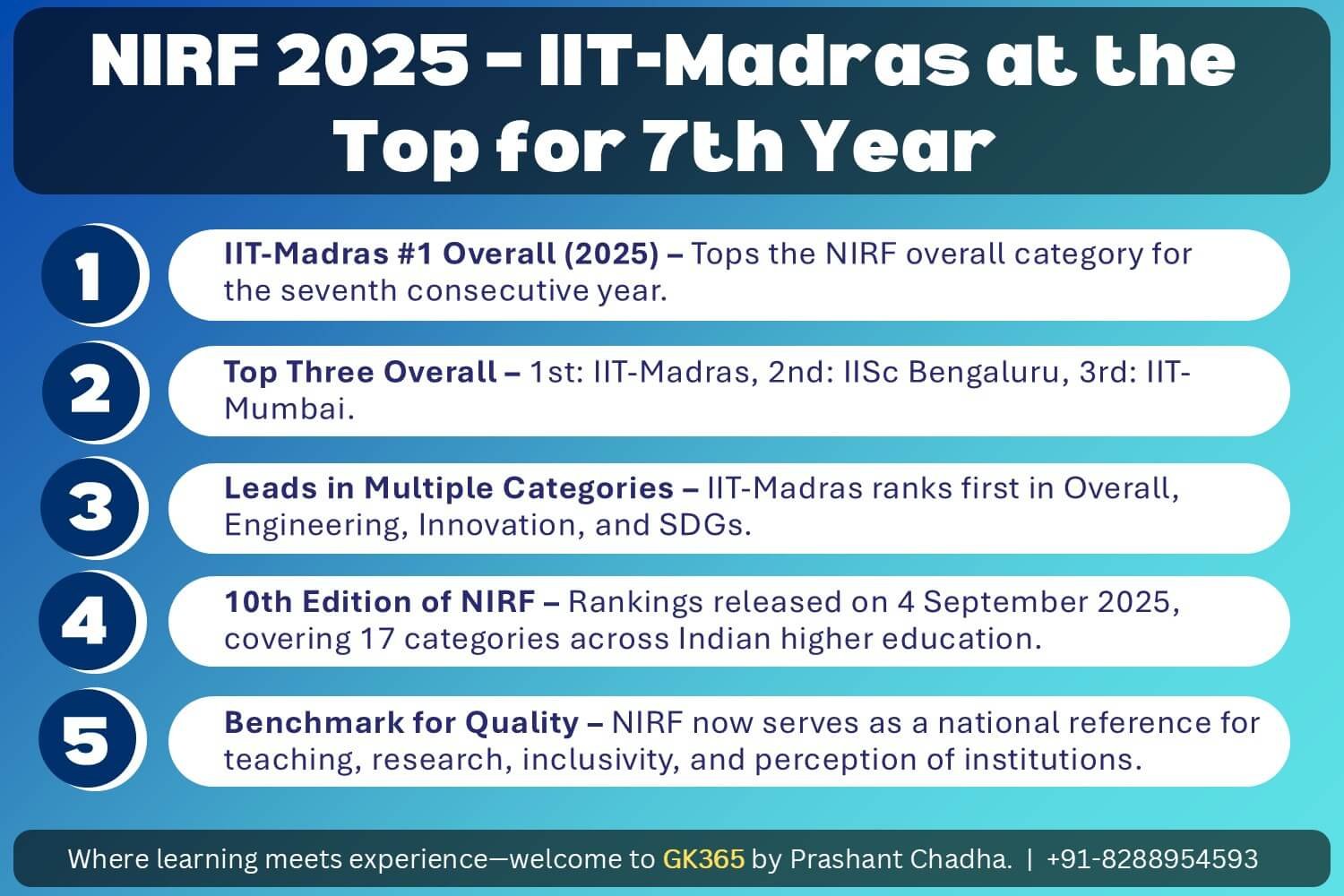
On 4 September 2025, the Ministry of Education released the 10th edition of the National Institutional Ranking Framework (NIRF). IIT-Madras retained its position as India’s top institution in the overall category for the seventh consecutive year — an unprecedented streak that reflects sustained excellence in teaching, research, and innovation.
The 2025 rankings cover 17 categories, including a new addition focused on Sustainable Development Goals (SDGs). This edition marks a decade of NIRF rankings, which have become the definitive benchmark for measuring quality in Indian higher education.
📜 Background of NIRF
The Ministry of Human Resource Development (now Ministry of Education) launched NIRF in 2015. The framework provides a standardized system to compare Indian institutions using transparent, published metrics across teaching quality, research output, inclusivity, and public perception.
Over ten years, NIRF has evolved into the primary reference point for students, parents, recruiters, and policymakers. The 2025 edition marks a decade of rankings, with more institutions participating than ever before — widening the base for comparison across academic streams.
Think of NIRF as a “report card” for colleges and universities. Just as students get grades on different subjects, institutions are scored on teaching, research, placements, diversity, and reputation — then ranked from best to others.
🏆 Overall Top Performers
The top three institutions in the overall category for NIRF 2025 are:
- 1st: IIT-Madras — Leads in teaching, research, innovation, and startup ecosystem
- 2nd: IISc Bengaluru — Premier research institution with world-class doctoral programmes
- 3rd: IIT-Mumbai (Bombay) — Strong engineering and technology centre
IIT-Madras stands out for its consistent performance across all five NIRF parameters. IISc remains the undisputed leader in pure research, while IIT-Bombay maintains its position as a leading centre for engineering innovation.
Top 3 Memory Aid: “MBI” — Madras, Bengaluru (IISc), IIT-Bombay. Remember: M comes first, then B twice!
📌 Category-Wise Toppers

NIRF 2025 covers 17 categories, each recognizing excellence in specialized fields. Here are the toppers across major categories:
| Category | Top Institution | Location |
|---|---|---|
| Overall | IIT-Madras | Chennai |
| Engineering | IIT-Madras | Chennai |
| Innovation | IIT-Madras | Chennai |
| SDGs (New) | IIT-Madras | Chennai |
| Research Institutions | IISc Bengaluru | Bengaluru |
| Medical & Dental | AIIMS Delhi | New Delhi |
| Law | NLSIU Bengaluru | Bengaluru |
| Agriculture | IARI Delhi | New Delhi |
| Management | IIM Ahmedabad | Ahmedabad |
| Pharmacy | Jamia Hamdard | New Delhi |
| Architecture | IIT-Roorkee | Roorkee |
| Colleges | Hindu College | Delhi |
| State Public Universities | Jadavpur University | Kolkata |
| Open Universities | IGNOU | New Delhi |
| Skill Universities | Symbiosis Skills University | Pune |
Do not confuse: IIT-Madras tops 4 categories (Overall, Engineering, Innovation, SDGs), but IISc Bengaluru tops Research Institutions. AIIMS Delhi leads Medical, not any IIT. IIM Ahmedabad leads Management, followed by IIM Bangalore and IIM Kozhikode.
⚙️ Ranking Parameters Explained
NIRF uses five main parameters to evaluate institutions. Each parameter carries a specific weightage:
- Teaching, Learning & Resources (TLR): Faculty quality, student-faculty ratio, academic support, infrastructure
- Research and Professional Practice (RP): Publications, citations, patents, sponsored research
- Graduation Outcomes (GO): Placements, higher studies, median salary, entrepreneurship
- Outreach and Inclusivity (OI): Gender diversity, regional representation, support for disadvantaged groups
- Perception (PR): Peer perception, employer feedback, public image
Education Minister Dharmendra Pradhan suggested adding entrepreneurship as a future parameter. This could reduce the weight on perception scores and reward measurable outcomes like startup creation. Should research-focused institutions be evaluated on startup metrics?
🌟 IIT-Madras: The 7-Year Streak
IIT-Madras has dominated the overall rankings since 2019. The institute’s sustained excellence rests on multiple pillars:
- Research Infrastructure: Hosts India’s first 5G testbed and advanced research centres
- Startup Ecosystem: Incubators and accelerators have produced hundreds of startups
- Sustainability Focus: Leading work on clean energy and climate action — recognized by the new SDG category
- Industry Linkages: Strong collaborations with both Indian and global companies
- Faculty Excellence: High-quality teaching and mentorship programmes
The new SDG category in 2025 further highlights IIT-Madras’s commitment to sustainable development, reinforcing its position at the apex of Indian higher education.
🇮🇳 Vision: Viksit Bharat 2047
Education Minister Dharmendra Pradhan linked the NIRF rankings to the vision of “Viksit Bharat 2047” — India as a developed nation by its centenary of independence. Key policy directions include:
- One Nation, One Data: Creating a unified, reliable database of education statistics across India
- Entrepreneurship Focus: Future NIRF cycles may include startup creation as a parameter
- SDG Integration: The new SDG category reflects changing priorities in higher education
- Global Competitiveness: Push for Indian institutions to climb international rankings
🌍 Challenges in Indian Higher Education
Despite NIRF successes, Indian higher education faces significant challenges:
- Faculty Shortages: Public universities report persistent vacancies in teaching positions
- Research Funding Gap: Elite institutions receive disproportionate funding compared to the wider system
- Urban-Rural Divide: Access gaps remain between metropolitan centres and rural regions
- Global Rankings: Indian institutions need stronger international partnerships and exchanges
NIRF provides a roadmap for improvement, but systemic reforms are needed to translate rankings into broader educational transformation.
The tension between elite institutions and the broader higher education system is a key debate. Should resources be concentrated in top-ranked institutions, or distributed more equitably? How can NIRF incentivize quality improvement across all tiers?
Click to flip • Master key facts
For GDPI, Essay Writing & Critical Analysis
5 questions • Instant feedback
NIRF 2025 was released on 4 September 2025 by the Ministry of Education. This is the 10th edition of the rankings.
IISc Bengaluru tops the Research Institutions category. IIT-Madras tops Overall, Engineering, Innovation, and SDGs.
TLR stands for Teaching, Learning & Resources — covering faculty quality, student-faculty ratio, and infrastructure.
NLSIU (National Law School of India University) Bengaluru has consistently topped the Law category in NIRF rankings.
IIT-Madras has topped the overall NIRF rankings for 7 consecutive years, starting from 2019.








