
“Literacy must lead to empowerment and self-reliance, not just higher counts on paper.” — Dharmendra Pradhan, Union Education Minister, on International Literacy Day 2025
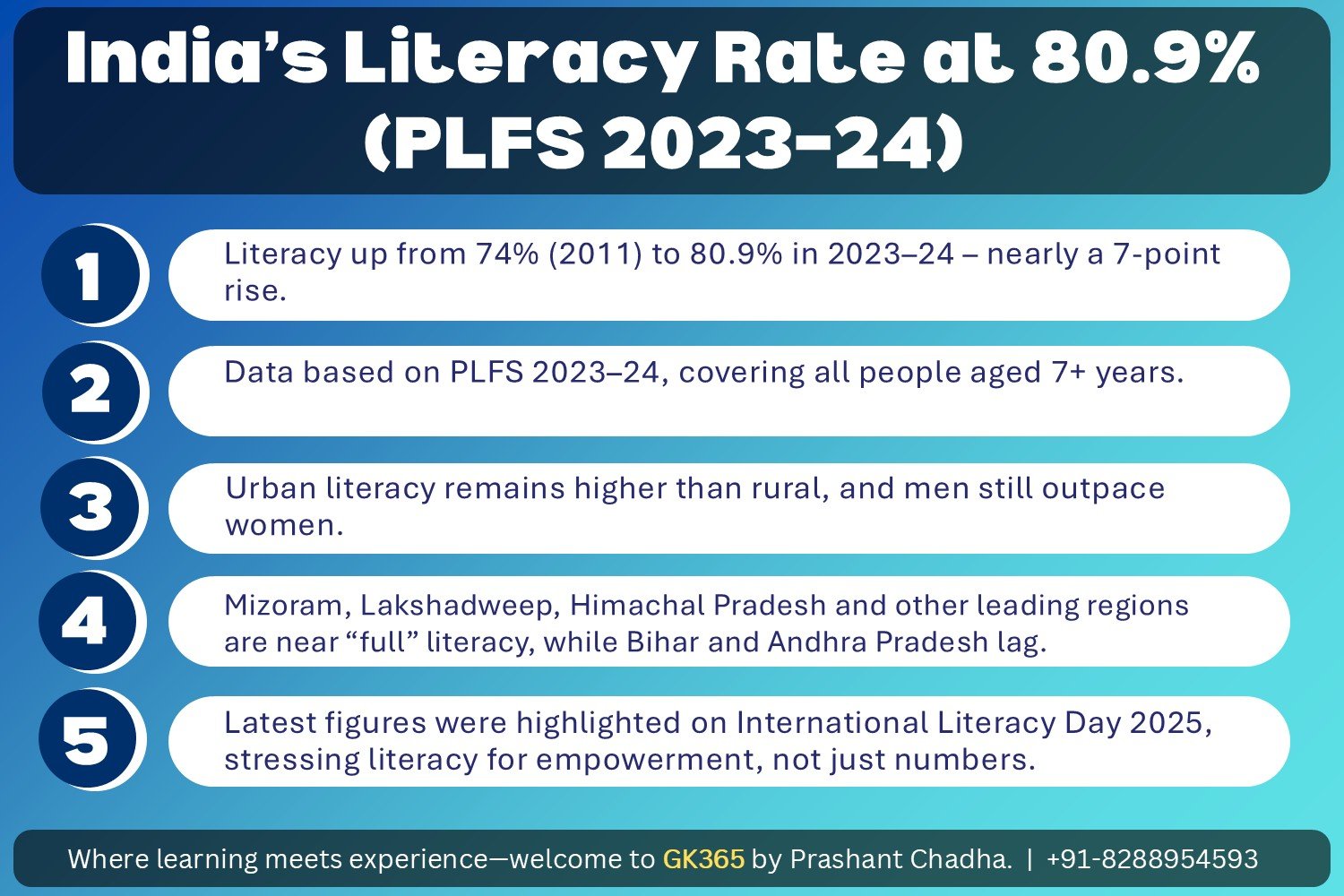
India’s literacy rate has climbed to 80.9% according to the Periodic Labour Force Survey (PLFS) 2023–24, up from 74% in the 2011 Census. This represents a gain of nearly 7 percentage points over a decade. Union Education Minister Dharmendra Pradhan announced the new figure on International Literacy Day 2025 (September 8). The rise is powered by ULLAS – Nav Bharat Saaksharta Karyakram, the national adult literacy programme running from 2022 to 2027.
📚 ULLAS: The National Literacy Programme
ULLAS – Nav Bharat Saaksharta Karyakram (New India Literacy Programme) is the main national programme for adult literacy, running from 2022 to 2027. It is a centrally sponsored scheme covering all non-literate adults aged 15 and above.
The scheme funds five components:
- Foundational Literacy and Numeracy (FLN) — Basic reading, writing, and arithmetic
- Critical Life Skills — Financial, legal, and digital awareness
- Basic Education — Equivalence to formal schooling
- Vocational Skills — Employment-oriented training
- Continuing Education — Lifelong learning pathways
The approved outlay stands at ₹1,037.90 crore. Learning content is available in 26 languages with more than 100 primers prepared by NCERT and CIIL.
Think of ULLAS as a “literacy mission” that uses an app, volunteers, and local-language primers to teach adults who missed formal schooling. Anyone can sign up on the ULLAS app, learn from volunteer teachers, and take a test called FLNAT to get certified. It’s like a nationwide adult education campaign powered by smartphones.
📈 Scale and Outcomes of ULLAS
By late May 2025, the Ministry reported impressive participation figures:
- 2.40 crore registered learners on the ULLAS app and portal
- 41 lakh volunteer teachers registered
- 1.77 crore learners appeared in FLNAT by May 30, 2025
- ~1.82 crore test appearances across 33 states and UTs by ILD 2025
- ~90% pass rate in the Foundational Literacy and Numeracy Assessment Test (FLNAT)
This shows broad participation and strong completion rates, indicating that the programme is delivering measurable outcomes.
FLNAT = Foundational Literacy and Numeracy Assessment Test — the certification exam under ULLAS. Around 90% of learners who appear in FLNAT pass the test, showing the programme’s effectiveness.
🏆 Fully Literate States & UTs
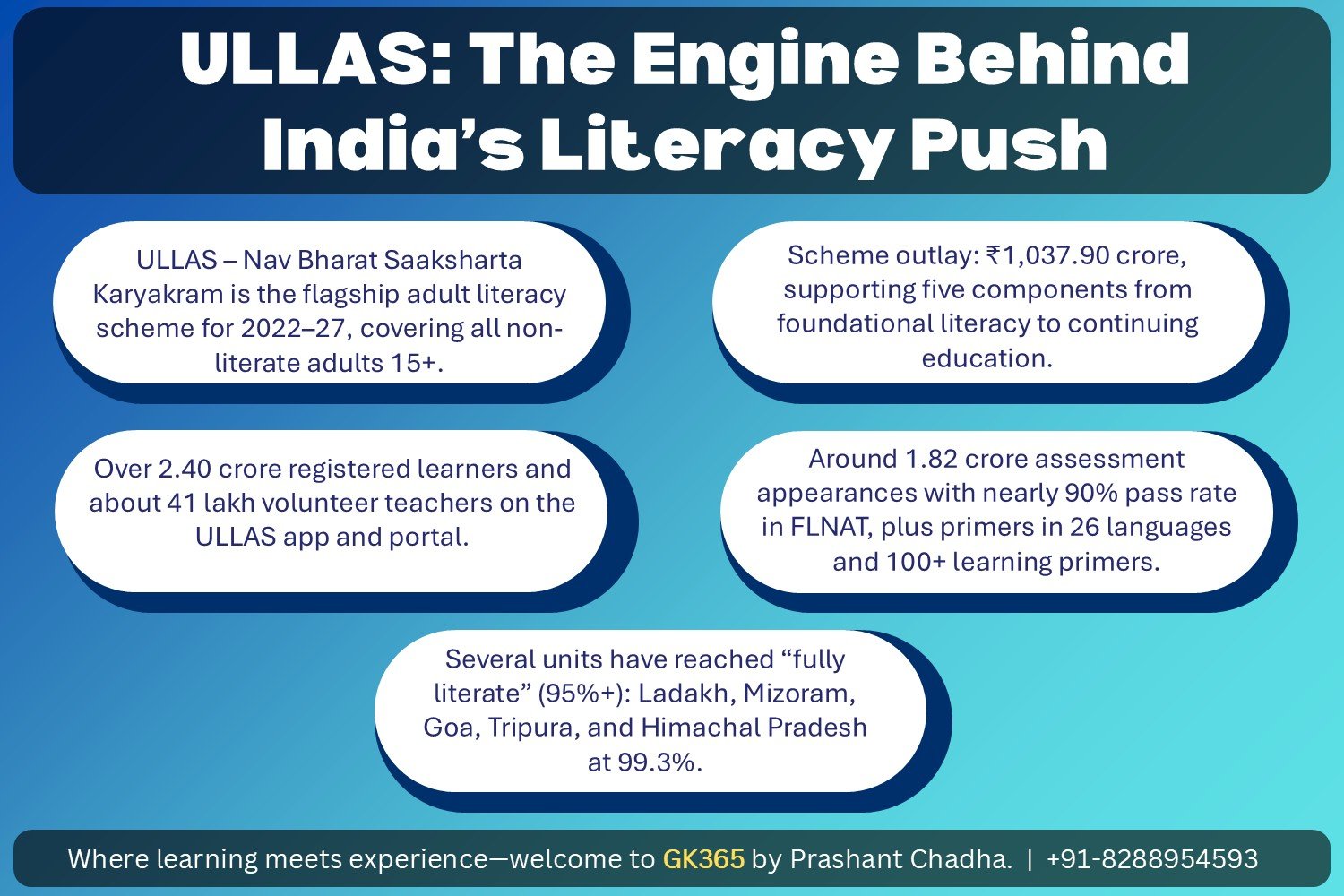
Under ULLAS, “fully literate” status means at least 95% functional literacy in the unit. Five states/UTs have achieved this milestone:
| State/UT | Date Declared | Literacy Level |
|---|---|---|
| Ladakh | June 24, 2024 | 95%+ (First to achieve) |
| Mizoram | May 20, 2025 | 95%+ |
| Goa | May 30, 2025 | 95%+ |
| Tripura | June 23, 2025 | 95%+ |
| Himachal Pradesh | September 8, 2025 | 99.3% |
Himachal Pradesh reached 99.3% literacy — rising from just 7% at Independence. The state achieved this through decades of focus on rural schools and access for remote areas. What lessons can Bihar and Andhra Pradesh (which lag behind) learn from Himachal’s journey?
⚠️ Gaps That Still Need Work
Despite the progress, significant disparities remain:
- Rural-Urban Gap: Urban literacy stands well above rural literacy
- Gender Gap: Men have higher literacy rates than women
- State Disparities: Mizoram and Lakshadweep are near the top; Bihar and Andhra Pradesh lag behind
- Tribal Areas: States with large rural and tribal populations face greater challenges
These gaps should guide targeted interventions and resource allocation between 2025 and 2027.
Don’t confuse: The 80.9% figure is from PLFS 2023–24 (for age 7+), NOT from a Census. The last Census literacy figure was 74% in 2011. PLFS is an annual survey by the Ministry of Statistics, while Census is conducted every 10 years.
🚀 What Drove the Rise Since 2011?
Three forces drove the rise from 74% in 2011 to 80.9% in 2023–24:
- ULLAS Programme: Brought millions of learners and volunteers into a structured course ending with FLNAT certification
- State-Level Campaigns: Local drives aligned with the national plan helped Ladakh, Mizoram, Goa, Tripura, and Himachal Pradesh cross the 95% bar
- Digital Platforms: Low-cost smartphones and the ULLAS app reduced friction in registration, learning, and testing
💻 Digital Literacy & ILD 2025 Theme
International Literacy Day 2025 (September 8) carries the theme “Promoting Literacy in the Digital Era”.
At the main event, Minister of State Jayant Chaudhary spoke about digital skills and their link with reading and writing. He underlined the role of India’s public digital platforms in faster access to learning and services.
The theme fits the current push to add basic financial skills and digital skills to core literacy courses, making literacy more relevant for the modern economy.
🎯 Policy Priorities for 2025–27
The next two years will shape whether India can move from 80.9% to near-universal literacy:
- Target Bottom Quartile Districts: Channel funds to blocks with widest rural and gender gaps
- Women’s Participation: Anchor literacy centres in SHGs and anganwadi hubs; provide childcare during classes
- Raise Standards: Add digital skills, money-management modules, and health-literacy to the 95% bar
- District FLNAT Dashboards: Publish pass rates and repeat-test data for accountability
- Language Coverage: Connect each primer with audio versions for low-literacy households
- Share State Models: Replicate Ladakh, Tripura, and Goa success stories in similar regions
Click to flip • Master key facts
For GDPI, Essay Writing & Critical Analysis
5 questions • Instant feedback
India’s literacy rate is 80.9% according to PLFS 2023-24, up from 74% in Census 2011.
ULLAS stands for Nav Bharat Saaksharta Karyakram (New India Literacy Programme), running from 2022 to 2027.
Ladakh was the first UT to be declared fully literate (95%+ functional literacy) on June 24, 2024.
ULLAS has 5 components: Foundational Literacy, Life Skills, Basic Education, Vocational Skills, and Continuing Education.
Himachal Pradesh has achieved 99.3% literacy rate, the highest among the fully literate states and UTs.








