
Table of Contents
1. Introduction
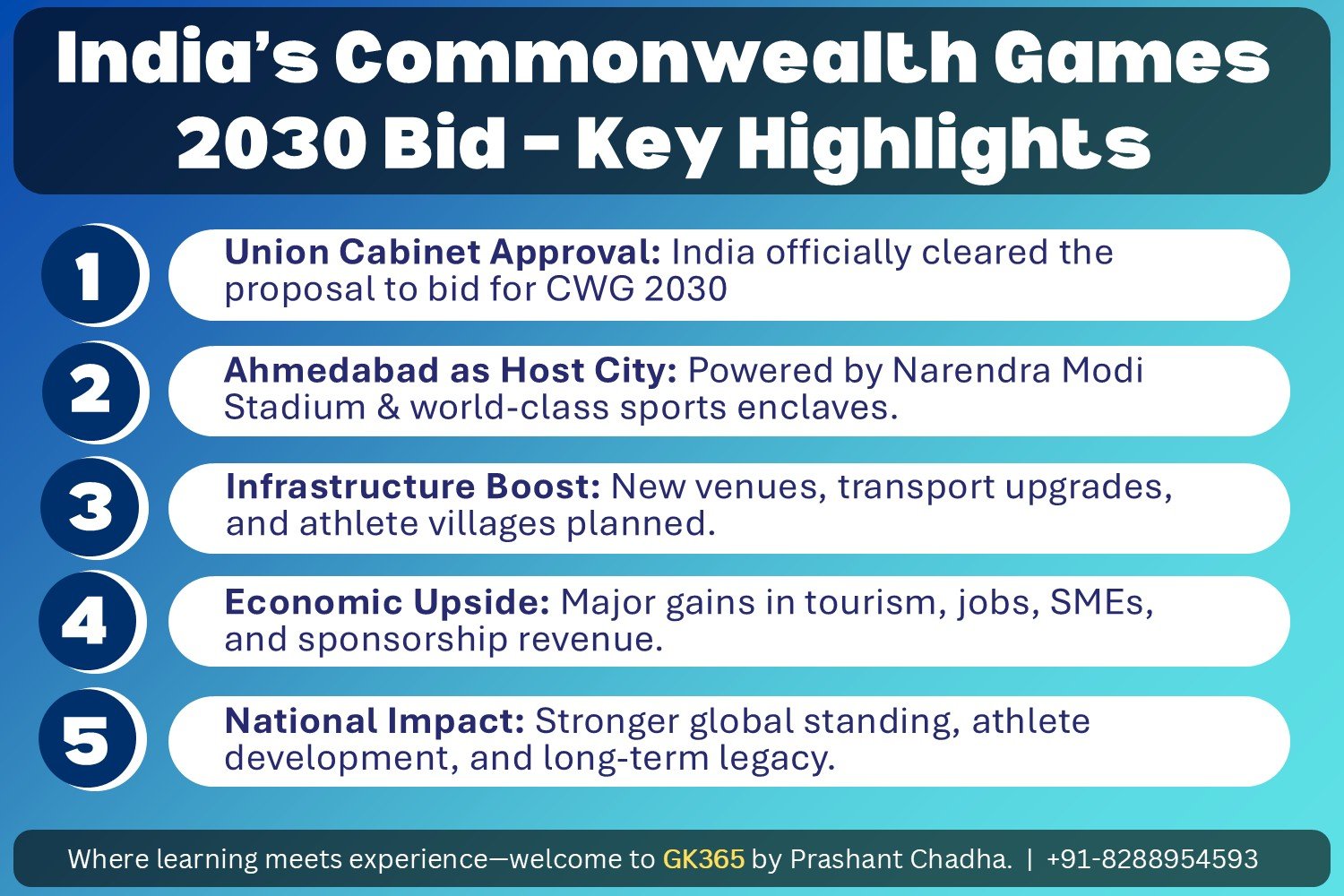
India has taken a clear step toward a larger role in global sport. In August 2025, the Union Cabinet chaired by Prime Minister Narendra Modi approved a proposal to submit India’s bid for the 2030 Commonwealth Games (CWG). The Ministry of Youth Affairs and Sports placed this proposal before the Cabinet.
The move goes far beyond routine event planning. It signals ambition in sport, infrastructure, and economic strength. It offers India a chance to show its capacity on an international stage.
The Commonwealth Games bring together athletes from 72 countries. A successful bid will draw thousands of competitors, coaches, officials, journalists, and fans to India. The event can reshape the sports ecosystem, speed up urban growth, and open new opportunities across sectors linked to the Games.
2. Union Cabinet Approval and Policy Framework
The Union Cabinet’s approval covers the core requirements for a global multi-sport event. The decision allows the signing of the Host Collaboration Agreement with the Commonwealth Games Federation. It also includes government guarantees that involve central ministries, departments, and state authorities.
Financial support forms a key part of this framework. The central government has cleared a grant-in-aid for the Gujarat government. The state will carry out the main projects if the bid succeeds. This division of roles links national-level policy with state-level delivery.
India used a similar model for earlier events such as the 2010 Commonwealth Games in Delhi and the 2023 ICC Cricket World Cup. The 2030 plan builds on that experience.
3. Why Ahmedabad was Chosen as the Host City
The government chose Ahmedabad as the main host city after steady growth in its urban systems. The city has expanded in planned housing, transport, and public services. It connects well with other parts of India and the world.
The centerpiece of the bid is the Narendra Modi Stadium. It is the largest cricket stadium in the world, with a capacity of over 130,000 spectators. It has already staged major fixtures, including the 2023 ICC Cricket World Cup final.
Ahmedabad also has the Sardar Vallabhbhai Patel Sports Enclave and several training centers. These sites can support a wide range of CWG sports. The city benefits from strong road networks, a metro system, and an international airport that links it to key hubs.
4. Lessons from Commonwealth Games 2010 in New Delhi
India has earlier experience as a CWG host. New Delhi staged the 2010 edition, which was the largest multi-sport event held in India at that time.
Key Highlights of CWG 2010
- More than 6,000 athletes from 71 nations took part.
- The Games featured 17 sports and 272 medal events.
- The Jawaharlal Nehru Stadium served as the main venue, along with sites such as the Indira Gandhi Indoor Stadium and Talkatora Stadium.
- India recorded its best medal haul in CWG history, with 101 medals in total. The tally included 38 gold, 27 silver, and 36 bronze. The country finished second on the table after Australia.
- The event upgraded stadiums, added new housing, and supported expansion of the Delhi Metro.
Lessons for CWG 2030
The 2010 Games faced strong criticism on some fronts. Costs rose far beyond early estimates and reached more than ₹70,000 crore. Allegations of weak management and last-minute construction led to public debate on planning and oversight.
For 2030, the government aims to apply these lessons. Stronger project management, transparent contracts, and steady monitoring will matter at every stage. The plan also stresses long-term use of each facility. Timely completion and clean execution can create a legacy stronger than that of 2010.
5. Infrastructure Readiness and Sports Facilities
A successful CWG demands a full network of venues, not just one main stadium. Gujarat will need competition and training sites for athletics, swimming, hockey, wrestling, weightlifting, badminton, squash, and more. Ahmedabad’s sports enclave aims to meet many of these needs. Plans include an indoor arena, an aquatics complex, and multi-sport halls.
The bid will require new or upgraded transport links, athlete villages, and digital systems. These assets will stay in use after 2030. Local athletes can train at world-class facilities. Future national and international events can use the same infrastructure.
Experience with earlier mega-events shows that careful planning can support sport in a region for many years. Poor planning, in contrast, leaves venues underused. The CWG 2030 plan leans toward long-term community use and steady maintenance.
6. Expected Economic Impact
Boost to Tourism
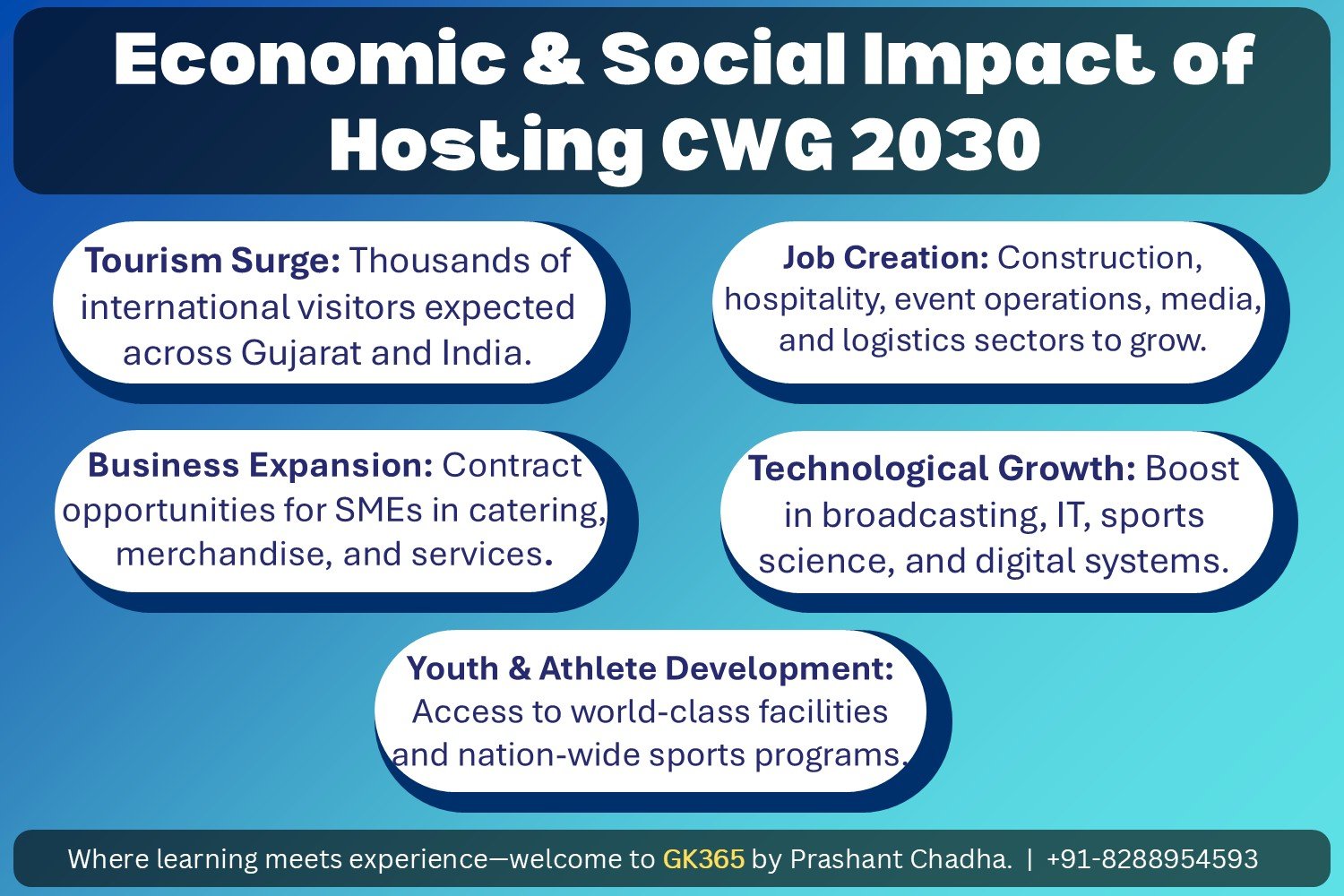
Mega sporting events attract visitors from across the globe. The 2030 Commonwealth Games are expected to draw tens of thousands of tourists to Ahmedabad, Gandhinagar, Vadodara, and other nearby centers.
Hotels, guest houses, restaurants, and local shops will see higher demand. Many visitors will plan trips that extend beyond the Games. They can travel to Rajasthan, Delhi, Goa, and other Indian destinations. This flow of visitors brings higher foreign exchange earnings and wider exposure for Indian culture and heritage.
Job Creation and Business Growth
Large events create jobs before, during, and after the competition period. Construction linked to stadiums, training centers, and transport projects will employ thousands of workers. These roles cover skilled and unskilled labor.
During the Games, organizers will need staff for security, transport, hospitality, translation, and venue operations. Local supply chains for food, uniforms, and equipment will grow.
Small and medium enterprises can secure contracts in catering, merchandise, logistics, and maintenance. Many of these firms can keep the new capacity once the Games end, which supports wider business growth.
Revenue from Media and Sponsorships
Broadcasting and sponsorship drive much of the money in modern sport. Television rights and digital streaming deals for CWG 2030 will target a global audience. India’s large viewer base gives the event special commercial strength.
Prime-time slots for athletics, cricket, and other popular sports will attract high advertising rates. National and international brands from banking, telecom, IT, and consumer goods will compete for visibility during the Games. This mix can create strong revenue streams for organizers and partners.
7. Opportunities Beyond Sports
Sports Science and Research
The CWG bid can deepen India’s work in sports science. High-performance centers will need biomechanics labs, physiotherapy units, and recovery zones. These tools can raise athletes’ performance and reduce risk of injury.
Universities and research institutes in Gujarat can link up with experts from other countries. Joint projects can focus on sports medicine, nutrition, recovery, and human performance. These efforts will stay relevant long after 2030 and will support athletes in many disciplines.
Event Management and Logistics
A multi-sport event on this scale tests every part of event management. Organizers must plan accommodation, transport, and security for thousands of athletes and officials. Volunteer training will cover guest services, venue support, and basic protocol.
Indian firms that work on CWG 2030 will gain deep experience in scheduling, risk management, and crowd flow. They can then apply this knowledge to domestic leagues, concerts, and future international events.
Broadcasting, IT, PR, and Communications
The Games will produce thousands of hours of live and recorded content. Media teams will handle filming, editing, commentary, and highlight packages. Technology partners will set up systems for ticketing, match schedules, accreditation, and crowd control.
Public relations and communication teams will present India as a strong host for sport and tourism. These fields will open roles for skilled professionals in journalism, production, design, data, and communication strategy.
8. Impact on Indian Athletes and Youth
A home Commonwealth Games offers clear benefits for Indian athletes. They can compete on familiar tracks, fields, and courts. Home support in the stands can lift performance.
The 2010 Delhi Games showed this effect. India recorded 101 medals, including 38 golds. This remains the country’s best CWG tally.
The 2030 Games can reach far beyond elite sport. School programs linked to the event can promote athletics, swimming, hockey, wrestling, and other sports. Community initiatives can highlight fitness, fair play, and regular training. Many children who watch or attend the Games may pick up a sport for life. Some of them may become national players in later years.
9. National Pride and Global Standing
Large sports events shape how a country sees itself and how others see it. Hosting CWG 2030 would show India as a confident and capable organizer of complex tournaments. It would strengthen India’s case for future bids, including any long-term Olympic goal.
The Games can give citizens shared moments of pride. People from different regions, languages, and backgrounds will cheer the same flag and the same athletes. For a diverse country, such experiences support unity and common purpose.
10. Long-Term Legacy of Hosting CWG 2030
The influence of CWG 2030 will extend beyond the competition period. Key legacy outcomes can include:
- Upgraded roads, transport links, power networks, and sports venues that serve daily life and future events.
- A stronger global profile for Gujarat, which can draw conferences, exhibitions, and other sports events.
- Growth of India’s sports economy, with higher values for sponsorships, leagues, merchandising, and broadcast rights.
- Wider access to sport for women, children, and young people from rural regions, through targeted programs and facilities.
Careful planning can prevent underused venues or wasted spending. Each new facility can have clear roles for community use, high-performance training, and future tournaments.
11. Challenges and Preparations Ahead
Large events always bring risks. CWG 2030 will demand focused effort on several fronts:
- Cost Management: Mega-events often cross early budget limits. Clear budgets, open bidding, and regular audits can reduce strain on public funds.
- Timely Construction: Stadiums, training sites, roads, and athlete villages must be ready well before 2030. Delays can affect test events and can harm India’s image as a host.
- Security: The safety of athletes, officials, and spectators will sit at the center of planning. State and central agencies must work to a common plan, with clear lines of command.
- Sustainability: Large-scale construction and energy use can place stress on the environment. Plans can favor green buildings, efficient public transport, and careful waste management.
Strong attention to these areas will shape how CWG 2030 is judged in future years.
12. Conclusion
India’s decision to bid for the 2030 Commonwealth Games marks a key point in its rise in global sport. Ahmedabad stands at the heart of this vision, with major venues and growing urban capacity.
The Union Cabinet’s approval shows clear political backing and financial commitment. The 2010 New Delhi Games provided both high points and sharp lessons. The 2030 project can draw strength from that record through better planning, tighter control of costs, and a sharper focus on long-term use.
If the bid gains acceptance, India will host a major international festival of sport. The Games can inspire young people, create jobs, and deepen India’s global presence. The year 2030 can then stand out as a landmark in the country’s sporting and economic story.
Below is the complete output following your required structure — Infographics, Key Takeaways Table, and SEO Tags — based entirely on the provided article “India’s Bid to Host Commonwealth Games 2030”.
_______________________________________
Key Takeaways Table
| Aspect | Details |
|---|---|
| Government Decision | Union Cabinet approved India’s bid for CWG 2030, with central–state collaboration. |
| Host City Selection | Ahmedabad chosen due to strong infrastructure, Narendra Modi Stadium, and sports enclaves. |
| Lessons From 2010 CWG | Emphasis on better planning, cost control, timely construction, and transparency. |
| Infrastructure Development | New stadiums, aquatics centers, athlete villages, and upgraded transport systems planned. |
| Economic Impact | Major gains expected through tourism, jobs, SMEs, media rights, and sponsorship revenue. |
| Opportunities Beyond Sports | Growth in sports science, logistics, broadcasting, IT, PR, and event management sectors. |
| Youth & Athlete Benefits | Improved training facilities, sports participation, and national performance potential. |
| National & Global Standing | Strengthens India’s sporting reputation and future Olympic hosting potential. |
| Long-Term Legacy | Enhanced infrastructure, stronger sports economy, community access, and global visibility. |