
“Roads must serve people and protect nature too.” — The guiding principle behind India’s first wildlife overpass corridor
The National Highways Authority of India (NHAI) has built the country’s first wildlife overpass corridor on the Delhi-Mumbai Expressway. The 12-kilometre stretch runs through the buffer zone of the Ranthambore Tiger Reserve. This project combines modern road design with wildlife conservation goals.
The corridor includes five large overpasses, India’s longest wildlife underpass, and several other eco-friendly features. These help animals move freely across the landscape without interference from traffic. The design also reduces human-animal conflict in protected areas and reflects India’s shift toward sustainable infrastructure.
🌉 What is a Wildlife Overpass and Why is it Important?
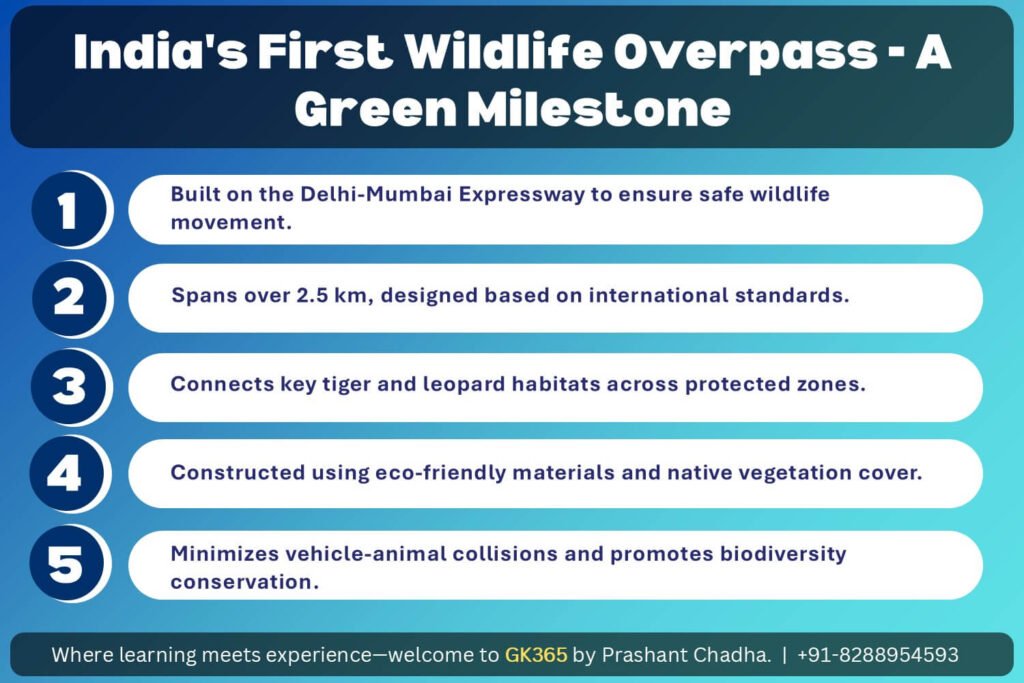
A wildlife overpass is a bridge made for animals to safely cross roads. These structures help prevent animal deaths and keep their habitats connected. Most are covered with plants and trees to resemble natural surroundings.
Countries like Canada, the Netherlands, and the United States have already adopted this model with success. India is now beginning to follow their lead with the Delhi-Mumbai Expressway project.
Think of a wildlife overpass as a “green bridge” for animals. Just like humans use bridges to cross rivers, animals use these vegetated overpasses to cross highways safely. The bridge looks and feels like their natural forest, so they use it instinctively.
📰 Why is This Project in the News?
This is the first time a national expressway in India has been planned with wildlife protection at its center. The Delhi-Mumbai Expressway, which passes near the Ranthambore Tiger Reserve, now sets an example for other infrastructure efforts.
As roadkill and habitat encroachment increase across India, this project shows how development can respect the environment. Camera evidence has already captured tigers and bears using the corridor safely.
First in India: This is India’s first dedicated wildlife overpass corridor on a national expressway. The 1.2 km underpass is also India’s longest wildlife underpass.
✨ Key Features of the Delhi-Mumbai Wildlife Corridor
The corridor incorporates multiple design elements to ensure safe animal passage:
- Wildlife Segment: 12 km through the Ranthambore buffer zone
- Overpasses: 5 vegetated bridges, each 500 metres long
- Underpass: 1.2 km — India’s longest wildlife underpass
- Terrain Fit: 5 km of sunken or raised road to match land contours
- Safety Barriers: 4-metre-high walls and 2-metre sound barriers
- Camera Evidence: Tigers and bears recorded using the route
| Feature | Specification | Purpose |
|---|---|---|
| Overpasses | 5 units, 500m each | Safe crossing for large mammals |
| Underpass | 1.2 km (longest in India) | Passage for smaller animals |
| High Walls | 4 metres | Prevent animals entering highway |
| Sound Barriers | 2 metres | Reduce noise disturbance |
| Terrain-Sensitive Road | 5 km stretch | Minimize landscape disruption |
🌿 Environmental and Eco-Friendly Measures
Beyond the overpasses and underpasses, the project includes several green initiatives:
- Natural Terrain Use: Overpasses follow the natural shape of the land
- Tree Planting: 35,000+ trees planted along the corridor
- Rainwater Storage: Harvesting systems built along the route
- Modular Building: Prefabricated construction reduced waste
- Wildlife Safety: Low-glare lights and noise barriers installed
The corridor shows that infrastructure and conservation need not be enemies. Could this model be applied to other ecologically sensitive zones like the Western Ghats or Northeast India?
🎯 Objectives and Long-Term Impact
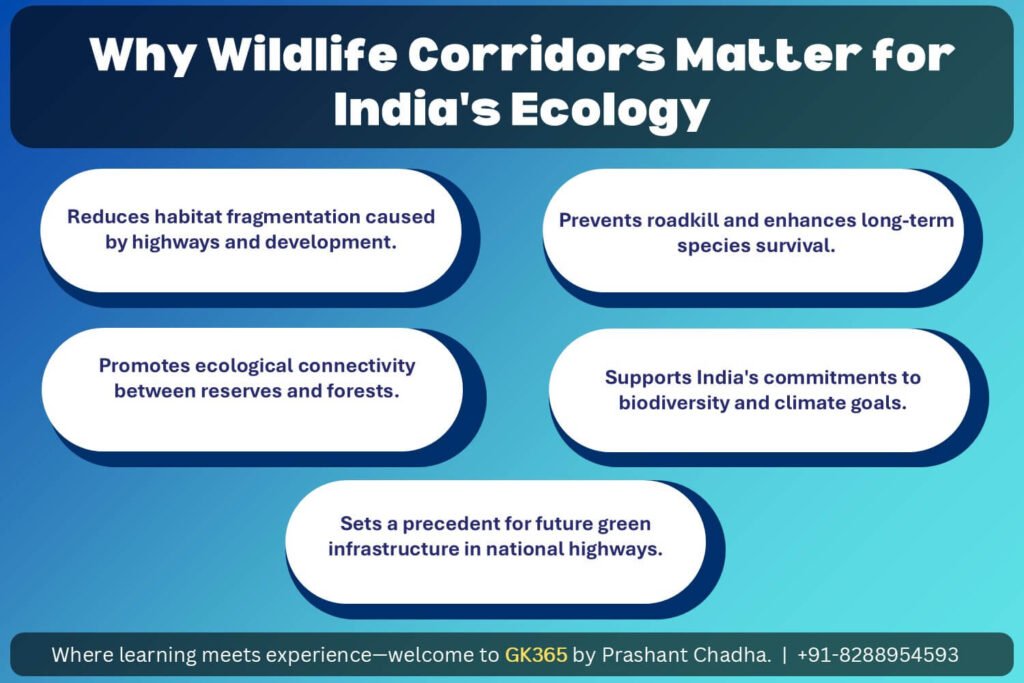
The project aims to achieve multiple conservation and infrastructure goals:
- Help tigers, leopards, and bears move between Ranthambore and the Chambal Valley
- Reduce road accidents involving animals
- Demonstrate how roads can be built without harming wildlife
- Support global efforts like the UN Sustainable Development Goals
By connecting two major ecosystems, the corridor ensures genetic diversity among wildlife populations and reduces isolation of animal groups.
🛣️ India’s Shift Toward Wildlife-Friendly Highways
This is not an isolated case. Other states are taking similar steps toward eco-sensitive road construction:
- Punjab: Planning an urban wildlife corridor on the Zirakpur bypass
- Maharashtra: Samruddhi Mahamarg has 209 animal underpasses and 8 overpasses
- Future Plans: Projects in Madhya Pradesh and Karnataka are in progress
This marks a fundamental shift in how India approaches highway construction in ecologically sensitive areas.
Don’t confuse: The Delhi-Mumbai Wildlife Corridor (first wildlife overpass on national expressway) with Samruddhi Mahamarg (has more underpasses but is not specifically a “wildlife corridor”). The Delhi-Mumbai project is unique for its integrated approach.
🌍 Global Examples of Wildlife Corridors
India joins a growing list of countries that prioritize wildlife-friendly infrastructure:
- Canada: Banff National Park has both overpasses and underpasses — one of the most successful models globally
- Netherlands: Over 600 wildlife crossings for animals from frogs to deer
- USA: California’s new overpass aims to protect endangered mountain lions
Click to flip • Master key facts
For GDPI, Essay Writing & Critical Analysis
5 questions • Instant feedback
The Delhi-Mumbai Wildlife Corridor passes through the buffer zone of Ranthambore Tiger Reserve in Rajasthan.
There are 5 wildlife overpasses, each 500 metres long, as part of this corridor.
India longest wildlife underpass is 1.2 km, built as part of this project.
The National Highways Authority of India (NHAI) implemented this project.
Over 35,000 trees have been planted along the corridor as part of environmental restoration.








