
📰 NATIONAL

India’s First Wildlife Overpass Corridor

📑 Table of Contents Introduction What is a Wildlife Overpass? Why is This in the News? Key Features of the Corridor Environmental Measures Objectives & Long-Term Impact India's Wildlife-Friendly Highway...

⏱️ 8 min read
📊 1,515 words
📅 July 2025
SSC Banking Railways UPSC TRENDING
🎧 Prefer listening? Check out our podcast

“Roads must serve people and protect nature too.” — The guiding principle behind India’s first wildlife overpass corridor

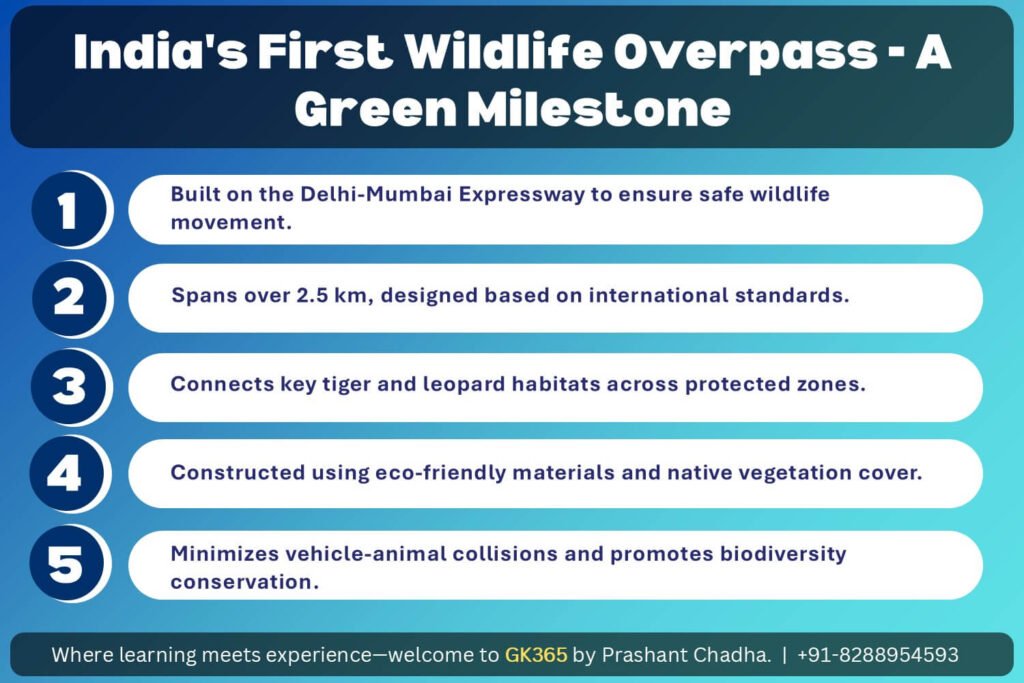
The National Highways Authority of India (NHAI) has built the country’s first wildlife overpass corridor on the Delhi-Mumbai Expressway. The 12-kilometre stretch runs through the buffer zone of the Ranthambore Tiger Reserve. This project combines modern road design with wildlife conservation goals.

The corridor includes five large overpasses, India’s longest wildlife underpass, and several other eco-friendly features. These help animals move freely across the landscape without interference from traffic. The design also reduces human-animal conflict in protected areas and reflects India’s shift toward sustainable infrastructure.

12 km Corridor Length
5 Overpasses Built
1.2 km Longest Underpass
35,000+ Trees Planted
📊 Quick Reference
Project Name Delhi-Mumbai Wildlife Corridor
Implemented By NHAI
Location Ranthambore Buffer Zone
Year 2025
Each Overpass 500 metres long
Wildlife Recorded Tigers & Bears

🌉 What is a Wildlife Overpass and Why is it Important?
India's First Wildlife Overpass Corridor on Delhi-Mumbai Expressway
India’s First Wildlife Overpass Corridor on Delhi-Mumbai Expressway near Ranthambore

A wildlife overpass is a bridge made for animals to safely cross roads. These structures help prevent animal deaths and keep their habitats connected. Most are covered with plants and trees to resemble natural surroundings.

Countries like Canada, the Netherlands, and the United States have already adopted this model with success. India is now beginning to follow their lead with the Delhi-Mumbai Expressway project.

🎯 Simple Explanation

Think of a wildlife overpass as a “green bridge” for animals. Just like humans use bridges to cross rivers, animals use these vegetated overpasses to cross highways safely. The bridge looks and feels like their natural forest, so they use it instinctively.

📰 Why is This Project in the News?

This is the first time a national expressway in India has been planned with wildlife protection at its center. The Delhi-Mumbai Expressway, which passes near the Ranthambore Tiger Reserve, now sets an example for other infrastructure efforts.

As roadkill and habitat encroachment increase across India, this project shows how development can respect the environment. Camera evidence has already captured tigers and bears using the corridor safely.

✓ Quick Recall

First in India: This is India’s first dedicated wildlife overpass corridor on a national expressway. The 1.2 km underpass is also India’s longest wildlife underpass.

✨ Key Features of the Delhi-Mumbai Wildlife Corridor

The corridor incorporates multiple design elements to ensure safe animal passage:

  • Wildlife Segment: 12 km through the Ranthambore buffer zone
  • Overpasses: 5 vegetated bridges, each 500 metres long
  • Underpass: 1.2 km — India’s longest wildlife underpass
  • Terrain Fit: 5 km of sunken or raised road to match land contours
  • Safety Barriers: 4-metre-high walls and 2-metre sound barriers
  • Camera Evidence: Tigers and bears recorded using the route
Feature Specification Purpose
Overpasses 5 units, 500m each Safe crossing for large mammals
Underpass 1.2 km (longest in India) Passage for smaller animals
High Walls 4 metres Prevent animals entering highway
Sound Barriers 2 metres Reduce noise disturbance
Terrain-Sensitive Road 5 km stretch Minimize landscape disruption

🌿 Environmental and Eco-Friendly Measures

Beyond the overpasses and underpasses, the project includes several green initiatives:

  • Natural Terrain Use: Overpasses follow the natural shape of the land
  • Tree Planting: 35,000+ trees planted along the corridor
  • Rainwater Storage: Harvesting systems built along the route
  • Modular Building: Prefabricated construction reduced waste
  • Wildlife Safety: Low-glare lights and noise barriers installed
💭 Think About This

The corridor shows that infrastructure and conservation need not be enemies. Could this model be applied to other ecologically sensitive zones like the Western Ghats or Northeast India?

🎯 Objectives and Long-Term Impact
Wildlife corridor connecting Ranthambore and Chambal ecosystems
The corridor connects Ranthambore and Chambal Valley ecosystems

The project aims to achieve multiple conservation and infrastructure goals:

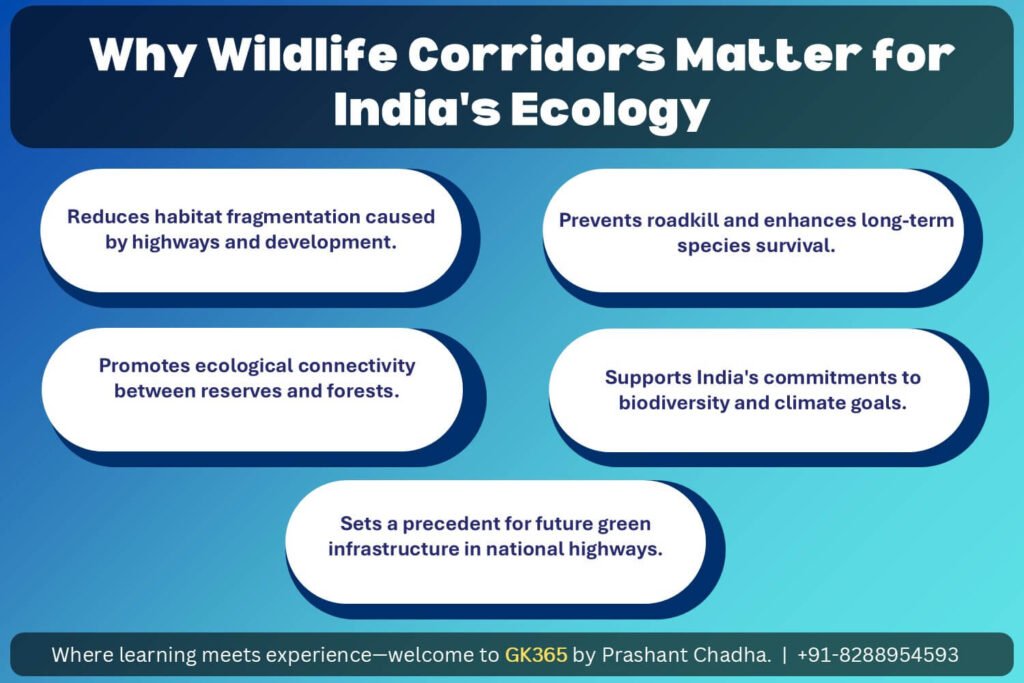
  • Help tigers, leopards, and bears move between Ranthambore and the Chambal Valley
  • Reduce road accidents involving animals
  • Demonstrate how roads can be built without harming wildlife
  • Support global efforts like the UN Sustainable Development Goals

By connecting two major ecosystems, the corridor ensures genetic diversity among wildlife populations and reduces isolation of animal groups.

🛣️ India’s Shift Toward Wildlife-Friendly Highways

This is not an isolated case. Other states are taking similar steps toward eco-sensitive road construction:

  • Punjab: Planning an urban wildlife corridor on the Zirakpur bypass
  • Maharashtra: Samruddhi Mahamarg has 209 animal underpasses and 8 overpasses
  • Future Plans: Projects in Madhya Pradesh and Karnataka are in progress

This marks a fundamental shift in how India approaches highway construction in ecologically sensitive areas.

⚠️ Exam Trap

Don’t confuse: The Delhi-Mumbai Wildlife Corridor (first wildlife overpass on national expressway) with Samruddhi Mahamarg (has more underpasses but is not specifically a “wildlife corridor”). The Delhi-Mumbai project is unique for its integrated approach.

🌍 Global Examples of Wildlife Corridors

India joins a growing list of countries that prioritize wildlife-friendly infrastructure:

  • Canada: Banff National Park has both overpasses and underpasses — one of the most successful models globally
  • Netherlands: Over 600 wildlife crossings for animals from frogs to deer
  • USA: California’s new overpass aims to protect endangered mountain lions
1990s
Canada builds first wildlife overpasses at Banff National Park
2000s
Netherlands expands to 600+ wildlife crossings nationwide
2022
Maharashtra’s Samruddhi Mahamarg includes 209 underpasses
2024
California begins construction of Wallis Annenberg Wildlife Crossing
2025
India inaugurates first wildlife overpass corridor on Delhi-Mumbai Expressway
🧠 Memory Tricks
Number Pattern:
“5-5-12-35” — 5 overpasses, each 500m, across 12 km, with 35,000+ trees
Location Link:
“R-C Connection” — Ranthambore to Chambal Valley, both tiger habitats connected
First in India:
“NHAI 2025” — NHAI built India’s first wildlife overpass in 2025
📚 Quick Revision Flashcards

Click to flip • Master key facts

Question
Where is India first wildlife overpass corridor located?
Click to flip
Answer
On the Delhi-Mumbai Expressway, passing through the Ranthambore Tiger Reserve buffer zone.
Card 1 of 5
🧠 Think Deeper

For GDPI, Essay Writing & Critical Analysis

🌍
Can India balance rapid infrastructure development with wildlife conservation? What policy changes would help?
Consider: Environmental Impact Assessments, mandatory wildlife corridors in forest zones, public-private partnerships for green infrastructure.
⚖️
Should wildlife corridors be mandatory for all highways passing through protected areas? What are the trade-offs?
Think about: Cost implications, construction delays, long-term ecological benefits, SDG alignment, tourism potential.
🎯 Test Your Knowledge

5 questions • Instant feedback

Question 1 of 5
Which tiger reserve’s buffer zone does the Delhi-Mumbai Wildlife Corridor pass through?
A) Sariska Tiger Reserve
B) Pench Tiger Reserve
C) Ranthambore Tiger Reserve
D) Jim Corbett Tiger Reserve
Explanation

The Delhi-Mumbai Wildlife Corridor passes through the buffer zone of Ranthambore Tiger Reserve in Rajasthan.

Question 2 of 5
How many wildlife overpasses are part of the Delhi-Mumbai Wildlife Corridor?
A) 3
B) 5
C) 7
D) 10
Explanation

There are 5 wildlife overpasses, each 500 metres long, as part of this corridor.

Question 3 of 5
What is the length of India’s longest wildlife underpass built in this project?
A) 500 metres
B) 800 metres
C) 1 kilometre
D) 1.2 kilometres
Explanation

India longest wildlife underpass is 1.2 km, built as part of this project.

Question 4 of 5
Which organization implemented the Delhi-Mumbai Wildlife Corridor project?
A) National Highways Authority of India (NHAI)
B) Wildlife Institute of India
C) Ministry of Environment
D) Forest Survey of India
Explanation

The National Highways Authority of India (NHAI) implemented this project.

Question 5 of 5
How many trees have been planted along the Delhi-Mumbai Wildlife Corridor?
A) 10,000+
B) 20,000+
C) 35,000+
D) 50,000+
Explanation

Over 35,000 trees have been planted along the corridor as part of environmental restoration.

0/5
Loading…
📌 Key Takeaways for Exams
1
First in India: The Delhi-Mumbai Expressway features India’s first dedicated wildlife overpass corridor, inaugurated in 2025 by NHAI.
2
Location: The 12 km corridor passes through the buffer zone of Ranthambore Tiger Reserve in Rajasthan.
3
Key Features: 5 overpasses (500m each), India’s longest underpass (1.2 km), 35,000+ trees, and 4-metre high safety walls.
4
Ecosystem Connection: Links Ranthambore Tiger Reserve with Chambal Valley, enabling tiger, leopard, and bear movement.
5
Other Examples: Maharashtra’s Samruddhi Mahamarg has 209 underpasses; Punjab planning Zirakpur corridor.
6
Global Context: Canada’s Banff, Netherlands’ 600+ crossings, and California’s mountain lion overpass are leading global models.

❓ Frequently Asked Questions

What is India’s first wildlife overpass corridor?
It is a 12 km stretch on the Delhi-Mumbai Expressway featuring 5 overpasses and India’s longest underpass (1.2 km), passing through the Ranthambore Tiger Reserve buffer zone. Built by NHAI and inaugurated in 2025.
Why are wildlife corridors important?
They reduce habitat fragmentation, lower animal deaths on roads, maintain genetic diversity among wildlife populations, and decrease human-animal conflict. They also support biodiversity conservation aligned with UN Sustainable Development Goals.
Which animals use this corridor?
Camera traps have recorded tigers and bears using the corridor. The passage also benefits leopards and other wildlife moving between Ranthambore and Chambal Valley ecosystems.
Are more such projects planned in India?
Yes. Maharashtra’s Samruddhi Mahamarg already has 209 underpasses and 8 overpasses. Punjab is planning an urban wildlife corridor on the Zirakpur bypass. Projects in Madhya Pradesh and Karnataka are also in progress.
How does India’s project compare globally?
Countries like Canada (Banff National Park), the Netherlands (600+ crossings), and the USA (California’s mountain lion overpass) have pioneered such systems. India now joins this global movement toward wildlife-friendly infrastructure.
🏷️ Exam Relevance
UPSC Prelims UPSC Mains (GS-III) SSC CGL SSC CHSL State PSC Railways Banking PO UPSC CAPF
🎯 Featured Course for 2026 Aspirants
🔥 Bestseller
The Ultimate GK Course 2026

The Ultimate GK Course 2026

Complete Current Affairs + Static GK Mastery

Stop scattered preparation. Get everything you need—daily current affairs, monthly compilations, topic-wise static GK, and 1000+ practice questions—in one comprehensive course designed by Prashant Sir.

👥 2,400+ enrolled
4.9 rating
📅 Valid till Dec 2026
₹1,499 ₹2,999 SAVE 50%
Enroll Now & Start Learning

What’s Included in Your Course:

📰
Daily Current Affairs Updates
📚
Monthly PDF Compilations
🧠
Complete Static GK Module
✍️
1000+ Practice Questions

⏰ Limited Time Offer — Early Bird Price — Enroll before prices increase!

Prashant Chadha

Connect with Prashant

Founder, WordPandit & The Learning Inc Network

With 18+ years of teaching experience and a passion for making learning accessible, I’m here to help you navigate competitive exams. Whether it’s UPSC, SSC, Banking, or CAT prep—let’s connect and solve it together.

18+
Years Teaching
50,000+
Students Guided
8
Learning Platforms

Stuck on a Topic? Let’s Solve It Together! 💡

Don’t let doubts slow you down. Whether it’s current affairs, static GK, or exam strategy—I’m here to help. Choose your preferred way to connect and let’s tackle your challenges head-on.

🌟 Explore The Learning Inc. Network

8 specialized platforms. 1 mission: Your success in competitive exams.

Trusted by 50,000+ learners across India

Leave a Comment

GK365 - Footer



