
“The future of cross-border payments is instant, transparent, and borderless — and it runs through the banking systems we already trust.”
In 2025, Infosys and Mastercard announced a strategic partnership to transform cross-border payments. The collaboration embeds Mastercard Move — Mastercard’s global money movement portfolio — into Finacle, Infosys’ widely-used banking platform. The integration enables banks to move money across 200+ countries in 150+ currencies with faster settlement, clearer tracking, and lower costs.
This partnership addresses a longstanding pain point in global finance: the slow, expensive, and opaque nature of traditional cross-border transfers. With access to approximately 95% of the world’s banked population, the combined solution positions banks to compete with fintech disruptors while maintaining regulatory compliance.
📢 The Partnership Announcement
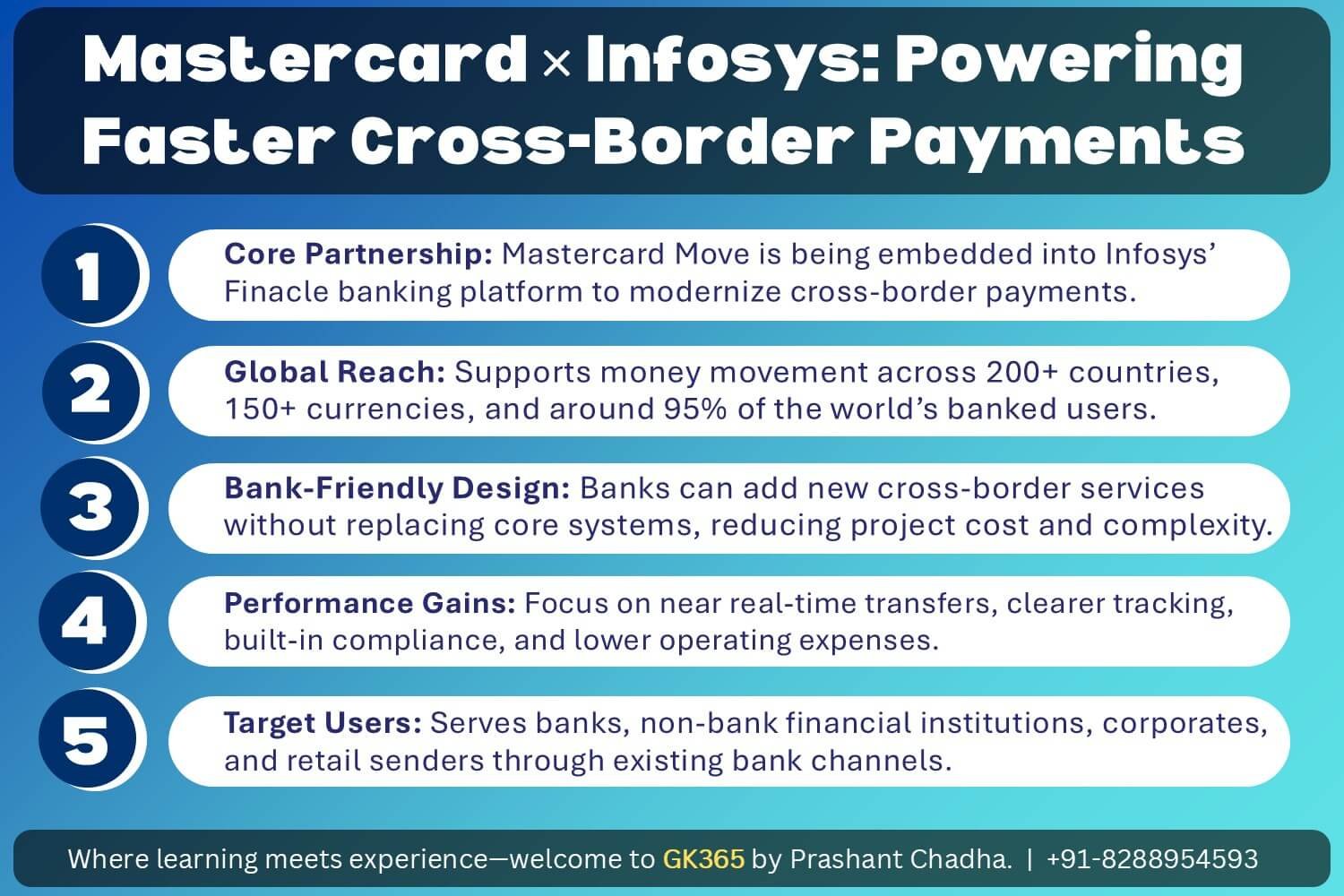
The 2025 announcement marks a significant shift in how banks can approach cross-border payments. By embedding Mastercard Move directly into Finacle, banks gain access to new cross-border capabilities without replacing their core systems. The integration promises faster settlement times, reduced operational costs, and the scale needed for growth in digital banking.
The partnership responds to growing demand from financial institutions seeking to modernize their payment infrastructure. Banks want digital-first solutions that can compete with fintech players while meeting stringent regulatory requirements across multiple jurisdictions.
Think of it like adding a high-speed express lane to an existing highway. Banks already have their road (Finacle), and now they can plug in Mastercard’s express lane (Mastercard Move) to send money faster across borders — without rebuilding the entire highway.
💳 Understanding Mastercard Move
Mastercard Move is Mastercard’s comprehensive global money movement portfolio. It serves a diverse range of users including banks, non-bank financial institutions, corporations, and retail senders. The platform offers near real-time processing in many corridors, with built-in compliance screening and fraud detection.
Key capabilities include broad geographic coverage spanning 200+ countries, support for 150+ currencies, and access to approximately 95% of the world’s banked population. The service handles everything from individual remittances to large corporate treasury operations.
Mastercard Move = Money Movement. Remember: Move covers 200+ countries, 150+ currencies, and reaches 95% of banked users globally.
🏦 Infosys Finacle: A Global Banking Platform
Finacle is Infosys’ flagship digital banking solution serving hundreds of financial institutions worldwide. The platform covers core banking operations, payments processing, lending, and treasury management. Its modular architecture allows banks to adopt features incrementally based on their needs.
Finacle’s design philosophy emphasizes flexibility and integration. Banks can plug in new capabilities — like Mastercard Move — without undertaking massive system overhauls. This approach significantly reduces implementation time and costs while maintaining operational continuity.
✨ Key Features of the Integration
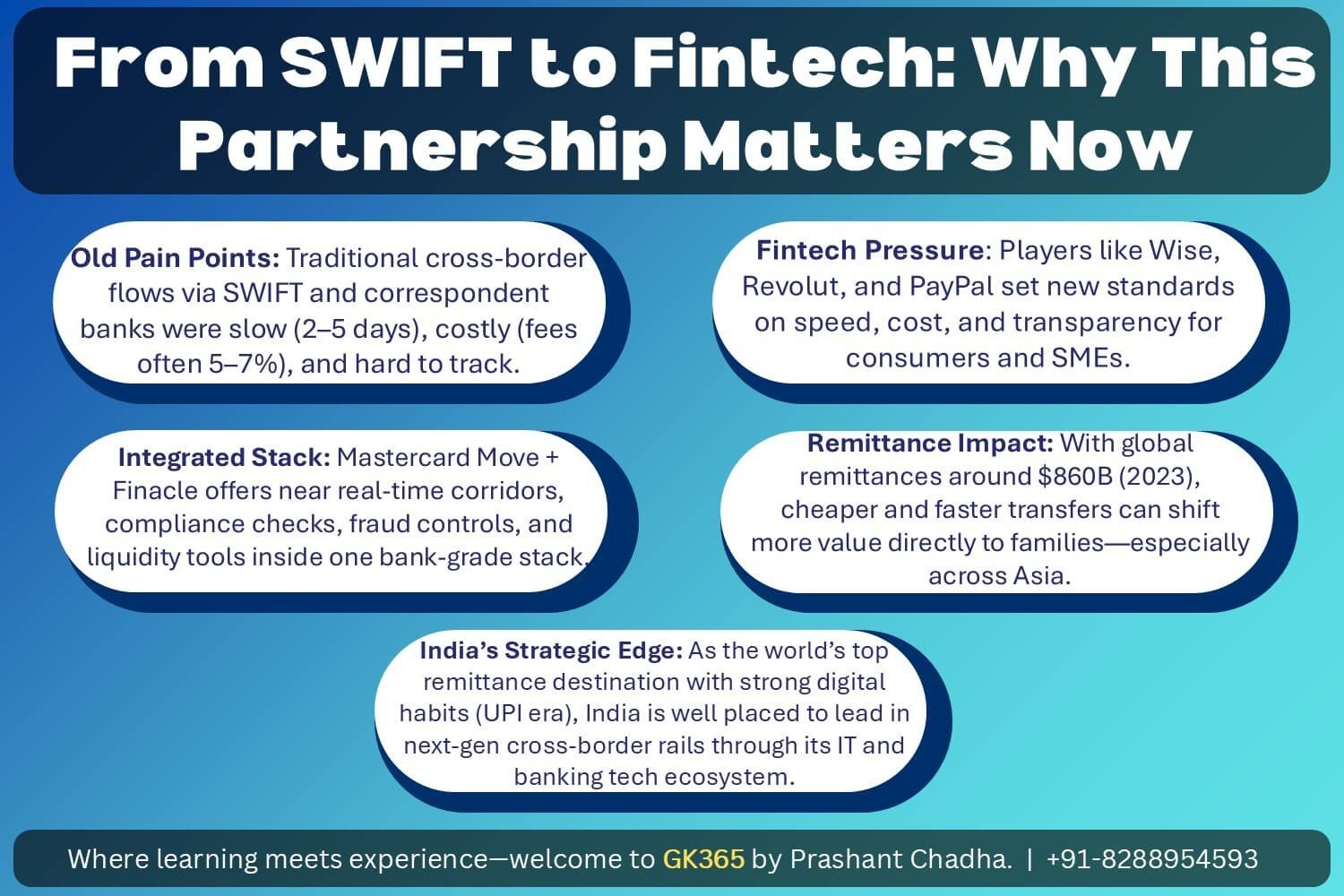
The Mastercard Move and Finacle integration delivers several critical capabilities:
- Near Real-Time Payments: Faster settlement in many payment corridors
- Global Coverage: Access to 200+ countries and 150+ currencies
- Compliance & Fraud Controls: Built-in screening and security measures
- Liquidity Tools: Advanced treasury management for high-volume users
- Plug-and-Play Integration: Minimal disruption for banks already on Finacle
| Feature | Traditional System | Mastercard Move + Finacle |
|---|---|---|
| Settlement Time | 2-5 days | Near real-time (many corridors) |
| Transaction Cost | 5-7% per transfer | Significantly reduced |
| Tracking | Limited visibility | End-to-end transparency |
| Integration Effort | Major system overhaul | Plug-and-play for Finacle banks |
🌍 Impact on Global Remittances
Global remittances totaled approximately $860 billion in 2023, representing a vital lifeline for millions of families worldwide. Migrant workers sending money home face high fees and slow transfers under traditional systems. The Infosys-Mastercard partnership aims to address these pain points directly.
Faster and cheaper transfers mean more money reaches recipients. For families in developing nations, even small reductions in transfer costs can translate to meaningful improvements in household income. Asia, which receives the largest share of global remittances, stands to benefit significantly.
If traditional transfers cost 5-7% in fees, a worker sending $500 home loses $25-35 to intermediaries. With billions flowing annually, even a 2% reduction in costs could redirect hundreds of millions of dollars to families who need it most.
🇮🇳 India’s Remittance Economy and Strategic Advantage
India receives the largest share of global remittances, making this partnership particularly significant for the country. Indian diaspora workers across the Gulf, US, UK, and other regions send substantial sums home each year. Faster, cheaper cross-border rails directly benefit millions of Indian families.
India’s domestic digital payment ecosystem — shaped by UPI (Unified Payments Interface) — has conditioned users to expect instant transfers and transparent pricing. Infosys’ role as a major banking technology provider positions India well in the global shift toward modern cross-border payment systems.
Don’t confuse: This partnership is about cross-border payments (international transfers). UPI handles domestic payments within India. The two address different needs but share the philosophy of instant, transparent transactions.
⚖️ How This Partnership Compares with SWIFT, Wise, and Others
The cross-border payments landscape includes several major players, each with distinct approaches:
- SWIFT: Secure messaging network for banks — enables communication but not end-to-end speed
- Wise (formerly TransferWise): Low-cost model targeting consumers and small businesses
- PayPal & Revolut: Retail and small business focused with digital-first interfaces
- Mastercard Move + Finacle: Targets bank channels and large-scale institutional use with compliance controls
The key differentiator: while fintechs often bypass traditional banking, this partnership works through banks, giving them tools to compete while maintaining the trust and regulatory compliance that institutions require.
| Platform | Primary Users | Key Strength |
|---|---|---|
| SWIFT | Banks | Secure messaging standard |
| Wise | Consumers, SMEs | Low fees, transparency |
| PayPal/Revolut | Retail users | Digital-first convenience |
| Mastercard Move + Finacle | Banks, large institutions | Scale + compliance |
🚧 Challenges and Risks Ahead
Despite its promise, the partnership faces significant hurdles:
- Regulatory Complexity: Operating across 200+ jurisdictions means navigating varied and evolving compliance requirements
- Fraud and Cyber Risks: Cross-border flows attract sophisticated criminal activity
- Adoption Lag: Some banks may delay system upgrades due to cost or internal resistance
- Emerging Competition: Central Bank Digital Currencies (CBDCs) and new fintech models continue to evolve
Success will depend on maintaining security, keeping pace with regulatory changes, and continuously expanding corridor coverage.
Click to flip • Master key facts
For GDPI, Essay Writing & Critical Analysis
5 questions • Instant feedback
The partnership integrates Mastercard Move into Finacle (Infosys banking platform) to enable faster cross-border payments for banks.
The integrated solution covers 200+ countries, 150+ currencies, and reaches approximately 95% of the world’s banked population.
India receives the largest share of global remittances, making this partnership particularly significant for Indian families receiving money from abroad.
Traditional cross-border transfers typically cost 5-7% per transaction and take 2-5 days for settlement.
SWIFT founded in 1973 established the global messaging standard for cross-border bank communications that dominated for decades.








