
“In a market where trillion-dollar valuations were once unthinkable, Nvidia has rewritten the rules — becoming the first public company to cross the $4 trillion threshold.”
In 2025, Nvidia Corporation etched its name into financial history by becoming the first publicly traded company to surpass a $4 trillion market capitalization. This milestone reflects not just exceptional stock performance, but Nvidia’s central role in powering the global artificial intelligence revolution. From gaming graphics to data center dominance, the chipmaker’s journey underscores how technology has reshaped modern markets and the global economy.
📈 Nvidia’s Journey to $4 Trillion
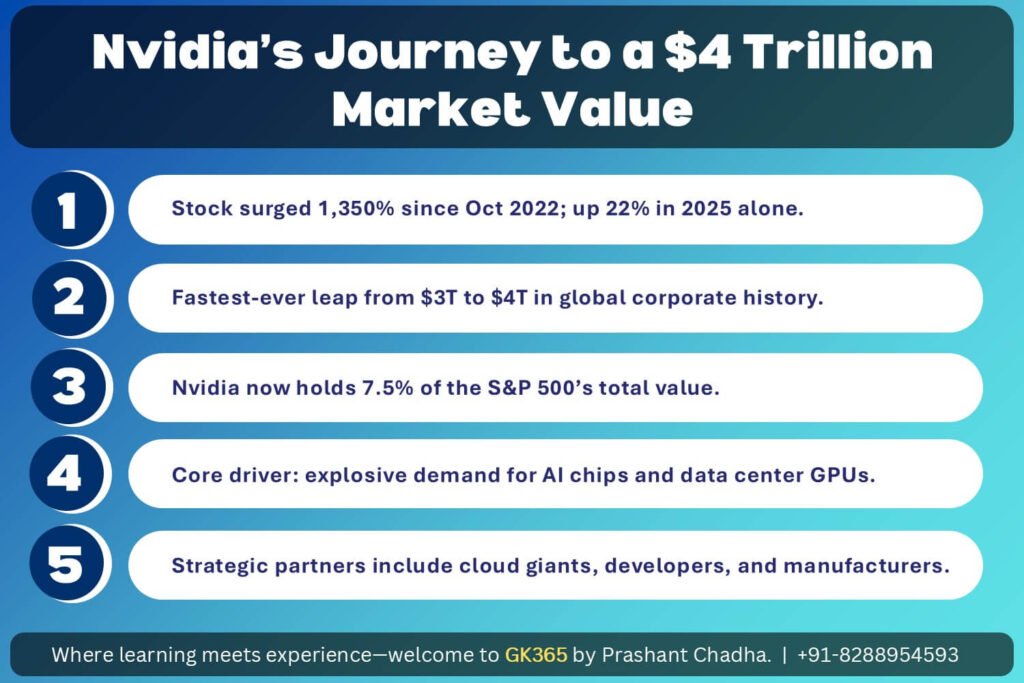
Nvidia’s share price has surged approximately 1,350% since October 2022, a performance that dwarfs the broader market’s gains. In 2025 alone, the stock climbed 22% while the S&P 500 managed just 6% — a testament to investor confidence in the company’s AI-driven growth story.
The company crossed the $3 trillion threshold just over a year before reaching $4 trillion. Such velocity is extraordinarily rare for a firm of this magnitude, reflecting both strong earnings performance and unwavering market faith in its dominant position in artificial intelligence infrastructure.
Think of Nvidia as the company that builds the “brains” for AI. Just as Intel once powered every personal computer, Nvidia’s GPUs now power almost every major AI system — from ChatGPT to self-driving cars. When AI demand explodes, Nvidia’s stock explodes with it.
🌍 Position in Global Stock Markets
Nvidia now accounts for approximately 7.5% of the S&P 500’s total market value. This means movements in Nvidia’s stock can significantly sway the entire index — a single company influencing the retirement savings of millions of Americans.
Beyond the S&P 500, Nvidia holds substantial weights in the Invesco QQQ Trust (tracking Nasdaq-100) and the Philadelphia Semiconductor Index (SOX). Its influence in the Dow Jones Industrial Average remains smaller since that index uses price-weighting rather than market-cap weighting.
Index Weights Matter: S&P 500 uses market-cap weighting (larger companies = bigger influence). Dow Jones uses price-weighting (higher stock price = bigger influence). Nvidia dominates cap-weighted indexes but has less impact on the Dow.
| Company | Market Cap (2025) | Primary Business |
|---|---|---|
| Nvidia | $4.0 Trillion | AI Chips, GPUs, Data Centers |
| Microsoft | ~$3.7 Trillion | Cloud, Software, AI |
| Apple | ~$3.1 Trillion | Consumer Electronics, Services |
| Amazon | ~$2.5 Trillion | E-commerce, Cloud (AWS) |
| Alphabet (Google) | ~$2.3 Trillion | Search, Advertising, Cloud |
💻 The Broader Technology Sector Context
The “Magnificent Seven” — Nvidia, Microsoft, Apple, Amazon, Alphabet, Meta, and Broadcom — now constitute approximately one-third of the entire S&P 500. This concentration of market value in just seven companies has not been seen since the dot-com era of 2000.
However, unlike the speculative excess of 2000, today’s tech giants generate substantial profits and maintain strong global market positions. Their valuations, while high, are backed by real revenue streams and demonstrable competitive advantages.
When seven companies control one-third of the market, what happens to diversification? Index fund investors who think they own “500 companies” are actually heavily exposed to just a handful of tech giants. Is this healthy for markets — or a systemic risk waiting to materialize?
🚀 Market Drivers Behind Nvidia’s Rise
AI and Data Center Demand: Nvidia’s GPUs have become the standard for training and running AI models. From OpenAI’s GPT systems to autonomous vehicle development, virtually every major AI project relies on Nvidia hardware. Cloud providers like Amazon, Microsoft, and Google have poured billions into Nvidia chips.
Gaming and GPU Leadership: The company’s origins in gaming graphics remain a steady revenue source and brand strength. The GeForce product line continues to dominate the consumer GPU market.
Ecosystem Strength: Nvidia’s CUDA software platform creates powerful lock-in effects. Developers trained on CUDA, cloud providers optimized for Nvidia hardware, and years of software investment make switching costs extraordinarily high for customers.
Don’t confuse: GPU (Graphics Processing Unit) with CPU (Central Processing Unit). CPUs are general-purpose processors (Intel, AMD). GPUs were designed for graphics but excel at parallel processing — making them ideal for AI workloads. Nvidia dominates GPUs; Intel dominates CPUs.
📊 Comparing Past and Present Market Cycles
Lessons from the Dot-Com Era: In 2000, many technology companies had sky-high valuations but minimal profits. When the bubble burst, valuations collapsed and many firms vanished entirely. The lesson: revenue must translate to durable, sustainable profits.
How Today’s Tech Surge Differs: Unlike 2000, Nvidia and its peers report strong earnings, broad product adoption, and defensible competitive moats. While valuations remain elevated, they are supported by real demand, established supply chains, and proven business models.
| Factor | Dot-Com Era (2000) | AI Era (2025) |
|---|---|---|
| Profitability | Most tech firms unprofitable | Leaders highly profitable |
| Revenue Base | Speculative, often minimal | Established, growing rapidly |
| Market Position | Fragmented, new entrants | Concentrated, dominant players |
| Technology Adoption | Early internet, limited reach | AI embedded across industries |
| Valuation Basis | Hype-driven | Earnings-backed (though premium) |
⚠️ Risks and Challenges
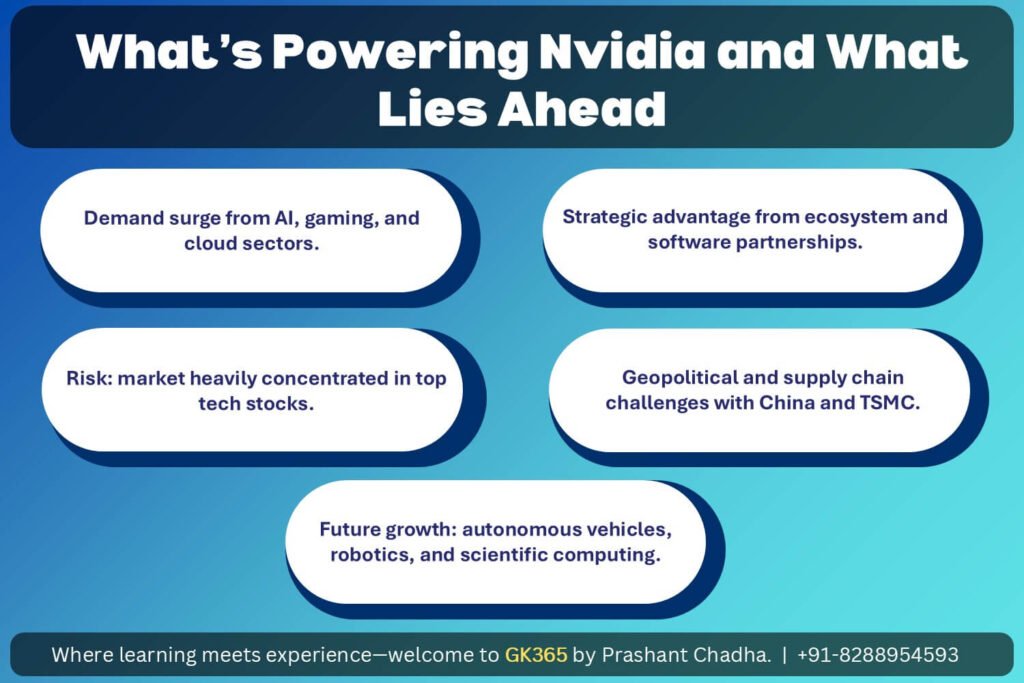
Market Concentration Risk: With a handful of giants driving most market gains, stress in any single company can significantly impact index funds and global portfolios. The interconnected nature of modern finance means Nvidia’s fortunes affect pension funds, 401(k)s, and sovereign wealth funds worldwide.
Geopolitical and Supply Chain Issues: Semiconductors sit at the center of U.S.–China tensions. Export controls on advanced chips to China directly impact Nvidia’s addressable market. Additionally, Nvidia depends on TSMC (Taiwan Semiconductor Manufacturing Company) for chip fabrication — a concentration of manufacturing risk in a geopolitically sensitive region.
Competition from Other Chipmakers: AMD continues to narrow the gap in AI chips. Intel is investing heavily in its foundry business. Meanwhile, tech giants like Google (TPU), Amazon (Trainium/Inferentia), and Microsoft are developing custom AI chips to reduce Nvidia dependency.
Key Risk Trio: (1) Market concentration in few stocks, (2) TSMC dependency for manufacturing, (3) U.S.–China export restrictions limiting sales. These three factors could significantly impact Nvidia’s growth trajectory.
🔮 Future Outlook for Nvidia and the Tech Sector
Growth Opportunities: AI adoption remains in early stages across many industries. Autonomous vehicles, robotics, healthcare diagnostics, drug discovery, and scientific research all represent expanding markets for high-end computing chips. Edge AI (processing on devices rather than in the cloud) opens additional hardware demand.
Potential Market Corrections: Premium valuations can correct sharply if earnings growth slows, interest rates rise, or investor sentiment shifts. The Federal Reserve’s monetary policy, corporate capital expenditure cycles, and geopolitical developments all pose potential headwinds. Investors must balance near-term volatility risk against long-term structural demand for AI infrastructure.
The AI chip market raises important questions: Should nations develop domestic semiconductor capabilities as a matter of national security? How should regulators approach market concentration when tech giants control critical infrastructure? Is the current valuation sustainable, or are we witnessing another bubble?
Click to flip • Master key facts
For GDPI, Essay Writing & Critical Analysis
5 questions • Instant feedback
Nvidia became the first publicly traded company to reach $4 trillion market capitalization in 2025.
Nvidia stock has risen approximately 1,350% since October 2022, driven by AI chip demand.
Nvidia accounts for about 7.5% of the S&P 500 total market value.
TSMC (Taiwan Semiconductor Manufacturing Company) manufactures Nvidia chips.
The top 7 tech firms (Magnificent Seven) represent approximately 33% of the S&P 500.








