
🌍 INTERNATIONAL

Yarlung Tsangpo Dam Project on Brahmaputra

πŸ“‘ Table of Contents Introduction Project Background Geographic Context Technical Specifications China's Strategic Objectives Geopolitical Concerns Environmental Risks Seismic & Safety Risks Flashcards Quiz Key Takeaways FAQs 🎧 Prefer listening?...

⏱️ 10 min read
πŸ“Š 1,895 words
πŸ“… August 2025
UPSC Banking SSC CGL NDA GLOBAL NEWS
🎧 Prefer listening? Check out our podcast

“Control water, control life. In the hands of upstream nations, rivers become instruments of power.” β€” Geopolitical observation on transboundary water politics

China has launched construction of what it calls the world’s largest hydropower dam on the Yarlung Tsangpo River in Tibet. Named the Motuo Hydropower Station, this mega-project targets electricity output that would surpass the Three Gorges Dam β€” currently the world’s largest power station. With an estimated cost of 1.2 trillion yuan (~$167 billion USD), the dam raises serious concerns about water security, ecological balance, and geopolitical stability for downstream nations India and Bangladesh.

$167B Estimated Cost
2,800+ River Length (km)
3Γ— Three Gorges Output
20 km Tunnel Length
πŸ“Š Quick Reference
Project Name Motuo Hydropower Station
River Yarlung Tsangpo (Tibet)
Downstream Name (India) Siang β†’ Brahmaputra
Downstream Name (Bangladesh) Jamuna
Policy Framework Xidiandongsong
Dam Configuration 5 Cascading Dams

πŸ“œ Project Background: The Motuo Hydropower Station
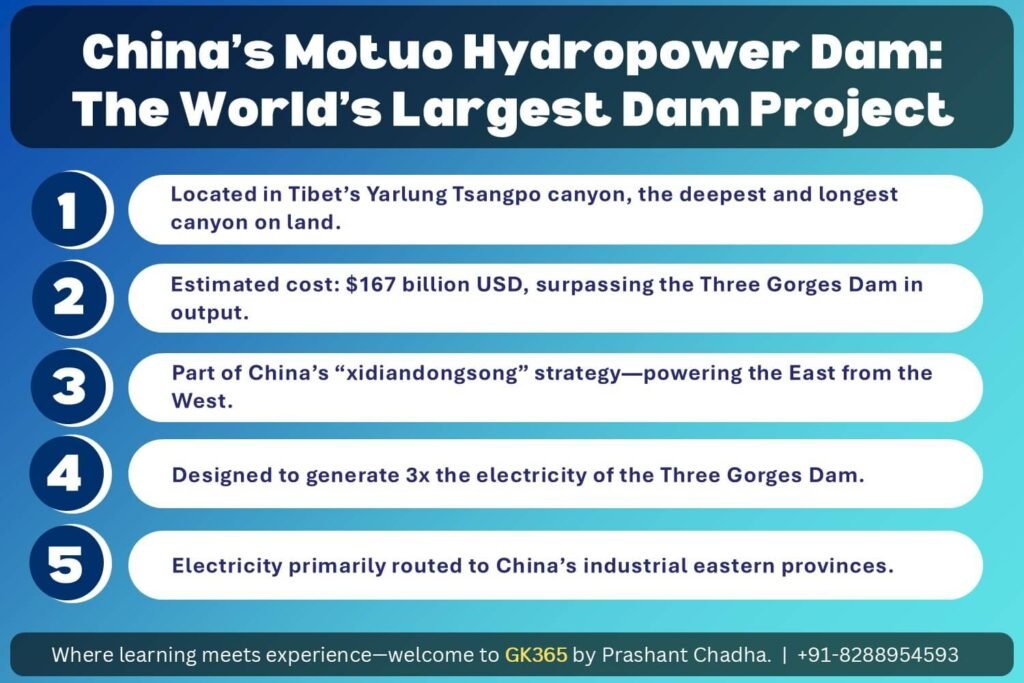
China's Yarlung Tsangpo Dam Project - Motuo Hydropower Station in Tibet
China’s Motuo Hydropower Station will be built in the Yarlung Tsangpo canyon β€” the deepest and longest canyon on Earth

The Motuo Hydropower Station will be constructed in the Yarlung Tsangpo canyon β€” the deepest and longest canyon on land. The river rises in Tibet, enters India as the Siang and then becomes the Brahmaputra, finally reaching Bangladesh as the Jamuna before emptying into the Bay of Bengal.

Chinese Premier Li Qiang officially launched the construction phase. The project’s planned output would surpass even the Three Gorges Dam, making it the world’s most powerful hydroelectric facility. Plans call for five cascading dams with tunnels approximately 20 kilometers long to divert water for power generation.

🎯 Simple Explanation

Think of the Yarlung Tsangpo like a giant water slide starting high in Tibet. China wants to build a massive dam at the steepest part of this slide to generate enormous amounts of electricity. But India and Bangladesh are at the bottom of this slide β€” they worry China could control how much water reaches them.

🌍 Geographic and Hydrological Context

The Yarlung Tsangpo runs more than 2,800 kilometers from the Tibetan Plateau to the Bay of Bengal. Its waters support farms, fisheries, and communities across the entire basin β€” serving as a lifeline for millions in Tibet, India, and Bangladesh.

The Motuo site sits amid steep gradients, heavy rainfall, and high seismic risk. The sharp drop in elevation offers exceptional hydropower potential β€” the canyon’s energy profile attracts dam engineers precisely because gravity does most of the work in generating electricity.

1994
Three Gorges Dam construction begins in China
2012
Three Gorges Dam fully operational β€” displaces 1+ million people
2020s
China expands Mekong River dams, affecting Southeast Asia
2024
Motuo project officially approved in China’s 14th Five-Year Plan
2025
Premier Li Qiang launches Motuo construction phase

βš™οΈ Technical Specifications and Design

The Motuo project involves sophisticated engineering at an unprecedented scale:

  • Five cascading dams along the canyon stretch
  • Tunnels ~20 km long to divert water for power generation
  • Channel straightening in some river sections to increase flow speed
  • Triple the electricity output of the Three Gorges Dam
  • Power primarily feeds eastern Chinese provinces, with some supply for Tibet
βœ“ Quick Recall

Key Numbers: 5 dams, 20 km tunnels, 3Γ— Three Gorges output, $167 billion cost. Remember: “5-20-3-167” for exam MCQs.

πŸ“Œ China’s Strategic Objectives

Leaders frame the project under “xidiandongsong” (θ₯Ώη”΅δΈœι€) β€” literally meaning “sending western electricity east.” This policy aims to tap Tibet’s renewable resources for eastern industrial centers while reducing coal dependency.

The strategic benefits for China include:

  • Carbon targets: Massive hydropower supports climate commitments
  • Grid stability: Seasonal water storage balances peak electricity demand
  • Economic development: Construction creates thousands of jobs
  • Infrastructure boost: Improves transport and manufacturing in remote Tibet
  • Water control: Upper-course control grants influence over downstream flows
πŸ’­ Think About This

China’s “xidiandongsong” policy frames the dam as domestic energy infrastructure. But critics argue it’s also about establishing strategic control over transboundary water resources β€” giving China leverage over downstream nations without firing a single shot.

Aspect Three Gorges Dam Motuo Hydropower Station
River Yangtze (domestic) Yarlung Tsangpo (transboundary)
Capacity 22,500 MW ~60,000+ MW (estimated)
Cost ~$31 billion ~$167 billion
Downstream Nations None (domestic river) India, Bangladesh
Seismic Risk Moderate High (active fault zone)

βš–οΈ Geopolitical Concerns for India and Bangladesh

The dam has triggered alarm bells in both India and Bangladesh:

India’s Concerns:

  • Fear of reduced dry-season flows in the Brahmaputra
  • Analysts warn of potential “water bomb” through sudden discharge
  • Limited leverage since China controls the upper course
  • National security implications for northeastern states

Bangladesh’s Concerns:

  • Heavy reliance on steady flows for irrigation and drinking water
  • Fishing communities depend on natural river patterns
  • Seeking transparency and data-sharing agreements
  • Vulnerable position as the furthest downstream nation
⚠️ Exam Trap

Don’t confuse: The river has THREE names β€” Yarlung Tsangpo (Tibet/China), Siang/Brahmaputra (India), and Jamuna (Bangladesh). Exams often test this name change across borders.

🌿 Environmental and Ecological Risks
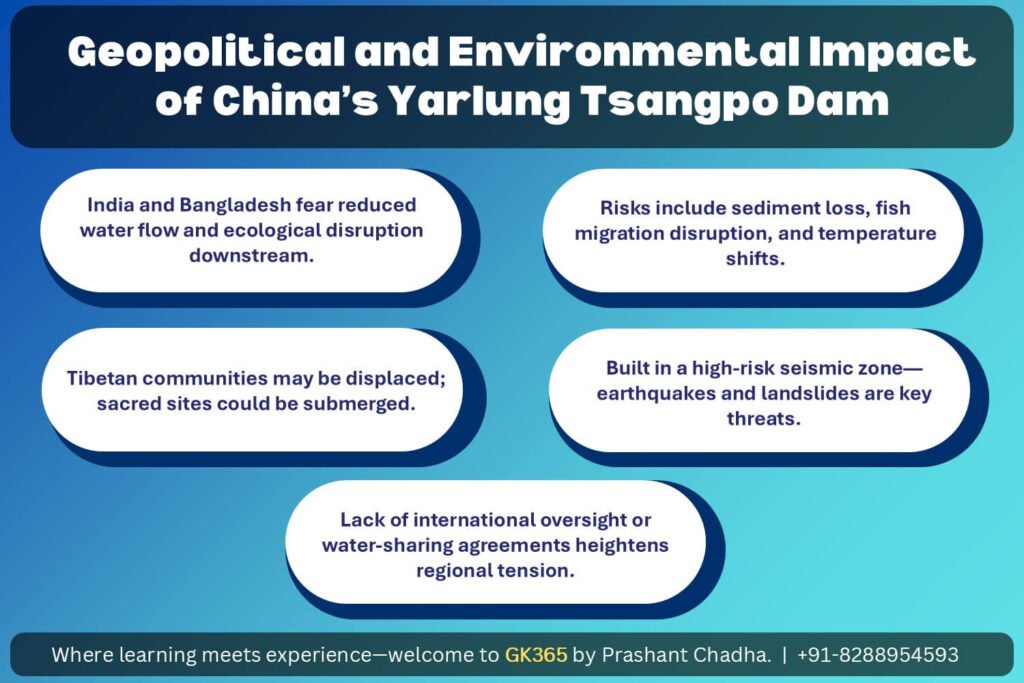
Environmental impact of Yarlung Tsangpo Dam on downstream regions
The dam’s environmental impact will extend far beyond Tibet β€” affecting ecosystems across India and Bangladesh

The environmental implications are severe and far-reaching:

  • Habitat destruction: Reservoirs will flood biodiversity-rich valleys
  • Species extinction: Rare endemic species face habitat loss
  • Sediment disruption: Channel changes alter natural sediment loads
  • Fish migration blocked: Dams create barriers for migratory species
  • Water quality changes: Temperature and oxygen shifts harm aquatic life
  • Downstream delta erosion: Reduced sediment threatens Bangladesh’s coast

πŸ”΄ Seismic and Safety Considerations

The Motuo site presents exceptional safety challenges:

  • High seismic risk: Located in an active earthquake zone
  • Landslide potential: Steep terrain prone to mass movements
  • Reservoir-induced seismicity: Large water bodies can trigger earthquakes
  • Cascade failure risk: Five dams mean five potential failure points
  • Downstream devastation: Dam failure would send catastrophic floods into India and Bangladesh

A major earthquake or landslide could trigger waves within the reservoir, potentially causing dam overtopping or structural failure β€” with devastating consequences for millions downstream.

βœ“ Quick Recall

Safety Acronym β€” “SLED”: Seismic zone, Landslide risk, Earthquake-induced waves, Downstream flood threat. These four factors make Motuo one of the riskiest dam projects ever attempted.

πŸ‘€ Social and Cultural Impacts in Tibet

Beyond geopolitics and environment, the human cost within Tibet deserves attention:

  • Forced displacement: Communities face relocation as reservoirs flood valleys
  • Livelihood loss: Farming and herding land submerged
  • Sacred sites threatened: The Yarlung Tsangpo holds deep spiritual significance for Tibetans
  • Suppressed dissent: Tibetan activists opposing similar projects have faced arrests
  • Cultural erasure: Traditional ways of life disrupted permanently

For many Tibetans, the river is not just water β€” it’s a sacred lifeline connecting communities to their ancestral heritage.

🧠 Memory Tricks
River Name Pattern:
“YSB-J” β€” Yarlung Tsangpo (Tibet) β†’ Siang/Brahmaputra (India) β†’ Jamuna (Bangladesh). One river, four names, three countries.
Cost Memory:
“167 Billion = 1-6-7” β€” Think of it as “1 dam, 6 times Three Gorges cost, 7 downstream impacts”
Policy Name:
“Xidiandongsong” = “Xi-dian-dong-song” = “West-electricity-east-send” β€” Western electricity sent eastward
πŸ“š Quick Revision Flashcards

Click to flip β€’ Master key facts

Question
What is the name of China’s mega-dam on the Yarlung Tsangpo?
Click to flip
Answer
Motuo Hydropower Station β€” estimated cost $167 billion, planned to produce 3Γ— the electricity of Three Gorges Dam.
Card 1 of 5
🧠 Think Deeper

For GDPI, Essay Writing & Critical Analysis

🌍
Should transboundary rivers be governed by international law, even when the upper-course nation claims sovereign rights over its territory?
Consider: UN Watercourses Convention, sovereignty vs. shared resources, historical precedents (Nile, Mekong, Indus), and the concept of “equitable utilization.”
βš–οΈ
Can renewable energy megaprojects like Motuo be truly “green” if they cause massive ecological destruction and displace indigenous communities?
Think about: Climate goals vs. local impacts, who bears the cost of clean energy, indigenous rights, and whether carbon neutrality justifies environmental devastation.
🎯 Test Your Knowledge

5 questions β€’ Instant feedback

Question 1 of 5
On which river is China building the Motuo Hydropower Station?
A) Mekong River
B) Yangtze River
C) Yarlung Tsangpo River
D) Yellow River
Explanation

The Motuo Hydropower Station is being built on the Yarlung Tsangpo River in Tibet. The river later becomes the Brahmaputra in India and Jamuna in Bangladesh.

Question 2 of 5
What does the Chinese policy “xidiandongsong” mean?
A) West-to-east water transfer
B) Sending western electricity east
C) South-to-north water diversion
D) Green energy initiative
Explanation

Xidiandongsong literally means “sending western electricity east” β€” a Chinese policy to use Tibet’s hydropower for eastern industrial provinces.

Question 3 of 5
What is the estimated cost of the Motuo Hydropower Station?
A) $31 billion
B) $85 billion
C) $120 billion
D) $167 billion
Explanation

The project cost is estimated at approximately $167 billion USD (1.2 trillion yuan), making it one of the most expensive infrastructure projects ever.

Question 4 of 5
What is the Yarlung Tsangpo River called when it enters India?
A) Siang River
B) Jamuna River
C) Ganga River
D) Indus River
Explanation

The Yarlung Tsangpo becomes the Siang River when it enters India (Arunachal Pradesh), then joins other tributaries to become the Brahmaputra in Assam.

Question 5 of 5
How many cascading dams are planned for the Motuo project?
A) 3 dams
B) 4 dams
C) 5 dams
D) 7 dams
Explanation

The project involves five cascading dams along the Yarlung Tsangpo canyon, each representing a potential failure point in case of earthquakes or landslides.

0/5
Loading…
πŸ“Œ Key Takeaways for Exams
1
Project: Motuo Hydropower Station on Yarlung Tsangpo River (Tibet) β€” world’s largest planned hydropower dam at ~$167 billion cost.
2
River Names: Yarlung Tsangpo (Tibet) β†’ Siang/Brahmaputra (India) β†’ Jamuna (Bangladesh) β€” one river, multiple names across three countries.
3
Policy: Part of “xidiandongsong” (θ₯Ώη”΅δΈœι€) β€” China’s policy to send western hydropower electricity to eastern industrial zones.
4
Geopolitical Risk: India and Bangladesh fear water manipulation, “water bomb” scenarios, and ecological damage with no binding international agreement.
5
Safety Concerns: High seismic zone, landslide risk, five cascading dams β€” failure could cause catastrophic downstream flooding.
6
Comparison: Will produce ~3Γ— the electricity of Three Gorges Dam but on a transboundary river, unlike the domestic Yangtze.

❓ Frequently Asked Questions

What is the Motuo Hydropower Station?
The Motuo Hydropower Station is a mega-dam project China is building on the Yarlung Tsangpo River in Tibet. With an estimated cost of $167 billion, it will be the world’s largest hydropower facility, producing approximately three times the electricity of the Three Gorges Dam.
Why are India and Bangladesh concerned about this dam?
Both countries depend on the river (called Brahmaputra in India and Jamuna in Bangladesh) for agriculture, drinking water, and fisheries. They fear China could control water flows β€” either reducing dry-season supplies or releasing sudden floods (a “water bomb”). There’s no binding international agreement on water-sharing or joint monitoring.
What does “xidiandongsong” mean?
“Xidiandongsong” (θ₯Ώη”΅δΈœι€) is a Chinese policy meaning “sending western electricity east.” It aims to harness hydropower from western regions like Tibet to power eastern industrial provinces, reducing coal dependency and meeting carbon targets.
What are the main safety risks of the Motuo dam?
The site is in a high seismic zone prone to earthquakes and landslides. Five cascading dams create multiple failure points. Heavy rainfall and steep terrain add to risks. A dam failure could send catastrophic floods into India and Bangladesh, affecting millions downstream.
How is this different from the Three Gorges Dam?
Three Gorges is on the Yangtze River, which is entirely domestic to China. The Motuo dam is on a transboundary river that flows into India and Bangladesh, making it an international issue. It will also be significantly more powerful (~3Γ— Three Gorges) and far more expensive (~5Γ— the cost).
🏷️ Exam Relevance
UPSC Prelims UPSC Mains (GS-II IR) UPSC Mains (GS-III Environment) SSC CGL SSC CHSL State PSC NDA/CDS CAPF CAT/MBA GDPI
🎯 Featured Course for 2026 Aspirants
πŸ”₯ Bestseller
The Ultimate GK Course 2026

The Ultimate GK Course 2026

Complete Current Affairs + Static GK Mastery

Stop scattered preparation. Get everything you needβ€”daily current affairs, monthly compilations, topic-wise static GK, and 1000+ practice questionsβ€”in one comprehensive course designed by Prashant Sir.

πŸ‘₯ 2,400+ enrolled
⭐ 4.9 rating
πŸ“… Valid till Dec 2026
β‚Ή1,499 β‚Ή2,999 SAVE 50%
Enroll Now & Start Learning β†’

What’s Included in Your Course:

πŸ“°
Daily Current Affairs Updates
πŸ“š
Monthly PDF Compilations
🧠
Complete Static GK Module
✍️
1000+ Practice Questions

⏰ Limited Time Offer β€” Early Bird Price β€” Enroll before prices increase!

πŸ’‘ Start Small, Learn Smart

Focused Micro-Courses for Targeted Prep

Don’t need everything? Pick exactly what you need. Affordable, focused courses starting at just β‚Ή99. Master one topic at a time.

Instant Access after payment
Lifetime validity once enrolled
Secure payment via Razorpay

Can’t decide? Start with any courseβ€”upgrade anytime to the Ultimate GK Course and get full credit applied!

Explore All Preplite Courses β†’
Prashant Chadha

Connect with Prashant

Founder, WordPandit & The Learning Inc Network

With 18+ years of teaching experience and a passion for making learning accessible, I’m here to help you navigate competitive exams. Whether it’s UPSC, SSC, Banking, or CAT prepβ€”let’s connect and solve it together.

18+
Years Teaching
50,000+
Students Guided
8
Learning Platforms

Stuck on a Topic? Let’s Solve It Together! πŸ’‘

Don’t let doubts slow you down. Whether it’s current affairs, static GK, or exam strategyβ€”I’m here to help. Choose your preferred way to connect and let’s tackle your challenges head-on.

🌟 Explore The Learning Inc. Network

8 specialized platforms. 1 mission: Your success in competitive exams.

Trusted by 50,000+ learners across India

Leave a Comment

GK365 - Footer



