Pakistan Leads the United Nations Security Council in July 2025
Pakistan leads the United Nations Security Council in July 2025 as president. Learn about Pakistan's UNSC presidency, key events on July 22-24, leadership role, and its track record in UN peacekeeping missions.
“Pakistan’s presidency offers a calm, firm voice for collective security and international partnership in an uncertain world.” — UN Diplomatic Observer
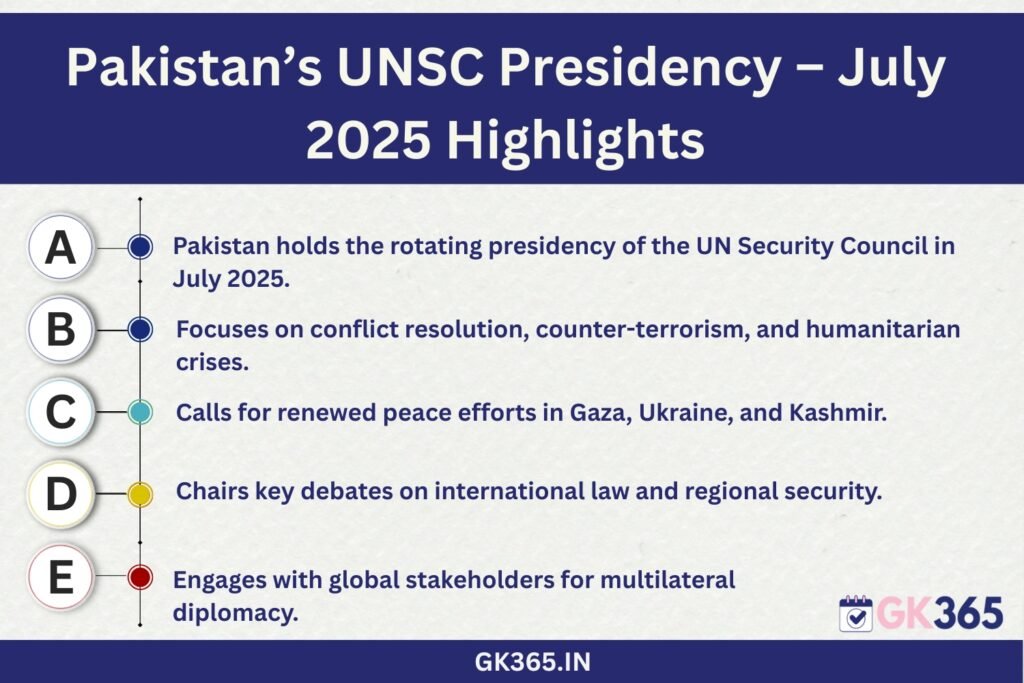
On July 1, 2025, Pakistan assumed the presidency of the United Nations Security Council (UNSC). This role places it at the center of global diplomacy, with responsibility for leading high-level discussions, setting the month’s agenda, and managing urgent decisions on peace and security.
Pakistan brings to this role decades of peacekeeping experience and a strong record of multilateral engagement. Its leadership comes at a time of global instability, and its actions will shape discussions on conflict resolution, cooperation, and international governance.
182/193Votes Received
200,000+Peacekeeping Troops
46+UN Missions
July 2025Presidency Month
📊 Quick Reference
EventUNSC Presidency
CountryPakistan
DurationJuly 1-31, 2025
Term2025-2026 (Non-permanent)
UN RepresentativeAmb. Asim Iftikhar Ahmad
Key MinisterIshaq Dar (Deputy PM)
🕊️ Understanding the United Nations Security Council
Pakistan assumes UNSC Presidency: Key facts and responsibilities
The UNSC is the UN’s primary body for international peace and security. It includes 15 members — 5 permanent (P5: USA, UK, France, Russia, China) and 10 elected non-permanent members. Each month, one member serves as president on a rotating basis.
The presidency reflects the diplomatic capacity of the presiding country and brings attention to its global priorities. The president chairs meetings, sets the agenda, and issues official statements on behalf of the Council.
🎯 Simple Explanation
Think of the UNSC as the UN’s emergency response team for global crises. The presidency is like being the team captain for a month — you decide what issues get discussed, lead all meetings, and speak on behalf of the entire team to the world.
Category
Permanent Members (P5)
Non-Permanent Members
Number
5 countries
10 countries
Term
Permanent
2 years (elected)
Veto Power
Yes
No
Presidency
Rotates monthly
Rotates monthly
🇵🇰 Pakistan’s Presidency: What It Means
Pakistan began its presidency on July 1, 2025, as part of its 2025–2026 term as a non-permanent member. It was elected to the Council with 182 out of 193 votes, signaling broad global support and diplomatic credibility.
As president, Pakistan will:
Lead all Security Council meetings
Manage the monthly program of work
Guide crisis discussions and decisions
Represent the Council before the UN and global audiences
This moment gives Pakistan a platform to promote peaceful dialogue and highlight its global policy views on multilateralism, conflict resolution, and humanitarian concerns.
💭 Think About This
With 182 out of 193 votes, Pakistan received one of the highest vote counts for a non-permanent seat. What does this overwhelming support indicate about Pakistan’s standing in the international community and its perceived role in global diplomacy?
📅 High-Level Events and Key Agendas
Pakistan has announced three major meetings in July 2025, each reflecting its diplomatic focus areas:
July 22, 2025
Multilateralism and Peaceful Conflict Resolution — Session exploring ways to replace force with dialogue and strengthen international cooperation
July 23, 2025
Special Session on Palestine — Council addresses humanitarian situation in Palestine and renews calls for peace
July 24, 2025
UN-OIC Cooperation — Meeting reviews UN partnership with Organisation of Islamic Cooperation for improved regional crisis responses
✓ Quick Recall
Memory Aid: “22-23-24” — Three consecutive days in July for Pakistan’s three signature events: Multilateralism (22), Palestine (23), UN-OIC (24). Deputy PM Ishaq Dar chairs all key sessions.
🧭 Leadership and Diplomacy
Ambassador Asim Iftikhar Ahmad serves as Pakistan’s Permanent Representative to the UN and will oversee most Council sessions. His leadership focuses on:
Transparency in Council operations
Inclusiveness in global viewpoints
Quick, informed responses to crises
Ishaq Dar, Deputy Prime Minister and Foreign Minister, will chair the key events during July 22-24. His direct involvement signals political accountability and strong diplomatic intent from Pakistan’s leadership at the highest level.
⚠️ Exam Trap
Don’t confuse: The UNSC President (rotating monthly) with the UN Secretary-General (permanent administrative head). Pakistan’s presidency is for July 2025 only, while the Secretary-General serves a 5-year term. Current UN Secretary-General is António Guterres (since 2017).
🌐 Pakistan’s Track Record at the UN
Pakistan’s extensive history of UN engagement and peacekeeping contributions
Pakistan’s credentials for this leadership role are backed by decades of consistent engagement:
Held the UNSC presidency several times since 1952
Contributed over 200,000 troops to more than 46 peacekeeping missions
Regularly advocates for diplomacy, nuclear disarmament, and conflict resolution
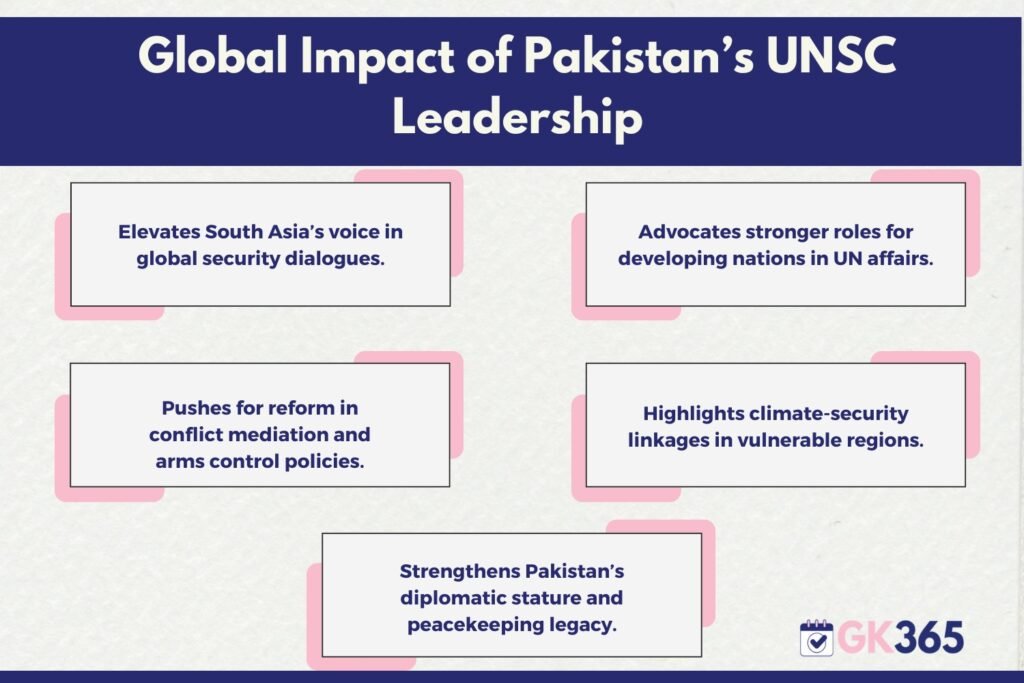
Strong voice for developing nations in multilateral forums
This consistent engagement reinforces Pakistan’s role as a responsible and experienced global actor committed to international peace.
⚖️ Challenges and Opportunities
Global Challenges:
Ongoing wars, forced migration, and climate-driven emergencies create urgency
Pakistan must build consensus among divided member states
Act quickly on new crises while balancing national interests with global needs
Opportunities:
Rebuild trust in global institutions
Highlight issues from underrepresented regions
Push for practical solutions in peace and security
Strengthen South-South cooperation
💭 For GDPI / Essay Prep
Pakistan’s presidency comes at a time when the P5 nations are often divided. How can a non-permanent member effectively navigate these divisions while maintaining neutrality? Consider the balance between advancing national interests and serving as an honest broker for global peace.
🧠 Memory Tricks
Vote Count Pattern:
“182 out of 193” — Pakistan received 94% of votes. Remember: “Almost unanimous support” for easy recall.
Peacekeeping Numbers:
“200K in 46+” — 200,000+ troops in 46+ missions. Think “200K soldiers, nearly 50 missions” for quick recall.
Key Dates:
“July 22-23-24” — Three consecutive days for three signature events. Mnemonic: “MUL-PAL-OIC” (Multilateralism, Palestine, OIC)
📚 Quick Revision Flashcards
Click to flip • Master key facts
Question
When did Pakistan assume the UNSC Presidency in 2025?
Click to flip
Answer
July 1, 2025 – Pakistan began its presidency as part of its 2025-2026 non-permanent member term.
Card 1 of 5
🧠 Think Deeper
For GDPI, Essay Writing & Critical Analysis
🌍
How can non-permanent UNSC members like Pakistan influence global security outcomes despite lacking veto power?
Consider: Agenda-setting power during presidency, coalition-building, moral authority from peacekeeping contributions, representing developing world perspectives.
⚖️
What are the structural limitations of the UNSC in addressing 21st-century security challenges, and how might rotating presidencies help or hinder reform efforts?
Think about: P5 veto gridlock, lack of African/Latin American permanent representation, modern threats like cyber warfare and climate security, consensus-building challenges.
🎯 Test Your Knowledge
5 questions • Instant feedback
Question 1 of 5
When did Pakistan assume the UNSC Presidency in 2025?
A) June 1, 2025
B) July 1, 2025
C) August 1, 2025
D) January 1, 2025
Explanation
Pakistan assumed the UNSC presidency on July 1, 2025, as part of its 2025-2026 non-permanent member term.
Question 2 of 5
How many votes did Pakistan receive when elected to the UNSC?
A) 150 out of 193
B) 170 out of 193
C) 182 out of 193
D) 193 out of 193
Explanation
Pakistan received 182 out of 193 votes when elected to the UNSC, demonstrating overwhelming international support.
Question 3 of 5
How many total members does the UN Security Council have?
A) 15 members (5 permanent + 10 non-permanent)
B) 10 members (5 permanent + 5 non-permanent)
C) 20 members (5 permanent + 15 non-permanent)
D) 12 members (5 permanent + 7 non-permanent)
Explanation
The UNSC has 15 members total: 5 permanent members (P5) with veto power and 10 non-permanent members elected for 2-year terms.
Question 4 of 5
What are the dates of Pakistan’s three key UNSC events in July 2025?
A) July 1, 2, 3
B) July 15, 16, 17
C) July 10, 20, 30
D) July 22, 23, 24
Explanation
Pakistan scheduled three key events on consecutive days: Multilateralism (July 22), Palestine (July 23), and UN-OIC Cooperation (July 24).
Question 5 of 5
Who is Pakistan’s Permanent Representative to the UN during this presidency?
A) Ishaq Dar
B) Ambassador Asim Iftikhar Ahmad
C) Shehbaz Sharif
D) Bilawal Bhutto Zardari
Explanation
Ambassador Asim Iftikhar Ahmad serves as Pakistan’s Permanent Representative to the UN, overseeing most Council sessions during the presidency.
0/5
Loading…
📌 Key Takeaways for Exams
1
Presidency Details: Pakistan assumed UNSC presidency on July 1, 2025, as part of its 2025-2026 non-permanent member term with 182/193 votes.
2
UNSC Structure: 15 members total — 5 permanent (P5 with veto power) + 10 non-permanent (2-year terms). Presidency rotates monthly among all members.
3
Key Events: Three signature sessions on July 22-24: Multilateralism, Palestine, and UN-OIC Cooperation — chaired by Deputy PM Ishaq Dar.
4
Leadership: Ambassador Asim Iftikhar Ahmad (UN Representative) leads daily operations; Ishaq Dar (Deputy PM & Foreign Minister) chairs key events.
5
Track Record: Pakistan has contributed 200,000+ troops to 46+ UN peacekeeping missions since 1952 — one of the largest contributors globally.
What is the UNSC and how does its presidency work?
The UN Security Council is the UN’s top body for international peace and security. It has 15 members — 5 permanent (USA, UK, France, Russia, China) and 10 non-permanent. The presidency rotates monthly among all members, giving each country a turn to chair meetings, set the agenda, and represent the Council.
How long will Pakistan serve on the UNSC?
Pakistan is a non-permanent member for the 2025–2026 term (2 years). Its presidency specifically runs from July 1 to July 31, 2025. Non-permanent members cannot serve consecutive terms after completing their 2-year tenure.
What makes Pakistan qualified for this role?
Pakistan has held the UNSC presidency multiple times since 1952, contributed over 200,000 troops to 46+ UN peacekeeping missions, and consistently advocates for diplomacy and conflict resolution. The 182/193 vote count reflects strong international confidence in Pakistan’s diplomatic capacity.
What issues will Pakistan focus on during its presidency?
Pakistan has planned three key events: July 22 (Multilateralism and Peaceful Conflict Resolution), July 23 (Special Session on Palestine), and July 24 (UN-OIC Cooperation). These reflect Pakistan’s priorities in diplomacy, humanitarian concerns, and regional partnerships.
What is the difference between permanent and non-permanent UNSC members?
The 5 permanent members (P5) have veto power — they can block any substantive resolution. Non-permanent members like Pakistan serve 2-year terms without veto power but can still vote, propose resolutions, and hold the rotating presidency. Both types participate equally in the monthly presidency rotation.
With 18+ years of teaching experience and a passion for making learning accessible, I'm here to help you navigate competitive exams. Whether it's UPSC, SSC, Banking, or CAT prep—let's connect and solve it together.
Don't let doubts slow you down. Whether it's current affairs, static GK, or exam strategy—I'm here to help. Choose your preferred way to connect and let's tackle your challenges head-on.