πŸ“° NATIONAL

Bharat Taxi

Bharat Taxi, registered as Multi-State Sahakari Taxi Cooperative Ltd, is India's first cooperative-owned ride-hailing service. Learn about Bharat Taxi's structure, benefits, and how it differs from Ola/Uber.

⏱️ 10 min read
πŸ“Š 1,892 words
πŸ“… August 2025
SSC Banking Railways UPSC TRENDING
🎧 Prefer listening? Check out our podcast

“Driver-owned, community-focused, cooperative-powered β€” a new model for India’s ride-hailing market.”

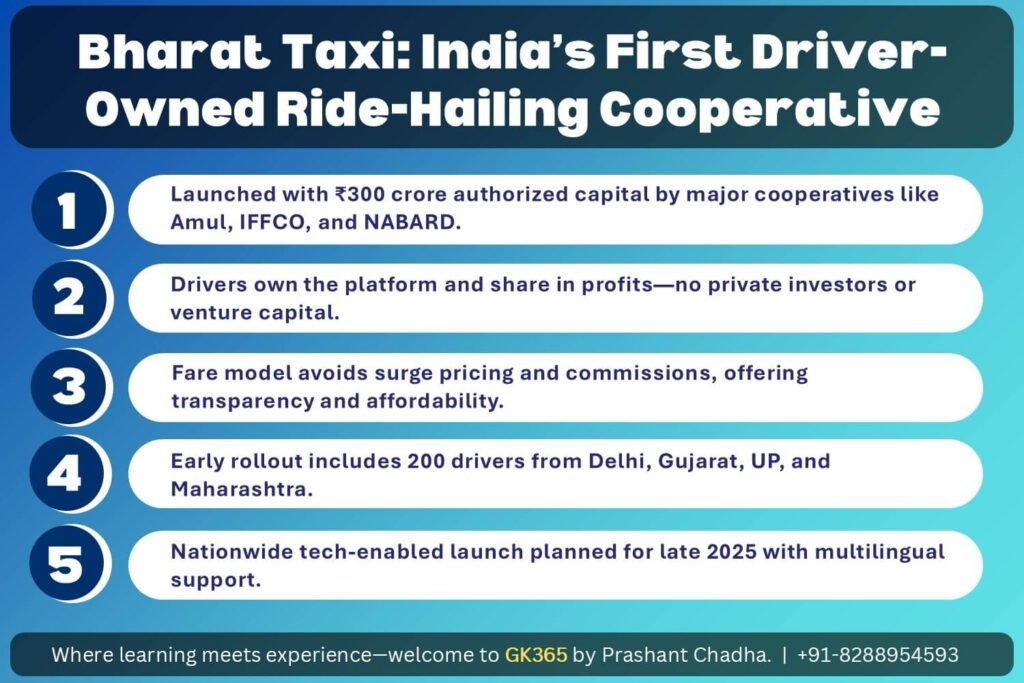
India’s ride-hailing market is set for a major shake-up. ‘Bharat’ Taxi, formed by a consortium of eight leading cooperatives, aims to challenge the dominance of Ola and Uber with a radically different model. Registered as Multi-State Sahakari Taxi Cooperative Ltd on June 6, 2025, this venture has an authorised capital of β‚Ή300 crore and has already begun onboarding drivers across multiple states.

Unlike private aggregators that extract commissions from drivers, ‘Bharat’ Taxi puts ownership in the hands of its members β€” the drivers themselves. The goal is a community-focused service that pairs a modern app with cooperative ownership, transparent pricing, and nationwide coverage including rural and semi-urban areas.

β‚Ή300 Cr Authorised Capital
8 Founding Cooperatives
200+ First Drivers Enrolled
2025 App Launch (Late)
πŸ“Š Quick Reference
Service Name Bharat Taxi
Registered As Multi-State Sahakari Taxi Cooperative Ltd
Registration Date June 6, 2025
Authorised Capital β‚Ή300 Crore
Ownership Model 100% Cooperative-owned
Government Equity None (Member-controlled)

πŸ“œ Background & Registration

Bharat Taxi - India's Cooperative Ride-Hailing Service Launch
Bharat Taxi: India’s first cooperative-owned ride-hailing service backed by major cooperative institutions

The service is registered as Multi-State Sahakari Taxi Cooperative Ltd, with registration taking place on June 6, 2025. The idea emerged from work on the National Cooperative Policy, which aims to widen cooperative roles in urban services beyond traditional sectors like dairy and agriculture.

Union Cooperation Minister Amit Shah flagged the concept, and leading cooperative bodies moved quickly to build it. The project represents a significant expansion of cooperative principles into the platform economy β€” a space traditionally dominated by venture capital-backed startups.

🎯 Simple Explanation

Think of ‘Bharat’ Taxi like Amul β€” but for taxis. Just as dairy farmers collectively own Amul and share profits, taxi drivers will collectively own ‘Bharat’ Taxi. Instead of a company in Bengaluru or San Francisco taking 25% of every ride, the drivers themselves control the platform and share the benefits.

πŸ›οΈ The Cooperative Structure Behind the Project

Eight founding institutions back the venture, bringing together India’s most successful cooperative organizations:

  • National Cooperative Development Corporation (NCDC)
  • Indian Farmers Fertiliser Cooperative Limited (IFFCO)
  • Gujarat Cooperative Milk Marketing Federation (GCMMF – Amul)
  • Krishak Bharati Cooperative Limited (KRIBHCO)
  • National Bank for Agriculture and Rural Development (NABARD)
  • National Dairy Development Board (NDDB)
  • National Cooperative Exports Limited (NCEL)
  • A regional cooperative partner

Ownership sits with cooperatives, not private investors. The government holds no equity, so members retain full decision power. This structure ensures that profit motive doesn’t override driver welfare or consumer interests.

βœ“ Quick Recall

Remember “AMUL Model”: Just as Amul is owned by dairy farmers through GCMMF, ‘Bharat’ Taxi will be owned by drivers through the cooperative structure. GCMMF (Amul) is actually one of the 8 founding members!

Cooperative Sector Notable Contribution
NCDC Development Finance Policy guidance & cooperative development
IFFCO Fertilizers Large-scale cooperative management expertise
GCMMF (Amul) Dairy Brand-building & member welfare model
KRIBHCO Fertilizers Farmer cooperative network
NABARD Rural Banking Financial infrastructure & rural reach
NDDB Dairy Development Technology & supply chain expertise
NCEL Exports Market expansion experience

🎯 Objectives & Vision

The cooperative sets clear aims that distinguish it from profit-driven aggregators:

  • Driver Ownership: Give drivers ownership stake and a vote in key matters
  • Affordable Fares: Offer competitive fares without heavy surcharges or surge pricing
  • Nationwide Network: Build coverage that extends to towns beyond metros
  • Transparent Pricing: Cut middlemen commissions with fair, open pricing structures
  • Rural Access: Serve semi-urban and rural areas often ignored by existing apps
πŸ’­ Think About This

Can the cooperative model that transformed Indian dairy (Operation Flood) work for the gig economy? The dairy revolution gave farmers ownership and fair prices β€” could ‘Bharat’ Taxi do the same for drivers?

βš–οΈ How ‘Bharat’ Taxi Differs from Ola/Uber

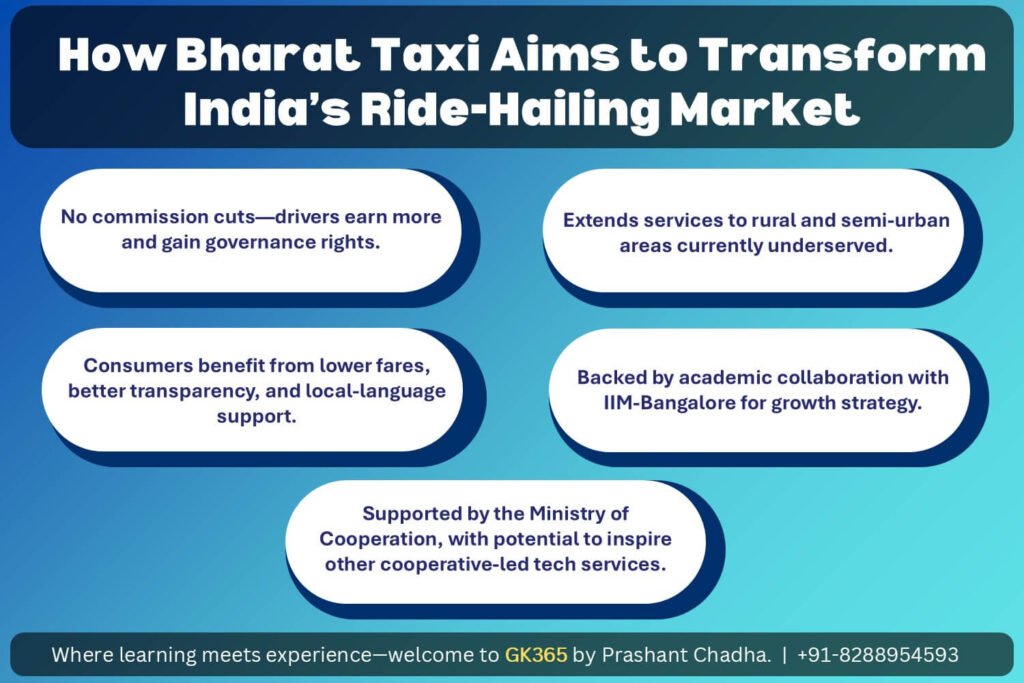
The model departs from standard aggregator practice in fundamental ways. Ola and Uber take commissions of 20-25% that significantly reduce driver earnings. ‘Bharat’ Taxi plans to share profits with members and keep fares transparent and stable.

Key differences include elimination of surge pricing, extension of service to rural and semi-urban areas, driver participation in governance, and a focus on long-term sustainability over rapid growth.

Aspect Ola/Uber Model Bharat Taxi Model
Ownership Private/Venture Capital Cooperative (Driver-owned)
Driver Commission 20-25% per ride Minimal/None + Profit sharing
Surge Pricing Yes (Dynamic) No (Stable fares)
Coverage Focus Metro cities Nationwide including rural
Driver Voice None in governance Voting rights in decisions
Profit Motive Investor returns Member welfare
⚠️ Exam Trap

Don’t confuse: ‘Bharat’ Taxi is NOT a government-owned company. The government holds ZERO equity. It is owned by cooperatives, which are member-owned organizations. The Ministry of Cooperation supports it but doesn’t fund or control it.

πŸ“± Technology & App Development Plans

A tender is in progress to select a technology partner for the app. Launch is planned for late 2025. The app will feature:

  • Unified Interface: One app works across all states (not city-by-city)
  • Transparent Fares: Clear fare display before booking
  • Digital Payments: Multiple payment options including UPI
  • Multi-language Support: Interface in major Indian languages

The Indian Institute of Management, Bangalore (IIM-B) is shaping marketing, customer growth, and expansion strategies. This brings structured planning to what is fundamentally a member-driven body.

June 2025
Multi-State Sahakari Taxi Cooperative Ltd registered (June 6)
Mid-2025
Driver enrolment begins; first 200 drivers from Delhi, Gujarat, UP, Maharashtra
2025
Technology partner selection via tender process
Late 2025
App launch planned with multilingual interface
2026+
Nationwide expansion; cooperative service stations for driver support

✨ Benefits for Drivers & Consumers

Bharat Taxi Benefits - Driver Ownership and Consumer Savings
Bharat Taxi promises driver ownership, profit-sharing, and affordable fares for consumers

For Drivers:

  • Share of profits instead of paying commissions
  • Role in governance β€” voting on key decisions
  • Access to cooperative benefits: insurance, loans, welfare schemes
  • Better earnings leading to higher retention
  • Support through cooperative service stations

For Consumers:

  • Lower fares as commissions shrink
  • Transparent, stable pricing β€” no surge pricing
  • Coverage in areas other apps often skip
  • Regional language support for ease of use
  • Links with cooperative banks can ease payments and refunds

⚑ Challenges & Risks

The venture faces significant hurdles:

  • Brand Competition: Ola and Uber have deep brand loyalty and established user bases
  • Technology Scale: Building a national tech platform that scales reliably is challenging
  • Governance Complexity: Managing decisions across many cooperatives needs careful design
  • Service Quality: Maintaining consistent service across varied regions
  • Driver Habits: Convincing drivers accustomed to existing platforms to switch

The Ministry of Cooperation supports wider cooperative roles in digital services, but direct government funding is absent β€” keeping member control intact but also limiting resources.

πŸ’­ For GDPI / Essay Prep

This initiative raises important questions about the future of the platform economy: Can cooperative ownership models compete with venture capital-backed platforms? Should the gig economy be restructured to give workers ownership stakes? What role should government play in supporting alternative business models?

🧠 Memory Tricks
8 Founders Pattern:
“NIKA-GNN + 1” β€” IFFCO, NCDC, KRIBHCO, Amul (GCMMF), NABARD, NDDB, NCEL + 1 regional partner = 8 founding cooperatives
Registration Date:
“6/6 for Sahakari” β€” June 6, 2025 (6th day of 6th month) β€” easy to remember!
Capital Amount:
“300 Crore for 0% Commission” β€” β‚Ή300 crore capital; zero/minimal commission model
Amul Connection:
“From Milk to Mobility” β€” GCMMF (Amul) is a founding member, applying the dairy cooperative model to taxis
πŸ“š Quick Revision Flashcards

Click to flip β€’ Master key facts

Question
What is Bharat Taxi registered as?
Click to flip
Answer
Multi-State Sahakari Taxi Cooperative Ltd, registered on June 6, 2025.
Card 1 of 5
🧠 Think Deeper

For GDPI, Essay Writing & Critical Analysis

🌍
Can the cooperative model that transformed Indian dairy through Operation Flood be replicated in the platform economy?
Consider: Scale economics of tech platforms; driver fragmentation vs farmer unions; capital requirements; brand competition; consumer switching costs.
βš–οΈ
Should gig economy workers have ownership stakes in the platforms they work for? What are the implications for Indias labour policy?
Think about: Worker classification debates; social security for gig workers; cooperative vs corporate efficiency; global platform capitalism trends.
🎯 Test Your Knowledge

5 questions β€’ Instant feedback

Question 1 of 5
When was Multi-State Sahakari Taxi Cooperative Ltd (Bharat Taxi) registered?
A) January 26, 2025
B) June 6, 2025
C) August 15, 2025
D) April 1, 2025
Explanation

Bharat Taxi was registered on June 6, 2025 as Multi-State Sahakari Taxi Cooperative Ltd.

Question 2 of 5
What is the authorised capital of Bharat Taxi?
A) β‚Ή100 Crore
B) β‚Ή500 Crore
C) β‚Ή300 Crore
D) β‚Ή1000 Crore
Explanation

The authorised capital is β‚Ή300 crore, funded entirely by the 8 founding cooperatives with no government equity.

Question 3 of 5
Which dairy cooperative is among the 8 founding members of Bharat Taxi?
A) Mother Dairy
B) Nandini
C) Britannia
D) GCMMF (Amul)
Explanation

GCMMF, which markets Amul products, is one of the 8 founding cooperatives of Bharat Taxi.

Question 4 of 5
Which of the following is a feature of Bharat Taxi that differs from Ola/Uber?
A) No surge pricing
B) Higher commissions for drivers
C) Focus only on metro cities
D) Venture capital funding
Explanation

Unlike Ola and Uber, Bharat Taxi will NOT have surge pricing β€” it plans stable, transparent fares.

Question 5 of 5
Which institution is providing advisory support for Bharat Taxi’s marketing and expansion?
A) IIT Delhi
B) IIM Bangalore
C) IIM Ahmedabad
D) ISB Hyderabad
Explanation

IIM Bangalore is providing advisory support for marketing, customer growth, and expansion strategies.

0/5
Loading…
πŸ“Œ Key Takeaways for Exams
1
Registration: ‘Bharat’ Taxi is registered as Multi-State Sahakari Taxi Cooperative Ltd on June 6, 2025, with β‚Ή300 crore authorised capital.
2
Ownership: 100% cooperative-owned by 8 founding members including NCDC, IFFCO, GCMMF (Amul), KRIBHCO, NABARD, NDDB, and NCEL. No government equity.
3
Key Difference: Unlike Ola/Uber, drivers own the platform, share profits, have voting rights, and there is no surge pricing.
4
Coverage Goal: Nationwide service including rural and semi-urban areas, with multilingual app support.
5
Advisory Support: IIM Bangalore is guiding marketing and expansion strategies; technology partner selection via tender.
6
Timeline: App launch planned for late 2025; first 200 drivers enrolled from Delhi, Gujarat, UP, and Maharashtra.

❓ Frequently Asked Questions

What is ‘Bharat’ Taxi and how is it different from Ola/Uber?
‘Bharat’ Taxi is India’s first cooperative-owned ride-hailing service, registered as Multi-State Sahakari Taxi Cooperative Ltd. Unlike Ola/Uber which are private companies taking 20-25% commission, ‘Bharat’ Taxi is owned by drivers through cooperatives, offers profit-sharing, has no surge pricing, and gives drivers voting rights in governance.
Is ‘Bharat’ Taxi a government-owned company?
No. ‘Bharat’ Taxi is NOT government-owned. It is 100% owned by 8 founding cooperatives including NCDC, IFFCO, GCMMF (Amul), KRIBHCO, NABARD, NDDB, and NCEL. The government holds zero equity, though the Ministry of Cooperation supports the cooperative movement in general.
Which famous dairy brand’s parent organization is a founding member?
GCMMF (Gujarat Cooperative Milk Marketing Federation), which markets Amul products, is one of the 8 founding cooperatives. This brings the successful Amul cooperative model β€” where dairy farmers own the brand β€” to the ride-hailing sector.
When will the ‘Bharat’ Taxi app be available?
The app is planned to launch in late 2025. A tender is underway to select a technology partner. The app will feature a unified nationwide interface (not city-by-city), multilingual support, transparent fare display, and digital payment options including UPI.
What benefits will drivers get from joining ‘Bharat’ Taxi?
Drivers will receive profit-sharing instead of paying commissions, voting rights in cooperative governance, access to insurance and loans through cooperative networks, support through cooperative service stations, and better long-term earnings stability compared to commission-based platforms.
🏷️ Exam Relevance
UPSC Prelims UPSC Mains (GS-II, GS-III) SSC CGL SSC CHSL Banking PO/Clerk State PSC RBI Grade B NABARD CAT/MBA GDPI
🎯 Featured Course for 2026 Aspirants
πŸ”₯ Bestseller
The Ultimate GK Course 2026

The Ultimate GK Course 2026

Complete Current Affairs + Static GK Mastery

Stop scattered preparation. Get everything you needβ€”daily current affairs, monthly compilations, topic-wise static GK, and 1000+ practice questionsβ€”in one comprehensive course designed by Prashant Sir.

πŸ‘₯ 2,400+ enrolled
⭐ 4.9 rating
πŸ“… Valid till Dec 2026
β‚Ή1,499 β‚Ή2,999 SAVE 50%
Enroll Now & Start Learning β†’

What’s Included in Your Course:

πŸ“°
Daily Current Affairs Updates
πŸ“š
Monthly PDF Compilations
🧠
Complete Static GK Module
✍️
1000+ Practice Questions

⏰ Limited Time Offer β€” Early Bird Price β€” Enroll before prices increase!

πŸ’‘ Start Small, Learn Smart

Focused Micro-Courses for Targeted Prep

Don’t need everything? Pick exactly what you need. Affordable, focused courses starting at just β‚Ή99. Master one topic at a time.

Instant Access after payment
Lifetime validity once enrolled
Secure payment via Razorpay

Can’t decide? Start with any courseβ€”upgrade anytime to the Ultimate GK Course and get full credit applied!

Explore All Preplite Courses β†’
Prashant Chadha

Connect with Prashant

Founder, WordPandit & The Learning Inc Network

With 18+ years of teaching experience and a passion for making learning accessible, I’m here to help you navigate competitive exams. Whether it’s UPSC, SSC, Banking, or CAT prepβ€”let’s connect and solve it together.

18+
Years Teaching
50,000+
Students Guided
8
Learning Platforms

Stuck on a Topic? Let’s Solve It Together! πŸ’‘

Don’t let doubts slow you down. Whether it’s current affairs, static GK, or exam strategyβ€”I’m here to help. Choose your preferred way to connect and let’s tackle your challenges head-on.

🌟 Explore The Learning Inc. Network

8 specialized platforms. 1 mission: Your success in competitive exams.

Trusted by 50,000+ learners across India

Leave a Comment

GK365 - Footer