
“Climate risk is not a distant threat — it is the lived reality of millions. India’s progress shows what focused policy can achieve, but the journey to resilience has only begun.”
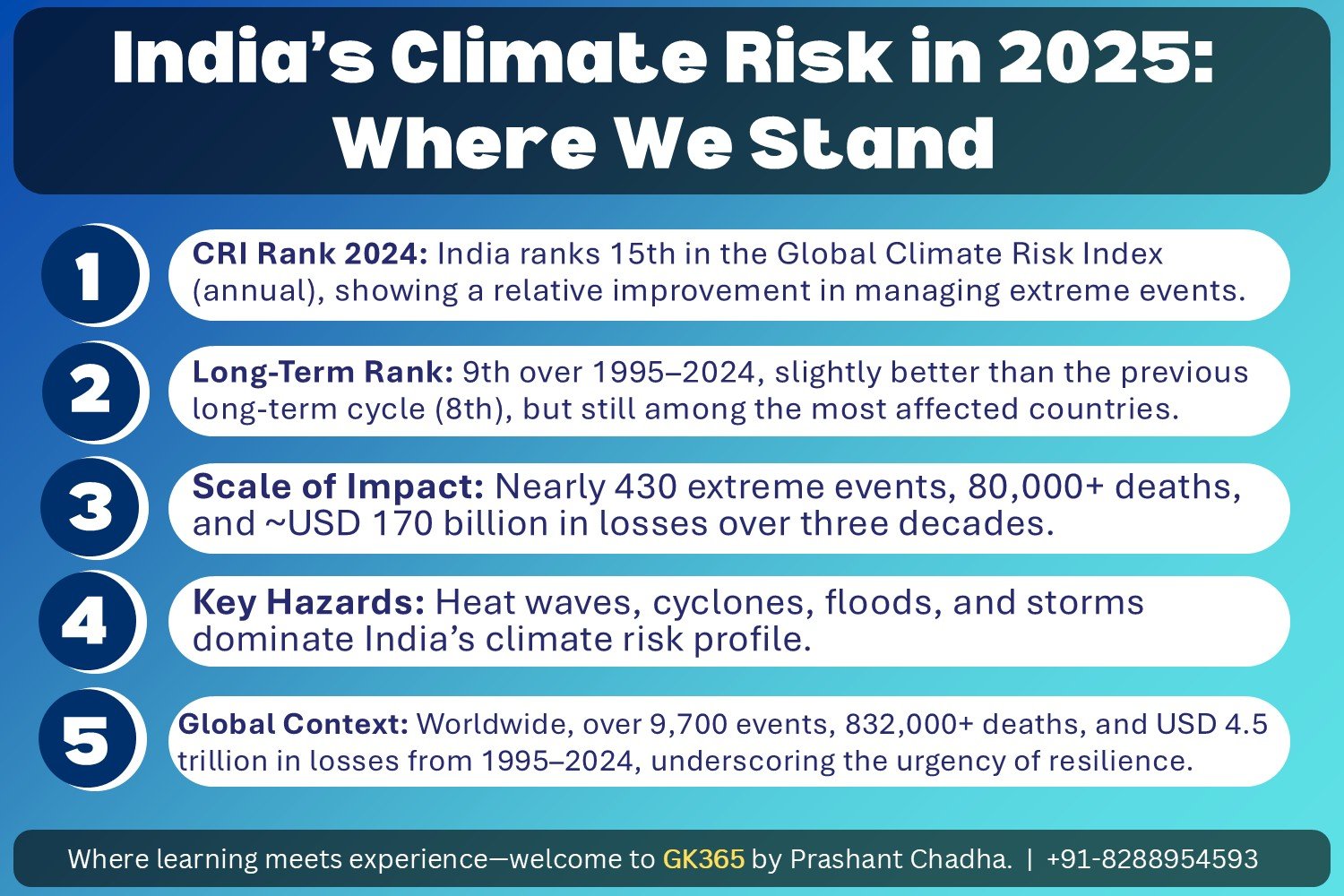
The Global Climate Risk Index (CRI) 2026, released by Germanwatch ahead of COP30 in Belém, places India at 15th position for 2024 and 9th over 1995–2024. A lower rank indicates comparatively lower impacts from extreme weather during the period measured — signaling improvements in preparedness, early warning systems, and post-disaster recovery.
This ranking matters for competitive exam aspirants because it connects climate science with governance, international negotiations, and India’s development trajectory. The report shapes how donors, insurers, and national planners assess vulnerability and allocate resources.
📊 What the Global Climate Risk Index Measures
The CRI is a retrospective assessment — it ranks countries by the human and economic toll of extreme weather events based on EM-DAT data. The index uses six indicators across absolute and relative deaths, affected populations, and economic losses.
The 2026 edition covers both 1995–2024 (long-term) and the year 2024 (annual). Importantly, the CRI does not predict future events. Rather, it reveals patterns of past impacts, helping countries assess whether their policy and risk management systems are improving over time.
Think of the CRI like a medical history report. It does not predict your next illness, but shows patterns of past health issues. A country ranking high has suffered more from extreme weather; a country improving its rank is managing disasters better — like someone whose health metrics are improving with better lifestyle choices.
| Indicator Type | What It Measures | Why It Matters |
|---|---|---|
| Absolute Deaths | Total fatalities from extreme events | Shows scale of human impact |
| Deaths per 100,000 | Mortality rate adjusted for population | Allows fair comparison across countries |
| Absolute Losses (USD) | Total economic damage in PPP terms | Reveals infrastructure vulnerability |
| Losses per GDP unit | Economic damage as share of GDP | Shows relative economic burden |
📈 India’s Rank in 2025: What Changed and Why
India improved in both the annual and long-term rankings: 15th in 2024 and 9th over 1995–2024, a slight improvement from 8th in the previous long-term cycle. Three factors contribute to this movement:
- Stronger early warning systems — 72-hour flood forecasting, heat advisories
- Better institutional response capacity — NDMA, state disaster authorities
- Policy reforms across sectors and states — NAPCC missions, state action plans
India’s leadership in resilient infrastructure globally through the Coalition for Disaster Resilient Infrastructure (CDRI) has also played a role in building adaptive capacity.
Don’t confuse: A “lower rank” on the CRI means BETTER performance (less impact from disasters). India moving from 8th to 9th long-term is an IMPROVEMENT. This is opposite to rankings like GDP where higher is better.
🌍 A Three-Decade Picture: Loss, Lives, and Money
From 1995 to 2024, the world experienced devastating climate impacts:
- 9,700+ extreme weather events globally
- 832,000+ deaths attributed to climate disasters
- USD 4.5 trillion in inflation-adjusted losses
India’s pattern aligns with this global picture. Over three decades, India has recorded:
- Nearly 430 extreme events
- 80,000+ deaths
- Around USD 170 billion in losses
Events such as Cyclones Hudhud (2014), Amphan (2020), the 2013 Uttarakhand floods, and recurring heat waves dominate this history. Heat waves and storms caused the largest share of fatalities and economic damage.
Key Numbers for Exams: India — 430 events, 80,000+ deaths, $170 billion losses over 30 years. Global — 9,700 events, 832,000 deaths, $4.5 trillion losses.
| Ranking Type | Most Affected Countries | India’s Position |
|---|---|---|
| Annual (2024) | St. Vincent & Grenadines, Grenada, Chad | 15th |
| Long-term (1995-2024) | Dominica, Myanmar, Honduras | 9th |
🌀 Events That Shaped India’s Risk Profile
India’s exposure spans coastlines, river basins, floodplains, and drought-prone regions. The major hazard categories include:
- Cyclones: Impact the east coast with storm surge and wind damage (Hudhud 2014, Amphan 2020, Fani 2019)
- Floods: Arise from monsoon extremes and rapid urbanisation (Uttarakhand 2013, Kerala 2018, Chennai 2015)
- Heat waves: Have intensified in duration and magnitude across northern and central India
- Droughts: Affect dryland agriculture in Maharashtra, Karnataka, and Rajasthan
The 2024 climate year was influenced by El Niño, though attribution studies continue to show strong human-driven warming signals. Smaller island states tend to experience sharp year-to-year shifts, while India remains consistently high in long-term rankings due to repeated, cumulative impacts.
Why do small island nations top annual rankings while larger countries dominate long-term lists? Small islands face catastrophic single events (one hurricane can affect entire GDP), while large countries like India face cumulative, repeated impacts that add up over decades.
⚖️ Policy Response: Institutions, Plans, and Early Warnings
India’s climate governance has expanded significantly since the National Action Plan on Climate Change (NAPCC) in 2008, anchored by its eight missions:
- National Solar Mission
- National Mission for Enhanced Energy Efficiency
- National Mission on Sustainable Habitat
- National Water Mission
- National Mission for Sustaining the Himalayan Ecosystem
- National Mission for a Green India
- National Mission for Sustainable Agriculture
- National Mission on Strategic Knowledge for Climate Change
States have followed with their own State Action Plans on Climate Change (SAPCCs), helping align local priorities with national frameworks.
India has also taken global initiative through the Coalition for Disaster Resilient Infrastructure (CDRI), launched in 2019. CDRI focuses on resilience standards for power, transport, and telecom systems, and supports small island states through programs such as IRIS (Infrastructure for Resilient Island States).
Early warning capabilities have strengthened significantly:
- Cities use 72-hour flood forecasting linked to dashboards
- Heat action plans now include ward-level mapping, cooling centers, and public advisories
- Cyclone tracking and evacuation systems have dramatically reduced mortality
💰 Finance and Collaboration: The Bigger Levers
Finance remains the critical bottleneck. The CRI calls for larger and faster flows across mitigation, adaptation, and loss-and-damage. It stresses that high-income and high-emitting countries must scale commitments to match the scale of global impacts.
Within India, discussions are growing around parametric and climate-linked insurance. These mechanisms trigger payouts when defined thresholds are crossed (such as temperature or rainfall levels), enabling faster relief and reducing fiscal strain. Pilot projects across several states and cities show promising results.
Traditional insurance requires damage assessment before payout — which takes time. Parametric insurance works differently: if rainfall exceeds 200mm in 24 hours, payment triggers automatically. Think of it like a fire sprinkler that activates at a set temperature, not after someone inspects the damage.
🏙️ What This Means for States, Cities, and Farms
National rankings mask large subnational variation. Different regions face distinct risk profiles:
- Coastal states: Need resilient transmission lines, cyclone shelters, and fast-restore power systems
- River basins: Require upstream rainfall and reservoir data integrated into district control rooms
- Dryland areas: Need drought plans, diversified cropping, and water budgeting
Cities face the most complex risk mix:
- Heat action plans should combine early warning, passive cooling in housing, and green-blue networks
- Flood-prone wards need pump stations, shelters, and community-linked alert systems
Agriculture needs localised climate-smart practices: heat-tolerant seeds, micro-irrigation, soil moisture tracking, and reliable crop insurance.
| Region Type | Primary Risks | Key Interventions Needed |
|---|---|---|
| Coastal States | Cyclones, storm surge, sea-level rise | Cyclone shelters, resilient power lines, early warning |
| River Basins | Floods, dam management | Integrated data systems, coordinated operations |
| Dryland Regions | Drought, water scarcity | Water budgeting, diversified cropping |
| Urban Areas | Heat waves, urban flooding | Heat action plans, green infrastructure |
🛤️ The Road Ahead: Priorities for 2025–2030
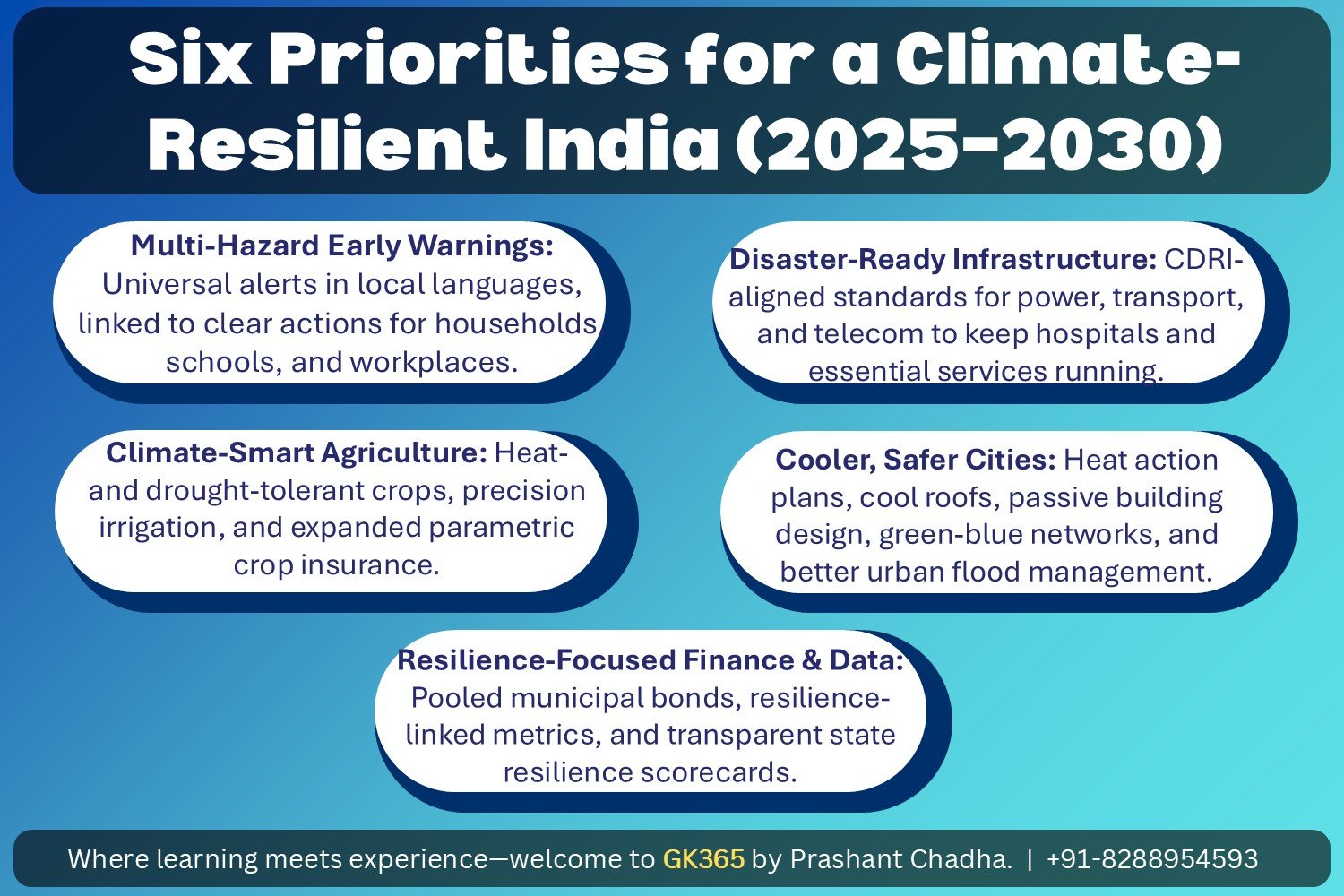
The CRI report outlines six key priorities for building climate resilience:
1) Universal Multi-Hazard Early Warnings: Complete nationwide coverage for all hazards. Ensure alerts are in local languages and tied to clear household, school, and workplace actions.
2) Disaster-Ready Infrastructure: Embed CDRI-aligned design standards into major infrastructure programs. Harden power and telecom assets in cyclone zones.
3) Scaled Climate-Smart Agriculture: Support heat- and drought-tolerant crop varieties, precision irrigation, and decentralized water storage. Expand parametric crop insurance.
4) Reduce Urban Heat: Update building codes for passive cooling. Prioritise cool roofs in public buildings and low-income housing. Expand tree cover.
5) Align Finance with Resilience Outcomes: Use pooled municipal bonds for heat and flood projects. Develop resilience metrics that unlock lower interest rates.
6) Track Outcomes Transparently: Publish annual state resilience scorecards covering casualties, injuries, days of service disruption, and recovery times.
The report reinforces India’s argument at international forums: developed nations must scale climate finance to match the scale of impacts borne by developing countries. India’s dual position — both vulnerable to climate impacts AND a leader in resilient infrastructure through CDRI — makes it a key voice in COP30 negotiations.
Click to flip • Master key facts
For GDPI, Essay Writing & Critical Analysis
5 questions • Instant feedback
India ranks 15th for 2024 and 9th for 1995-2024. A lower rank indicates less impact from extreme weather — meaning India has shown improvement.
The Global Climate Risk Index is published by Germanwatch, a German environmental and development NGO.
NAPCC was launched in 2008 with 8 missions covering solar, energy efficiency, sustainable habitat, water, Himalayan ecosystem, green India, sustainable agriculture, and strategic knowledge.
CDRI — Coalition for Disaster Resilient Infrastructure — was launched by India in 2019 at the UN Climate Action Summit.
Over 1995-2024, India recorded nearly 430 extreme events, 80,000+ deaths, and approximately USD 170 billion in losses.








